Alibaba readies its first robot dog for China's crowded market
Alibaba will soon unveil its first robot, a four-legged model from its Amap unit. With it, the company enters China's embodied AI market, where Unitree, Agibot and Ant Group already have a strong presence. It is the group's first robotics product in this segment. Amap is also exploring humanoid robots, but its first product will take a more down-to-earth form: a robot dog. Alibaba has not yet disclosed pricing or when sales will begin.
AI-processed from Bloomberg Tech; edited by Hamidun News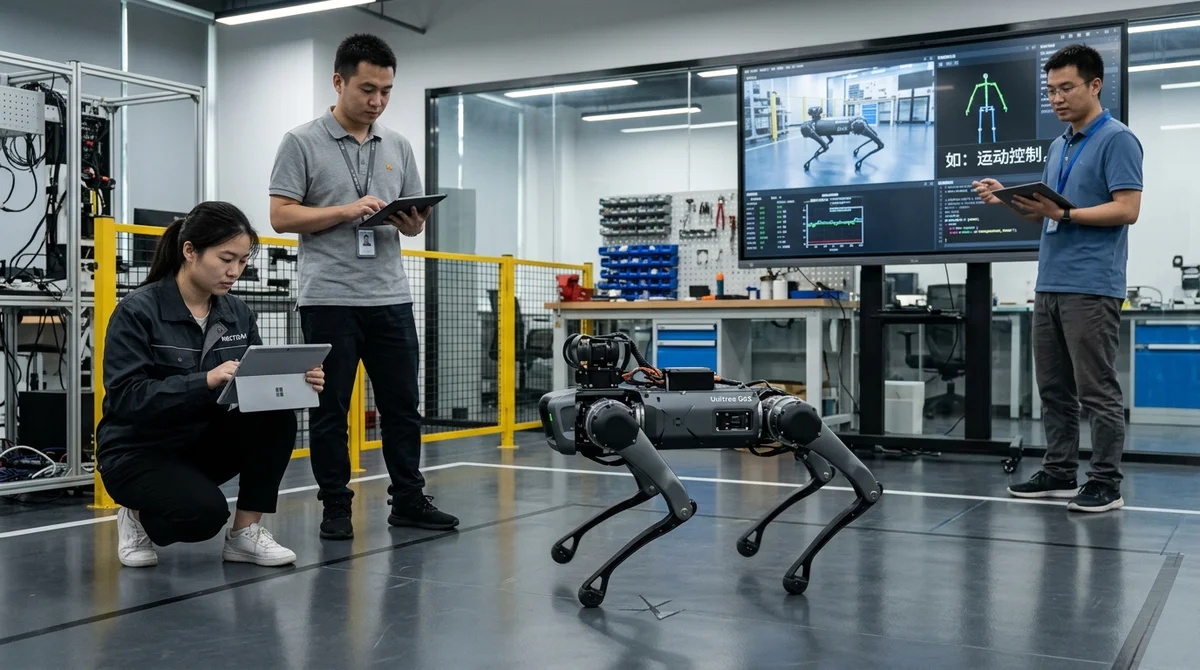
Alibaba is preparing to launch its first robot, a four-legged model from its Amap unit. For the Chinese tech giant, this is more than a new gadget. It marks an entry into embodied AI, a segment where competition is already fierce and interest from investors and consumers is only starting to accelerate.
What Amap will show
According to a company representative, Amap is building a quadruped meant to compete with Unitree's Go lineup. It will be Alibaba's first robotics product of this kind. Exact specs, pricing and a sales date have not been disclosed, but the announcement itself matters: Alibaba spent years building an AI ecosystem around its cloud, models and services, and is now stepping into the physical world. It is also a test of how well the company can turn its software work into commercial hardware.
"We expect to release our first four-legged robot soon,"
Amap said.
Amap is a logical choice. The unit is known as Alibaba's mapping and local services arm, so it already works with navigation, spatial data and routing, all of which are critical for mobile machines. According to industry reports, the embodied intelligence team inside Amap is also exploring humanoid robots. Starting with a robot dog looks more pragmatic, though: the form factor is easier to bring to market, easier to position, and easier to use as a testbed for autonomy, orientation and behavior in real-world environments.
Why the market is already crowded
Alibaba is entering a category where Unitree and Agibot are already entrenched and its affiliate Ant Group is also active. The long-term size of the market is not yet proven: embodied AI carries plenty of expectations, but there are still few mass-market ways to monetize it. Even so, money is flowing in fast. Chinese companies are trying to outpace not only local rivals but also Tesla and other American players. The market benefits from strong media buzz: humanoid machines and robot dogs have become a visible part of the tech conversation and draw interest even from people who have no plans to buy one yet.
For now, demand rests largely on early adopters and the spectacle of demos. Robots from Unitree and other makers were again in the spotlight at the Spring Festival Gala, where they danced, appeared in sketches and performed acrobatic moves. That makes a convenient showcase for startups and corporations, but it also intensifies the fight for people who know how to build these systems. One sign of overheating: UBTech offered to pay its chief scientist up to 124 million yuan to speed up its robotics development.
- The Unitree Go series is named as Alibaba's competitor
- The Unitree Go2 has a base consumer price of about $1 600
- Amap is exploring both quadrupeds and humanoids
- Capital and demand for engineers in Chinese robotics are growing fast
Against this backdrop, Alibaba's bet on a four-legged robot looks cautious but well-timed. Humanoids grab more attention, but robot dogs are the clearer product today: they are cheaper, more stable, and don't require overpromising at launch. If Amap can tie the hardware to its own navigation expertise and Alibaba's AI models, the company will have a convenient launchpad before a more ambitious move into humanoids.
What it means
Alibaba no longer treats AI solely as a cloud service, a model or an in-app assistant. Its move into embodied AI shows that the next big race among Chinese tech giants is no longer only about text, images and agents, but also about machines that can move in the real world. Even if Alibaba's first robot remains a niche device, the launch itself matters: it confirms that physical AI is shifting from a research topic to a product strategy for major platforms.
Key Questions Answered
What Amap will show?
According to a company representative, Amap is building a quadruped meant to compete with Unitree's Go lineup. It will be Alibaba's first robotics product of this kind. Exact specs, pricing and a sales date have not been disclosed, but the announcement itself matters: Alibaba spent years building an AI ecosystem around its cloud, models and services, and is now stepping into the physical world. It is also a test of how well the company can turn its software work into commercial hardware. "We expect to release our first four-legged robot soon," Amap said. Amap is a logical c
Why the market is already crowded?
Alibaba is entering a category where Unitree and Agibot are already entrenched and its affiliate Ant Group is also active. The long-term size of the market is not yet proven: embodied AI carries plenty of expectations, but there are still few mass-market ways to monetize it. Even so, money is flowing in fast. Chinese companies are trying to outpace not only local rivals but also Tesla and other American players. The market benefits from strong media buzz: humanoid machines and robot dogs have become a visible part of the tech conversation and draw interest even from people
What it means?
Alibaba no longer treats AI solely as a cloud service, a model or an in-app assistant. Its move into embodied AI shows that the next big race among Chinese tech giants is no longer only about text, images and agents, but also about machines that can move in the real world. Even if Alibaba's first robot remains a niche device, the launch itself matters: it confirms that physical AI is shifting from a research topic to a product strategy for major platforms.
Test Frontier LLMs & Autonomous Agents in One Workspace
Run Claude Opus 5.5, GPT-6, Gemini 3.1, and DeepSeek side-by-side in Nomad AI (nomadnet.ai) — unified model routing, deep research, and multimodal workflows under one subscription.
The AI world, distilled — once a week
Seven stories that actually mattered, hand-picked. No noise, no reposts, no press releases.
Done! Check your inbox for a confirmation.