Isaac 0: an $8,000 home robot that folds your laundry
Startup Weave Robotics has unveiled its first home robot, Isaac 0, built exclusively to fold clean laundry. The $7,999 device is stationary and plugs into a standard wall outlet. Processing one basket of clothes takes 30 to 90 minutes. For now, the robot cannot handle large items such as blankets and sheets, or clothes that are inside out. The model relies on remote operators to help with difficult cases, though the company says its autonomy will improve over time. Sales are currently limited to the San Francisco area. Isaac 0 is an example of narrowly specialized robotics trying to carve out a niche in premium consumer electronics.
AI-processed from The Verge; edited by Hamidun News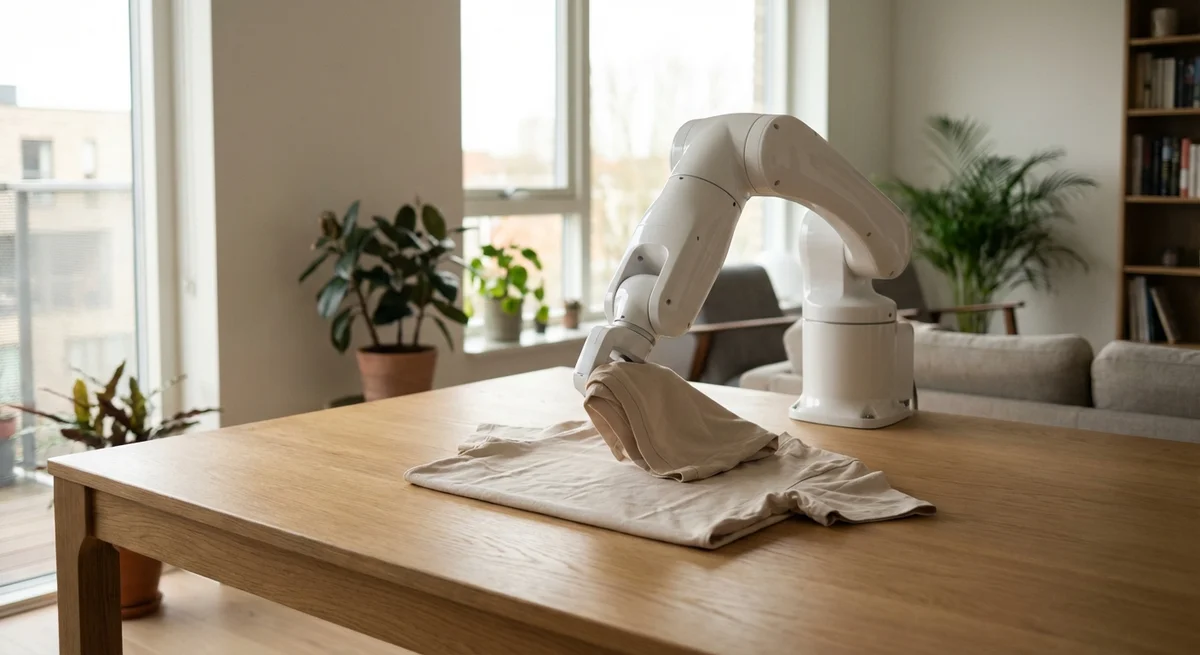
Isaac 0: an $8,000 home robot that folds your laundry
Startup Weave Robotics has unveiled its first home robot, Isaac 0, built exclusively to fold clean laundry. The $7,999 device is stationary and plugs into a standard wall outlet. Processing one basket of clothes takes 30 to 90 minutes. For now, the robot cannot handle large items such as blankets and sheets, or clothes that are inside out. A distinctive feature of the model is its use of remote operators to help in difficult cases, though the company promises its autonomy will grow over time. Sales are currently limited to the San Francisco area. It is an example of narrowly specialized robotics trying to claim a niche in premium consumer electronics.
As household tasks drift toward automation, a robot that can take over one of the most routine and disliked chores, folding laundry, looks like a significant step forward. Weave Robotics, founded only a year and a half ago, has unveiled its first product, a home robot called Isaac 0. It is positioned as a solution for people who value their time and are willing to pay for convenience, even if that convenience is not cheap.
Isaac 0 is a stationary robot, and its main and only function is to neatly fold clean clothes. The new device costs a hefty $7,999, which places it in the premium segment of consumer electronics. The robot plugs into a standard household outlet and does not require complicated installation. Isaac 0 takes 30 to 90 minutes to process one standard basket of laundry, which is probably comparable to the time a person spends, but frees that person for other things. However, despite its narrow specialization, the robot cannot yet handle every type of garment. Large items such as blankets or bed linen, as well as clothes that are inside out, remain beyond its current capabilities.
Another interesting feature of Isaac 0 is that it is not fully autonomous. In difficult cases, when the robot meets an unusual situation or a tricky garment shape, remote operators step in. This means people monitor the process and, when necessary, can intervene and control the machine remotely. Weave Robotics, however, assures customers that the robot's performance and autonomy will grow over time through improved algorithms and machine learning.
The arrival of such narrowly specialized robots as Isaac 0 raises questions about the future of home robotics. On one hand, the high price and limited functionality may look like a barrier for mainstream consumers. On the other, it may be a go-to-market strategy aimed at early adopters and wealthy customers willing to pay for innovation and for a solution to one specific problem. Limiting initial sales to the San Francisco area also points to a gradual approach to scaling. Isaac 0's success will depend on how effectively the company can increase the robot's autonomy, expand its functionality and, possibly, lower its price in the future.
Weave Robotics' Isaac 0 is an ambitious attempt to automate one of the most irritating household tasks. Despite the high price and current limitations, the robot is an interesting example of how tech startups are exploring new niches in consumer robotics. Time will tell whether Isaac 0 becomes an integral part of households or remains an exclusive gadget for enthusiasts willing to pay to solve one specific problem.
- Nov 2, 2026DeepSeek open-sources Super-agent prototype: p95 task completion time of 15.7 minutes vs. 29.5
- Nov 2, 2026Bun creator uses Claude Code to port 750K lines from Zig to Rust in 11 days
- Nov 2, 2026Microsoft releases 4B model Mage-VL-Cowork, which solves 66.0% of OSWorld-Verified tasks
- Nov 2, 2026Meta's Muse assistant keeps dossiers on loved ones and gets root on Ubuntu by default
Test Frontier LLMs & Autonomous Agents in One Workspace
Run Claude Opus 5.5, GPT-6, Gemini 3.1, and DeepSeek side-by-side in Nomad AI (nomadnet.ai) — unified model routing, deep research, and multimodal workflows under one subscription.
The AI world, distilled — once a week
Seven stories that actually mattered, hand-picked. No noise, no reposts, no press releases.
Done! Check your inbox for a confirmation.