Sam Altman-backed Glydways raises $170M for robocar networks
Glydways, an autonomous transportation startup backed by Sam Altman, has raised about $170M in a Series C round. Almost immediately after the round closed, the company began discussing another $250M. The company is betting on closed robocar networks with controlled routes. That approach makes deployment easier, but it demands heavy investment in infrastructure, operations, and scaling in urban environments.
AI-processed from Bloomberg Tech; edited by Hamidun News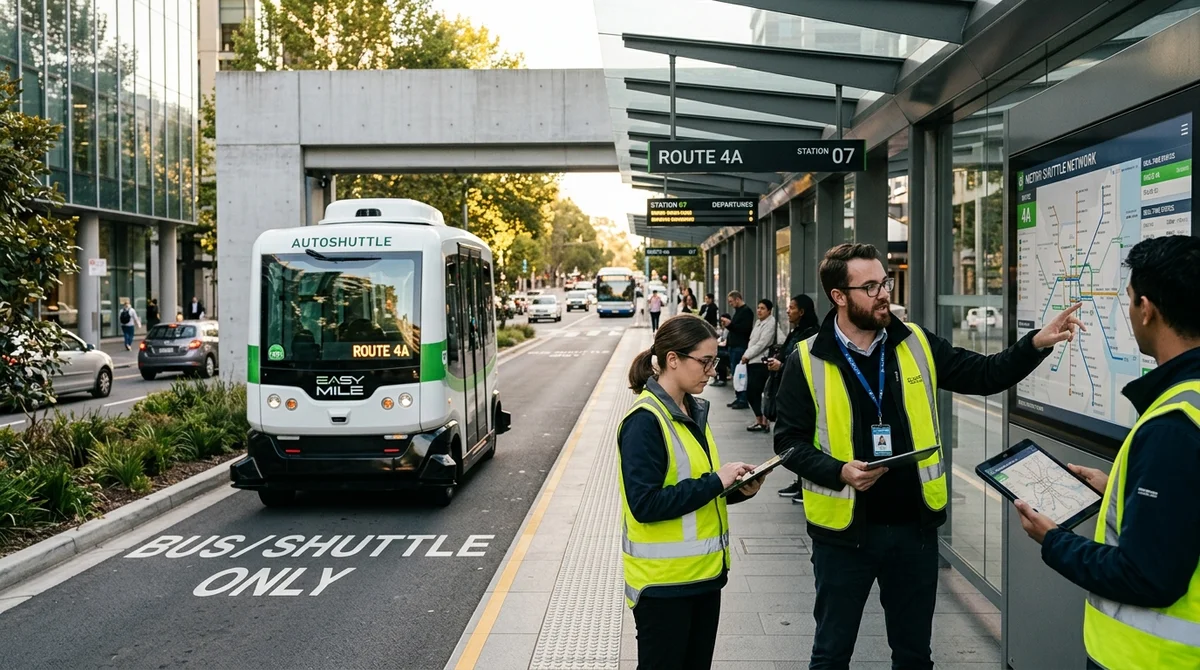
Glydways, an autonomous transportation startup, has raised about $170M in a Series C round and is already discussing another $250M. Investors are betting on closed robocar networks, even though the path to scaling these systems remains expensive and difficult.
Glydways' new round
The roughly $170M Series C shows that the market is still willing to fund transportation projects with long payback horizons. For Glydways, the money does more than top up the balance sheet. It signals that investors believe in a model where autonomous vehicles don't cover an entire city at once but run on a purpose-built network. The company began negotiating another $250M almost immediately after closing the round, which points to two things at once: its ambitions are growing fast, and this kind of business needs far more capital than a typical software startup.
Sam Altman's backing gives the project extra weight, but it doesn't answer the central question: can the company turn the idea into a sustainable commercial model? In autonomous transportation, money alone doesn't guarantee a breakthrough. A company has to build the vehicles, the infrastructure, the operating model, and relationships with cities or private partners all at the same time. That's why Glydways is already looking for its next round even after a large one: the window for launching and scaling may be short, and the cost of mistakes is very high.
Betting on closed routes
Glydways' core idea is not to send robocars into chaotic city traffic, but to build closed or semi-isolated transit loops where the environment is known in advance and can be controlled. This approach is seen as more realistic than trying to solve the entire problem of driverless driving in open city streets right away. When routes, traffic rules, pickup points, and logistics are defined ahead of time, the system has an easier job delivering predictability, safety, and sound economics. To investors, it looks like a compromise between a futuristic vision and engineering discipline.
But even a closed network is a very complex product. The company has to build more than an autonomous vehicle: it also has to tie that vehicle into the roadway, dispatch, traffic flow management, maintenance, charging, and customer service. A failure in any one link hurts the entire model. On top of that, each network has to be designed for a specific site, so scaling is slower than it is for purely digital platforms.
- Dedicated routes and a controlled environment
- Clearer safety and operational requirements
- High infrastructure costs before launch
- Slow city-by-city scaling
Why it needs more money
The additional $250M the company is discussing after its Series C makes sense for exactly this kind of business. In autonomous transportation, capital goes not only to software and model development but also to hardware, manufacturing, testing, certification, operations teams, and the launch of the first routes. In effect, Glydways isn't building a single app or a single vehicle. It's building an entire transportation system, where every new site requires integration, local adaptation, and lengthy preparation before commercial launch.
For the market, this is also a reminder that the next wave of AI companies won't be just about chatbots and APIs. The closer a project gets to the physical world, the more expensive the path from demo to real revenue becomes. Robotaxis, autonomous shuttles, and closed transit networks promise big impact, but investors have to pay for a long stretch of uncertainty. That's why large rounds at these companies read both as a sign of confidence and as an indicator of how hard it is to bring the technology to working scale.
What it means
The Glydways story shows where investor interest is shifting: from pure AI software to systems where AI is built into real-world infrastructure. If the company can prove that closed robocar networks work, the market will get a more pragmatic path for autonomous transportation — not for every road at once, but for specific, controlled routes.
- Nov 2, 2026Meta's Muse assistant keeps dossiers on loved ones and gets root on Ubuntu by default
- Nov 1, 2026Local models lose to Opus and Codex: 0.21 on a MacBook versus 1.00 for Codex
- Nov 1, 2026Kimi scores 96.2% on a 1C database analytics test and emerges as a fallback if Claude access is blocked
- Nov 1, 2026OpenAI Rewrites GPT Behavior Rules: Five Values and a Chain of Command
Key Questions Answered
What are the key details on Glydways' new round?
The roughly $170M Series C shows that the market is still willing to fund transportation projects with long payback horizons. For Glydways, the money does more than top up the balance sheet. It signals that investors believe in a model where autonomous vehicles don't cover an entire city at once but run on a purpose-built network. The company began negotiating another $250M almost immediately after closing the round, which points to two things at once: its ambitions are growing fast, and this kind of business needs far more capital than a typical software startup. Sam Altma
What are the key details on Betting on closed routes?
Glydways' core idea is not to send robocars into chaotic city traffic, but to build closed or semi-isolated transit loops where the environment is known in advance and can be controlled. This approach is seen as more realistic than trying to solve the entire problem of driverless driving in open city streets right away. When routes, traffic rules, pickup points, and logistics are defined ahead of time, the system has an easier job delivering predictability, safety, and sound economics. To investors, it looks like a compromise between a futuristic vision and engineering disc
Why it needs more money?
The additional $250M the company is discussing after its Series C makes sense for exactly this kind of business. In autonomous transportation, capital goes not only to software and model development but also to hardware, manufacturing, testing, certification, operations teams, and the launch of the first routes. In effect, Glydways isn't building a single app or a single vehicle. It's building an entire transportation system, where every new site requires integration, local adaptation, and lengthy preparation before commercial launch. For the market, this is also a reminder
Test Frontier LLMs & Autonomous Agents in One Workspace
Run Claude Opus 5.5, GPT-6, Gemini 3.1, and DeepSeek side-by-side in Nomad AI (nomadnet.ai) — unified model routing, deep research, and multimodal workflows under one subscription.
The AI world, distilled — once a week
Seven stories that actually mattered, hand-picked. No noise, no reposts, no press releases.
Done! Check your inbox for a confirmation.