Google funds a Texas data center being prepared to run on a major gas-fired plant
Google invested in the Goodnight data center in Texas, where two of six buildings, according to a permit application, could be powered by on-site gas generation. That would mean emissions of more than 4.5 million tons a year — comparable to nearly a million gasoline cars. The case points to a new trend: AI campuses are increasingly being built with local generation because power grids are not keeping up with demand.
AI-processed from Wired; edited by Hamidun News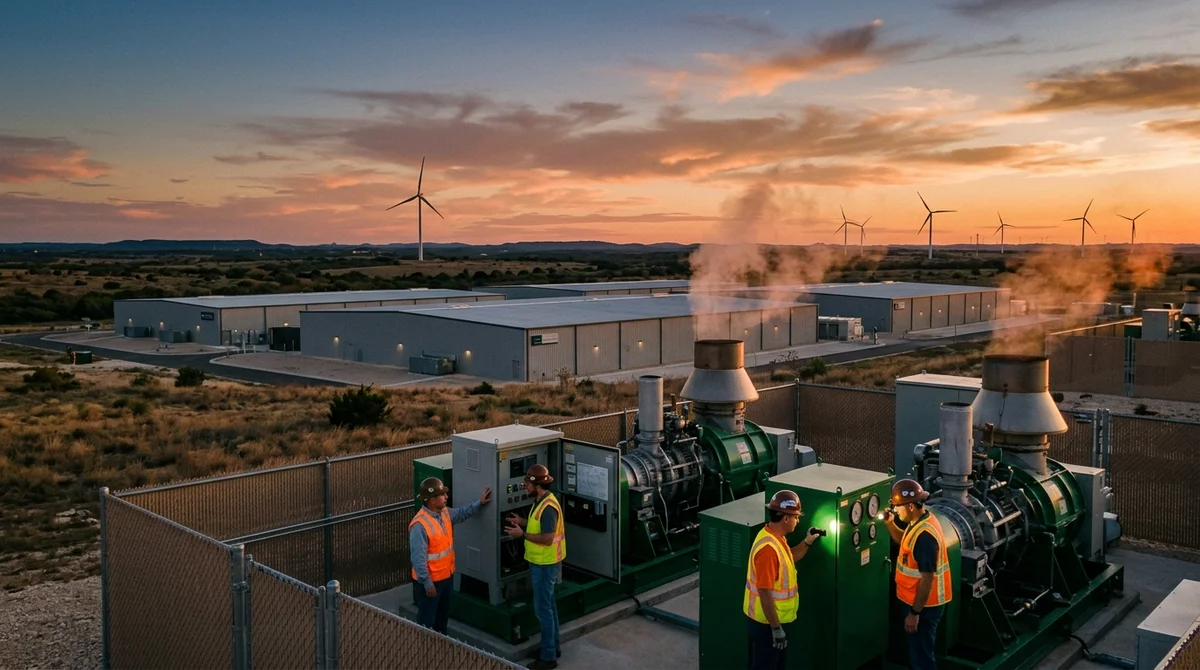
Google has invested in a new Goodnight data center in Texas that, according to project documents, can partially operate on its own gas generation. This is another signal that AI infrastructure increasingly relies not on a "green" agenda, but on rapid access to power capacity.
How the project is structured
The Goodnight campus in Armstrong County, Texas is being built by infrastructure company Crusoe with Google's participation. In November, Google announced $40 billion in investments in Texas AI infrastructure, and this facility is part of that project portfolio. According to an environmental permit application, the site will have six buildings: the first four will be connected to the shared power grid, while the fifth and sixth are planned to be powered by a private gas generation facility located directly on the campus.
The most controversial aspect is the scale of emissions. The documents cite a figure exceeding 4.5 million tons of greenhouse gas per year.
This is comparable to adding more than 970,000 gasoline-powered cars to the roads. However, Google clarifies that it currently has no final contract specifically for gas power supply to this campus. Yet the project scheme itself shows that such an option is already being seriously considered, meaning it has become part of a new logic for building large AI facilities.
Why gas is being chosen
Alongside gas generation for Goodnight, wind power of approximately 265 megawatts has also been announced. But the key takeaway from this story is not that Google has abandoned renewable energy, but that renewable energy sources alone are no longer sufficient to bring large data centers online on the required timescales. Developers are facing long queues to connect to grid networks and are seeking to obtain electricity directly, bypassing infrastructure bottlenecks.
"Grid growth is not keeping pace with AI demand, so gas has become a critically important bridge," says
Crusoe co-founder Cully Cavness.
Here's what makes this case exemplary:
- the site involves more than 900 megawatts of gas power capacity;
- part of the buildings must receive power not from the grid, but from on-site generation;
- nearly 100 gigawatts of gas projects are already being prepared for US data centers;
- similar campuses from other companies are being designed with even higher emissions.
This approach is called behind-the-meter power — where a facility builds its own generation capacity adjacent to consumption. For AI companies, this is a way to avoid waiting years for grid connection and to launch clusters for model training and inference faster. The problem is that the role of a "bridge" is almost everywhere filled by natural gas rather than battery storage, solar stations, or other low-carbon sources, which are still harder to deploy at the required scale and pace.
Climate and politics
This story is especially sensitive for Google because the company has long been one of the main symbols of Big Tech's climate commitments. In the context of the AI boom, this becomes more difficult: over the past five years, Google's cumulative emissions have grown noticeably, although the company itself claims that its data center emissions fell by 12 percent last year. In parallel, it is also developing alternative scenarios: another Texas facility in Haskell County is promised to be built next to a new solar station and energy storage system.
The political landscape is also changing. The White House recently gathered major technology companies to discuss how to expand new energy capacity without pressuring consumers. But for the market, this is more of a signal than a real mechanism.
Simultaneously, US senators have begun asking AI companies and data center operators to explain why new campuses increasingly choose gas over renewable sources.
What this means
Demand for AI computing is growing faster than electrical grids and clean power generation. Therefore, even companies with strict climate goals are beginning to consider local gas stations as a quick way to launch new capacity. For the market, this is bad news in terms of emissions, but an important indicator of what the race for AI infrastructure looks like in practice.
Need AI working inside your business — not just in your newsfeed?
I build production AI for companies — custom CRM, internal tools, autonomous agents, workflow automation. Owned by you, shaped to your process, no per-seat tax. Built by Zhemal Khamidun, CPO of AlpinaGPT (AI platform, 6,000+ users).
The AI world, distilled — once a week
Seven stories that actually mattered, hand-picked. No noise, no reposts, no press releases.
Done! Check your inbox for a confirmation.