Disneyland rolls out facial recognition entry, and opting out does not guarantee no camera capture
Disneyland in California has introduced facial-recognition entry at Disneyland Park and Disney California Adventure. Disney calls the system voluntary and says it will delete numerical facial templates after 30 days unless there are legal grounds or fraud risks. But there is an important caveat: even in regular non-biometric lines, a guest’s image may still be captured, while an employee checks the ticket manually.
AI-processed from Wired; edited by Hamidun News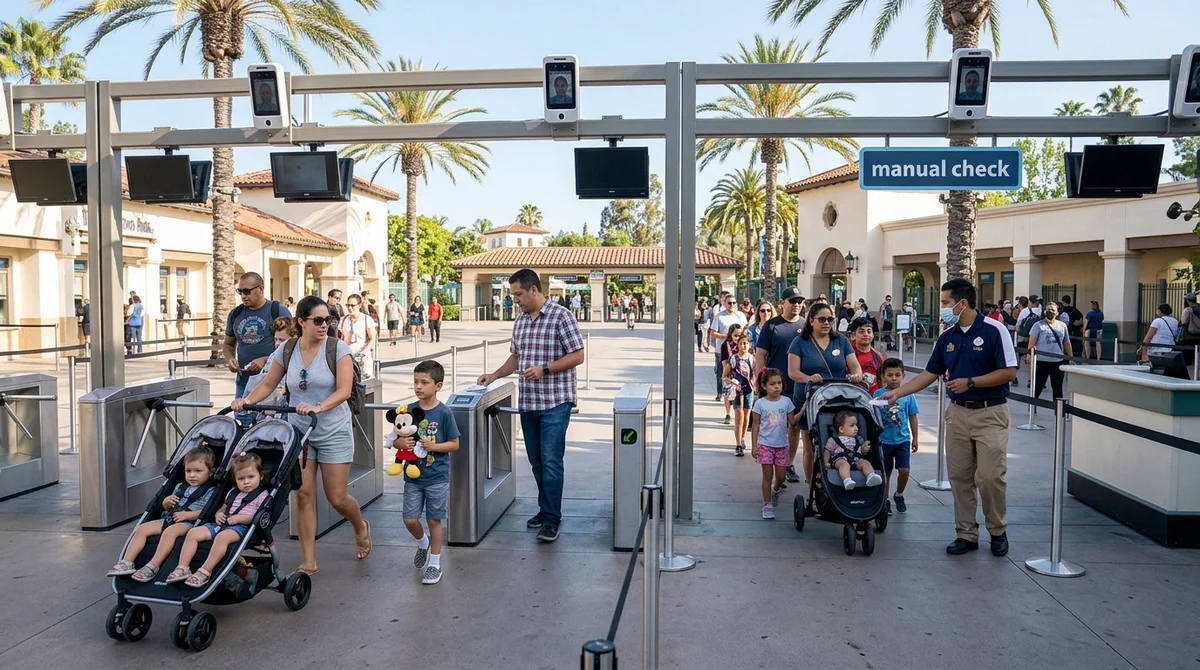
Disneyland in California has begun allowing guests to enter through facial recognition lines. Formally, the system is voluntary, but even if a visitor declines, they can still be photographed at the entrance — just without biometric matching.
How Entry Works
The new scheme operates at the entrances to Disneyland Park and Disney California Adventure Park. The camera captures a guest's face at the turnstile and compares it to an image saved when the ticket or annual pass was first used. The system then converts both images into numerical templates and searches for a match.
Disney explains this as speeding up repeat entry and fighting fraud, such as the transfer of other people's tickets. According to the company's official notification, participation in the system is optional. But the wording is important: refusal means not a complete absence of filming, but a refusal of biometric processing.
If a person goes through a regular line, an employee manually checks the ticket, and the image can still be captured by a camera.
"Participation in this system is optional,"
Disney's notification states.
What Exactly Is Collected
Disney claims it does not store a "face picture" in ordinary form for indefinite use. The system converts the image into unique numerical values and stores precisely those. According to company policy, these values are deleted within 30 days of creation, unless they need to be retained for legal reasons or to prevent fraud.
There is also a separate condition for children: visitors under 18 can use the system only with parental or guardian consent. At the same time, the company itself acknowledges that one hundred percent protection does not exist. The notification states that technical, administrative, and physical security measures are used, but no system is completely impenetrable.
For critics, this is a key point: any biometric database automatically becomes an attractive target for leaks and abuse.
Why This Causes Controversy
Facial recognition has long extended beyond airports and police databases. It is used by stadiums, arenas, and large venues where owners want to speed up entry and reduce manual checks. Disneyland is moving in the same direction, and that is exactly what privacy advocates find troubling: the technology is gradually transforming from an exception to a norm for ordinary daily life.
The practical question is also not as simple as official explanations suggest. According to on-site reports, most entry lines already operate with biometrics, and lines without it are noticeably less visible. Many guests simply choose the shortest queue and don't read the signs, so "voluntariness" easily becomes silent consent.
For families with children this is particularly sensitive: parents may not immediately understand what is happening with their child's data.
What changes for the visitor in practice:
- entry and re-entry may proceed faster if the system immediately finds a match;
- Disney gains an additional tool against ticket resale and transfer;
- even when declining biometrics, a person may still appear in a camera frame on a regular line;
- numerical templates are promised to be deleted in 30 days, but there are exceptions for legal purposes and fraud prevention;
- children under 18 need parental or guardian consent.
What This Means
Disney did not invent new technology, but took an important step toward its mass normalization. When facial recognition becomes a standard part of family recreation, the boundary between convenience and constant surveillance shifts even further — and the debate is no longer about whether the system works, but about where society is ready to draw the line.
Need AI working inside your business — not just in your newsfeed?
I build production AI for companies — custom CRM, internal tools, autonomous agents, workflow automation. Owned by you, shaped to your process, no per-seat tax. Built by Zhemal Khamidun, CPO of AlpinaGPT (AI platform, 6,000+ users).
The AI world, distilled — once a week
Seven stories that actually mattered, hand-picked. No noise, no reposts, no press releases.
Done! Check your inbox for a confirmation.