KDnuggets published a guide to local call analysis with Whisper, BERTopic, and Streamlit
KDnuggets showed how to build a local customer call analyzer without cloud APIs. The stack uses Whisper for audio transcription, Hugging Face's RoBERTa for sentiment and emotions, BERTopic for topics, and Streamlit for the dashboard. The project runs on your own machine and requires Python 3.9+, FFmpeg, and about 1.5–2 GB for the models.
AI-processed from KDnuggets; edited by Hamidun News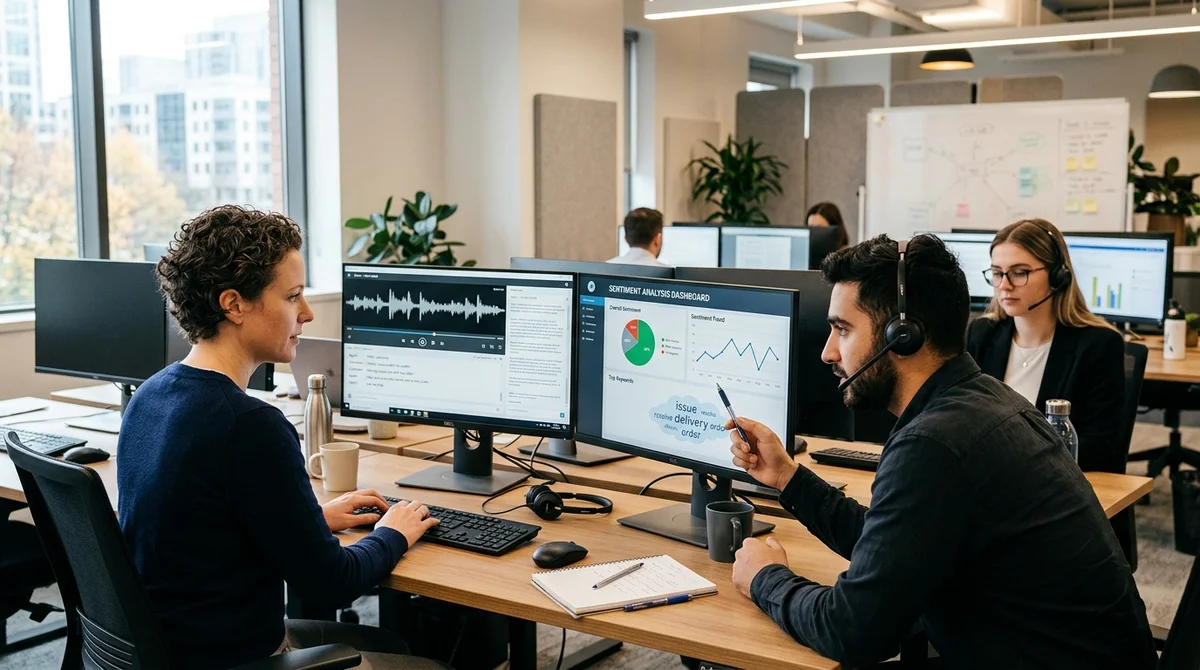
On April 17, 2026, KDnuggets published a step-by-step walkthrough of an open-source tool for analyzing customer calls. The project assembles a local pipeline: Whisper transcribes audio, models from Transformers determine sentiment and emotions, and BERTopic discovers recurring themes without sending recordings to external APIs.
How the Stack Works
The material is built around a simple modular scheme that can be reproduced on an ordinary machine. First, Whisper converts a call recording into text and splits it into segments with timestamps. The author uses the base or small version of the model as a compromise between speed and quality.
Next, the transcript goes into the cardiffnlp/twitter-roberta-base-sentiment-latest model, which calculates probabilities for positive, neutral, and negative, then outputs a final label and compound score ranging from minus one to plus one. After that, BERTopic groups conversations by meaning and extracts key themes like billing problems, delivery issues, or technical support concerns. The author separately explains why theme and sentiment solve different tasks.
Sentiment answers the question of whether the experience was good or bad, while emotions show what the customer actually feels: frustration, urgency, satisfaction. For themes, a combination of sentence-transformers, UMAP, HDBSCAN, and c-TF-IDF is used. An important practical detail: theme extraction begins to work properly not on a single call, but on at least a set of five to ten transcripts, where recurring patterns are already visible.
Why Local Execution
The main idea of the article is not simply to create another NLP demo project, but to demonstrate a useful corporate scenario without dependency on cloud APIs. For call centers, this comes down to privacy, cost, and data storage requirements. After the initial model download, which takes approximately 1.5 GB, the system can work offline. To get started, you need Python 3.9+, FFmpeg for audio processing, and about 2 GB of disk space—meaning the barrier to entry is quite low even for a small team.
"The main advantage is that everything works locally, and sensitive
customer data never leaves your machine."
In the article, this is presented as an argument not only about security but also about cost predictability. There's no per-API-call fee, no provider limits, and no risk of having to send the next customer recording to external infrastructure. The author also compares transformers with older dictionary-based methods like VADER: simple models can make mistakes on phrases with negation, while a transformer better understands the context of conversational speech, which is especially important for real complaints and ambiguous phrasing.
What the Dashboard Shows
The final layer of the project is a Streamlit interface with Plotly charts, aimed not at an ML engineer but at a manager or analyst. Through it, you can upload several mp3 or wav files, wait for processing, and immediately view a summary of the calls. Resource caching is used for acceleration, so heavy models don't reload with each action in the interface. The tool supports several modes: demo without audio, single file analysis, batch directory processing, and a full dashboard in the browser.
- Audio file upload and batch processing
- Transcript with sentiment highlighting
- Emotion timeline for long conversations
- Theme visualization and call distribution across clusters
- Navigation to specific conversations
Essentially, this is a ready-made framework for internal support services, product analytics, and operator quality control. A team can take the repository, change the input data, fine-tune or replace models, and quickly get a practical tool instead of an abstract notebook. This is exactly what makes the article valuable: it doesn't argue about the future of agent systems, but shows a concrete, reproducible scenario where the open-source stack already solves a business problem.
What This Means
Such publications show how quickly AI tools transition from experiments to operational practice. If call analysis previously often required a SaaS service and external data processing, now a basic system can be built locally, transparently, and without large API budgets.
Want to stop reading about AI and start using it?
AI News is a curated feed of AI/tech news. Hamidun Academy teaches you to use AI systematically in your work.
The AI world, distilled — once a week
Seven stories that actually mattered, hand-picked. No noise, no reposts, no press releases.
Done! Check your inbox for a confirmation.