MIT explains how AI and the mathematical and physical sciences can reinforce each other
MIT has published its vision for AI at the intersection of physics, mathematics, chemistry and materials science. Professor Jesse Thaler describes a two-way bridge: models should speed up scientific discovery, while scientific methods should make AI itself easier to understand and more reliable. The priorities include computing infrastructure, interdisciplinary programs and training "centaur scientists" who work fluently in both worlds.
AI-processed from MIT News; edited by Hamidun News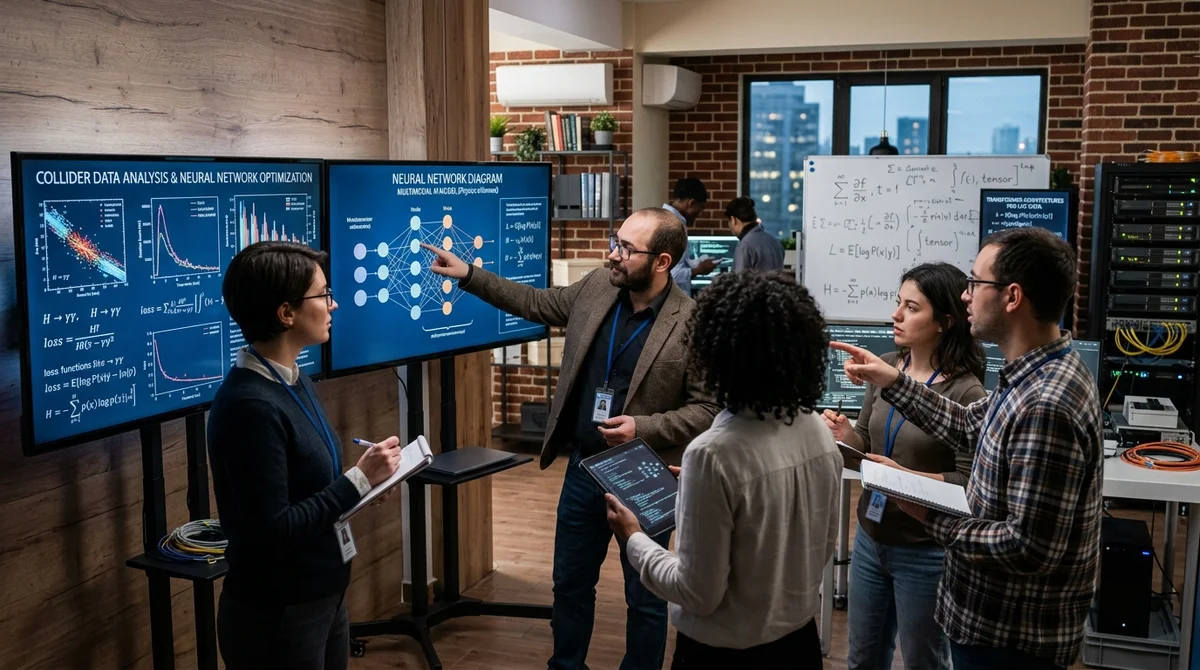
MIT has set out how artificial intelligence and the fundamental sciences can reinforce each other rather than develop separately. According to Professor Jesse Thaler, the next stage of AI depends not only on bringing models into science, but also on how much science can help us understand, improve and control these systems.
The logic of a two-way bridge
The discussion grew out of the AI+MPS workshop, which MIT held in 2025 with researchers in physics, mathematics, chemistry, materials science and astronomy. Those discussions produced a white paper with recommendations for universities, researchers and funders, later published in the journal Machine Learning: Science and Technology.
The main conclusion: AI already owes a great deal to the mathematical and physical sciences, because they supplied the hard problems, high-quality data and ideas on which modern machine learning methods were built.
Thaler proposes looking at the connection more broadly. It is not just about neural networks helping to find new materials, analyze collider data or solve mathematical problems. Scientific approaches can also improve AI itself: explain the behavior of models, suggest new architectures and make systems more controllable. MIT believes a distinct field is now taking shape at the intersection of the two worlds, one that will affect both the pace of scientific discovery and the quality of future intelligent systems.
"This has to be a movement in both directions."
What science gives AI
MIT calls this the science of AI: a scientific view of intelligent systems themselves. In the paper, Thaler divides it into three strands: science as a foundation for AI, science as a source of new algorithms, and science as a tool for explaining how models work.
For the fundamental disciplines, this is not abstract theory but a practical route that can speed up discoveries and make AI more reliable at the same time, especially where models are expected to deliver not only accuracy but also interpretability.
A consensus emerged quickly across the five scientific communities: the bridge between AI and science cannot be built through individual labs or one-off experiments. It needs shared conditions that work across disciplines and are sustained at the institutional level. Workshop participants boiled this baseline down to several practical priorities, relevant to universities, funders and research teams alike:
- investment in computing and data infrastructure;
- interdisciplinary research methods;
- more rigorous training of specialists at the intersection of fields;
- long-term support for projects where AI and science develop together.
High-energy physics offers one example. Researchers there build real-time algorithms to cope with the flow of data from colliders. Such solutions are needed to search for new physics, but they can later reach far beyond a single discipline and affect the broader AI stack. The logic is simple: the harder the scientific problem, the greater the chance that methods built for it prove useful in other areas, from signal analysis to more efficient model training.
Talent and MIT's strategy
The second recurring thesis is that models and compute are not enough. Real progress requires people who are equally confident in computing and in their own scientific discipline. Thaler calls them "centaur scientists". This is not about rare lone polymaths but about systematic training: from integrated courses for students to interdisciplinary PhD tracks, joint faculty hires and dedicated postdoc positions where young researchers can work between fields without a career penalty for being hybrid.
MIT believes it already has part of this infrastructure. Thaler cites IAIFI, the A3D3 institute and university programs that teach students to be "bilingual" in computing and in their core specialty. He puts particular emphasis on a systemic approach: the universities that win will be those that coordinate hiring, education, computing resources and research funding as a single strategy. As a sign of this course, MIT has already launched its first joint faculty search between the Schwarzman College of Computing and the Department of Physics.
What this means
MIT's position shows that the next round of AI depends increasingly not just on products and model scaling, but on fundamental science. For the market and for universities, this is a signal: the competitive advantage will more and more often belong to those who can combine algorithms, scientific expertise, data, infrastructure and the training of interdisciplinary teams.
Key Questions Answered
What are the key details on The logic of a two-way bridge?
The discussion grew out of the AI+MPS workshop, which MIT held in 2025 with researchers in physics, mathematics, chemistry, materials science and astronomy. Those discussions produced a white paper with recommendations for universities, researchers and funders, later published in the journal Machine Learning: Science and Technology. The main conclusion: AI already owes a great deal to the mathematical and physical sciences, because they supplied the hard problems, high-quality data and ideas on which modern machine learning methods were built. Thaler proposes looking at the
What science gives AI?
MIT calls this the science of AI: a scientific view of intelligent systems themselves. In the paper, Thaler divides it into three strands: science as a foundation for AI, science as a source of new algorithms, and science as a tool for explaining how models work. For the fundamental disciplines, this is not abstract theory but a practical route that can speed up discoveries and make AI more reliable at the same time, especially where models are expected to deliver not only accuracy but also interpretability. A consensus emerged quickly across the five scientific communities
What are the key details on Talent and MIT's strategy?
The second recurring thesis is that models and compute are not enough. Real progress requires people who are equally confident in computing and in their own scientific discipline. Thaler calls them "centaur scientists". This is not about rare lone polymaths but about systematic training: from integrated courses for students to interdisciplinary PhD tracks, joint faculty hires and dedicated postdoc positions where young researchers can work between fields without a career penalty for being hybrid. MIT believes it already has part of this infrastructure. Thaler cites IAIFI, t
Test Frontier LLMs & Autonomous Agents in One Workspace
Run Claude Opus 5.5, GPT-6, Gemini 3.1, and DeepSeek side-by-side in Nomad AI (nomadnet.ai) — unified model routing, deep research, and multimodal workflows under one subscription.
The AI world, distilled — once a week
Seven stories that actually mattered, hand-picked. No noise, no reposts, no press releases.
Done! Check your inbox for a confirmation.