Bumble launches Dates, an AI assistant meant to pull dating away from endless swiping
Bumble has unveiled Dates, a new mode in which an AI assistant first talks with the user about values, relationship goals and communication style, then suggests matches along with an explanation of why they might suit each other. The idea is to reduce fatigue from swiping and empty matches. The launch comes as the company's revenue and paying user base decline, and Bumble is betting on more meaningful dating.
AI-processed from Bloomberg Tech; edited by Hamidun News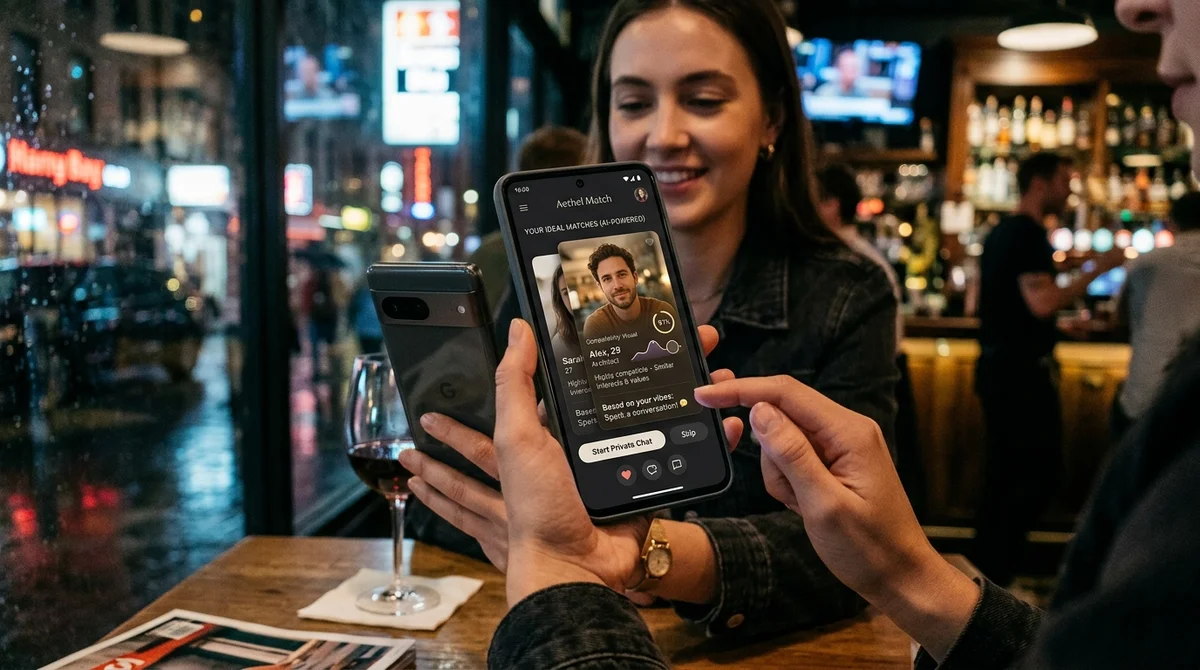
Bumble has introduced Dates, a new opt-in mode in which an AI assistant takes over part of a matchmaker's job: it first talks with the user about values, relationship goals and communication style, then suggests more compatible matches. The company is clearly trying to answer the fatigue caused by endless swiping and empty matches, which hurts both engagement and business metrics.
How Dates works
The new mode starts not with flipping through cards but with a private, detailed conversation. The assistant asks about values, relationship goals, communication style, lifestyle and dating intentions. The idea is simple: instead of trying to squeeze everything important into a short profile and a couple of photos, users describe themselves in a more natural format.
For a dating app this is a notable shift: the system collects not only formal preferences but also the context that usually gets lost between swipes.
When the service finds two people with similar answers, both receive a notification and a short explanation of why the pair might be a good fit. In other words, Bumble wants to recommend not just a "match" but a slightly interpreted pairing with reasoning behind it.
It also matters that the tool is a separate, optional flow: the company is not breaking the familiar interface for everyone at once, but offering a new path to those willing to try a more guided and less chaotic way of meeting people.
Why Bumble is changing the mechanics
Dates arrives not amid growth but amid a clear reset of the business. In its fourth-quarter 2025 report, Bumble reported a 14.3% drop in quarterly revenue, to $224.2 million, while the number of paying users fell 20.5%, to 3.3 million. For the company, this signals that the old model no longer works as before: people are tired of endless choice, samey profiles and chats that fade quickly.
Inside the company, this is described as a return to a women-first foundation and a quality reset: a bet on trust, authenticity and a higher-quality audience rather than raw volume. In this context, AI is needed not as a marketing sticker but as a way to better understand whom a person is actually looking for.
"When women feel safe and act with intention, the whole ecosystem works better."
This logic matters for Bumble's entire strategy. If the app helps users grasp a counterpart's intentions faster and cuts the number of random matches, it raises the chance of a real conversation and an actual meeting. If not, users simply go back to the old routine: dozens of swipes, a few listless chats and quick burnout.
What else Bumble is preparing
Dates is not a standalone experiment in a vacuum but part of a larger product overhaul that the company calls Bumble 2.0. On an investor call, management spoke of life "beyond the swipe" and said that in some scenarios the classic swipe may stop being the main mechanic altogether. Instead of flat cards, Bumble wants to move to profiles split into meaningful chapters, where people can show their story, habits and character, not just age, photos and a few tags.
- More detailed profiles with several thematic blocks instead of a single flat profile
- Several matching scenarios instead of a single swipe mechanic
- A gradual rollout to small groups of users with strict metric checks
- Deeper personalization on a new cloud-native, AI-first platform
This approach is needed not only for recommendation quality but also to reduce risk. Bumble does not want to repeat the typical path of large platforms, where a loud redesign breaks user habits and hurts monetization. So the company says outright that it will roll out changes in stages, checking whether they worsen engagement, payment metrics or the quality of conversations inside the app.
What this means
Dating apps are gradually moving away from the catalog model, where users manually sift through an endless stream of faces, toward a digital concierge model that first understands the request and then offers more precise options. For Bumble, this is an attempt to solve a product problem and a business problem at once: reduce swipe fatigue, restore the sense of meaningful dating and restart growth.
If Dates works, competitors will also have to move from the quantity of matches to the quality of compatibility.
- Oct 28, 2026Anthropic reveals how it builds Claude with Claude: the brain separate from the hands
- Oct 28, 2026Bayer Launches Multi-Agent Engine on AgentCore: 80% of Questions Handled Without Engineers
- Oct 28, 2026Liquid AI releases LFM2.5-24B-A2B: an agent model with 2B active parameters
- Oct 28, 2026AgentOrch: Pre-Planned AI Agents Now Trail Step-by-Step Execution by Just 8.5 Points
Key Questions Answered
How Dates works?
The new mode starts not with flipping through cards but with a private, detailed conversation. The assistant asks about values, relationship goals, communication style, lifestyle and dating intentions. The idea is simple: instead of trying to squeeze everything important into a short profile and a couple of photos, users describe themselves in a more natural format. For a dating app this is a notable shift: the system collects not only formal preferences but also the context that usually gets lost between swipes. When the service finds two people with similar answers, both
Why Bumble is changing the mechanics?
Dates arrives not amid growth but amid a clear reset of the business. In its fourth-quarter 2025 report, Bumble reported a 14.3% drop in quarterly revenue, to $224.2 million, while the number of paying users fell 20.5%, to 3.3 million. For the company, this signals that the old model no longer works as before: people are tired of endless choice, samey profiles and chats that fade quickly. Inside the company, this is described as a return to a women-first foundation and a quality reset: a bet on trust, authenticity and a higher-quality audience rather than raw volume. In thi
What else Bumble is preparing?
Dates is not a standalone experiment in a vacuum but part of a larger product overhaul that the company calls Bumble 2.0. On an investor call, management spoke of life "beyond the swipe" and said that in some scenarios the classic swipe may stop being the main mechanic altogether. Instead of flat cards, Bumble wants to move to profiles split into meaningful chapters, where people can show their story, habits and character, not just age, photos and a few tags. More detailed profiles with several thematic blocks instead of a single flat profile Several matching scenarios inst
Ship AI Faster with Founders, Engineers & Weekly Architecture Reviews
Inside Vibe Club (hamidun.com/club) — weekly live masterminds with Zhemal Khamidun, Tech Radar, full LMS access, and 370+ production Claude Code skills.
The AI world, distilled — once a week
Seven stories that actually mattered, hand-picked. No noise, no reposts, no press releases.
Done! Check your inbox for a confirmation.