Amazon to pair Cerebras' giant chips with Trainium to run AI models
Amazon plans to combine Cerebras' giant chips with its own Trainium processors to run AI models. It is a rare and notable signal: even hyperscalers with their own silicon are willing to plug in outside accelerators when those deliver gains in performance and flexibility. For the market, it is one more step toward hybrid AI stacks, where the chip's brand matters less than the end-to-end efficiency.
AI-processed from Bloomberg Tech; edited by Hamidun News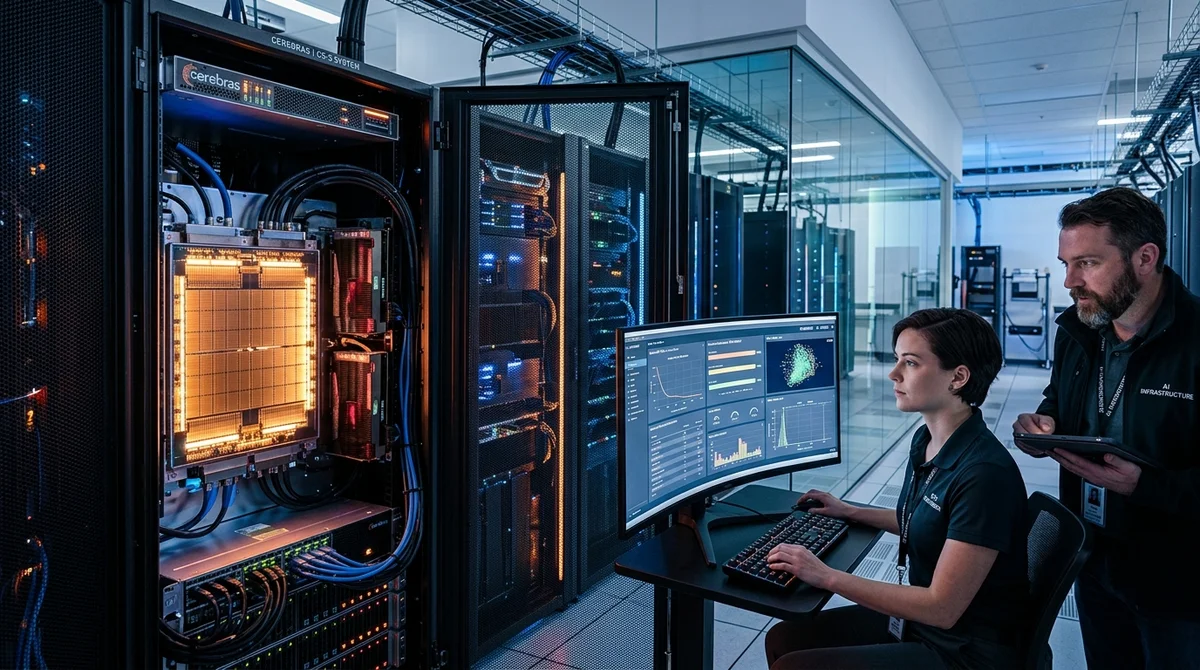
Amazon plans to use chips from startup Cerebras Systems together with its own Trainium processors to run AI models. The companies claim this pairing should run AI software more efficiently than relying on a single type of accelerator.
What Amazon decided
In essence, Amazon is betting not on one universal chip but on a combination of several architectures. The company plans to put Cerebras' giant processors next to its own Trainium line, strengthening its infrastructure for AI-model workloads.
It is an important signal: even the largest cloud players, which already design their own silicon, do not see it as sensible to lock themselves into in-house solutions alone if an outside technology can deliver better performance or easier operation.
For Amazon it is also a pragmatic move. Trainium remains a strategic asset, because it gives the company more control over costs and over the development of its own AI platform. Cerebras, for its part, is known for its focus on very large chips and a specialized approach to heavy computation. Together, they look like an attempt to build a more flexible system in which different accelerators take on the parts of the workload they handle best. The companies have not yet disclosed detailed technical specifications, but the logic of the partnership is already clear.
Why a hybrid
The AI market has long been constrained not only by model quality but by how exactly models are run in real services. When a model must be deployed quickly, serve requests reliably and not burn through the compute budget, the choice of hardware becomes a product decision, not just an infrastructure question.
That is why combining Amazon's own chips with Cerebras' offerings looks like an attempt to find a more efficient balance between control, scalability and speed on AI workloads.
The approach is especially interesting because it breaks the simple storyline of "everyone builds only on their own." Where companies once stressed independence and vertical integration, the end result for the customer now matters more: how fast a model can be launched, how predictably it performs under load, and how easily the accelerator fleet can grow as demand rises. In that sense, Amazon shows that having its own chip does not necessarily rule out partnering with a startup, if the startup solves an important technical problem.
A signal for the market
The Cerebras story matters beyond Amazon. It shows that AI infrastructure is entering a more mature stage, where the winner is not the loudest brand but the architecture that best fits a specific task. This is no longer about a symbolic bet on a single supplier, but about choosing the optimal configuration for particular models, budgets and service scenarios.
If Amazon's approach works, several clear signals will go out to the market.
- Large cloud platforms will mix in-house and external accelerators more actively.
- Chip startups get a chance to enter large AI stacks not just as an experiment but as a working layer of infrastructure.
- Competition shifts from a single "best" piece of hardware to a combination of hardware, software and cost of operation.
- For enterprise customers, what matters more is not where the chip comes from but how fast an AI service reaches production.
It is also worth noting that the partnership strengthens Cerebras itself. For a chip startup, working alongside Amazon is not just a nice signboard but confirmation that its architecture can be useful inside a major cloud player's ecosystem. For Amazon the benefit mirrors this: it gains an extra tool in the AI infrastructure race without abandoning its own Trainium line and without tying the whole stack to one type of compute.
What it means
Amazon is effectively acknowledging a new market norm: in the era of large AI models, the winner is not whoever pushes only its own hardware at any cost, but whoever assembles a working combination of technologies faster. For customers this is a good sign: cloud platforms have more ways to speed up AI services without rigid dependence on a single supplier.
- Nov 2, 2026The Verge reviewer builds a $50 Meta Muse Charm alternative with Claude Code
- Oct 31, 2026Worldwide Express hands disputed invoices to AI agents and cuts unresolved disputes by 75%
- Oct 30, 2026AWS gives coding agents a live site preview straight from an isolated session
- Oct 30, 2026Agent traffic on Zocdoc is up 30x since July, and ChatGPT faces two health lawsuits
Key Questions Answered
What Amazon decided?
In essence, Amazon is betting not on one universal chip but on a combination of several architectures. The company plans to put Cerebras' giant processors next to its own Trainium line, strengthening its infrastructure for AI-model workloads. It is an important signal: even the largest cloud players, which already design their own silicon, do not see it as sensible to lock themselves into in-house solutions alone if an outside technology can deliver better performance or easier operation. For Amazon it is also a pragmatic move. Trainium remains a strategic asset, because it
Why a hybrid?
The AI market has long been constrained not only by model quality but by how exactly models are run in real services. When a model must be deployed quickly, serve requests reliably and not burn through the compute budget, the choice of hardware becomes a product decision, not just an infrastructure question. That is why combining Amazon's own chips with Cerebras' offerings looks like an attempt to find a more efficient balance between control, scalability and speed on AI workloads. The approach is especially interesting because it breaks the simple storyline of "everyone bu
What are the key details on A signal for the market?
The Cerebras story matters beyond Amazon. It shows that AI infrastructure is entering a more mature stage, where the winner is not the loudest brand but the architecture that best fits a specific task. This is no longer about a symbolic bet on a single supplier, but about choosing the optimal configuration for particular models, budgets and service scenarios. If Amazon's approach works, several clear signals will go out to the market. Large cloud platforms will mix in-house and external accelerators more actively. Chip startups get a chance to enter large AI stacks not just
Test Frontier LLMs & Autonomous Agents in One Workspace
Run Claude Opus 5.5, GPT-6, Gemini 3.1, and DeepSeek side-by-side in Nomad AI (nomadnet.ai) — unified model routing, deep research, and multimodal workflows under one subscription.
The AI world, distilled — once a week
Seven stories that actually mattered, hand-picked. No noise, no reposts, no press releases.
Done! Check your inbox for a confirmation.