Amazon is designing AI chips for TVs and gadgets
Amazon has announced plans to develop its own chips for TVs, tablets, and other gadgets. The company believes custom hardware is the best way to support AI features on its devices. Amazon already runs custom processors successfully across its AWS cloud infrastructure, and it now wants to apply the same approach to consumer hardware.
AI-processed from 3DNews AI; edited by Hamidun News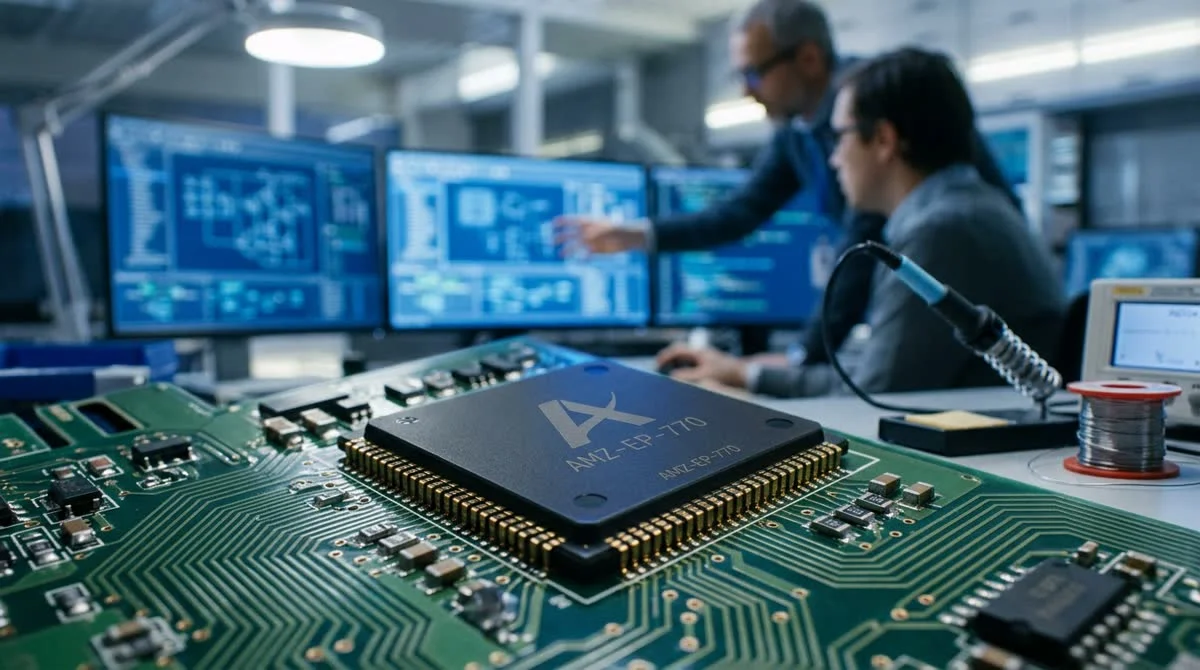
Amazon is developing its own AI-capable processors for TVs, tablets, and other gadgets. The company is convinced that custom chips are the only way to get the best performance out of the AI features it is building into its entire device lineup.
Why Amazon wants its own hardware
Amazon's push into silicon design started long before the current AI boom. Its AWS cloud business has long run on custom ARM chips: Graviton for server compute (the fourth generation launched in 2023), Inferentia for running trained neural networks cost-effectively, and Trainium for training large language models. Vertical integration has let AWS offer AI inference at a noticeably lower price than servers built on NVIDIA accelerators.
Applying the same logic to consumer devices looks like a straightforward move. The general-purpose MediaTek and Qualcomm processors that currently power Fire tablets and Fire TV aren't tuned for Amazon's specific workloads: on-device voice processing for Alexa, content personalization in Prime Video, and fast object recognition by cameras. A custom chip lets Amazon optimize for these scenarios right at the silicon level.
- AWS Graviton — ARM chips for cloud servers, 4th generation (2023)
- AWS Inferentia — specialized for AI inference, more cost-effective than GPUs
- AWS Trainium — for training neural networks
- Fire tablets and Fire TV — currently run on MediaTek and Qualcomm chips
- Echo devices — already use variants of a custom chip for voice processing
Why a failed smartphone didn't stop the program
Amazon is no stranger to risky hardware bets. The Fire Phone, unveiled in June 2014, shipped with Firefly — a feature that scanned objects for instant purchase on Amazon — and a 3D display driven by four front-facing cameras. The device failed to find buyers: within a few months, the company wrote off roughly $170 million in losses and discontinued the phone.
The flop didn't kill the hardware program, though. Alexa-powered Echo speakers became some of the most widespread smart devices on the market, Fire TV consistently ranks among the top 3 streaming media players in the US, and budget Fire tablets hold onto the niche of affordable family devices priced from $50–70. Expanding the custom chip lineup follows the same playbook: rather than fight for the flagship segment, give mass-market devices an AI edge.
What it means
Amazon is following a path already laid out by Apple (A- and M-series chips), Google (Tensor in Pixel), and Samsung (Exynos): vertical integration of "processor + OS + services" lets a company squeeze maximum performance out of specific use cases. If Amazon manages to carry its cloud expertise from Trainium and Inferentia down to the consumer level, Alexa and new AI features will get a fundamentally different level of performance — with the ability to handle some tasks locally, without constantly calling out to the cloud. For users, that means faster responses and less dependence on the quality of their internet connection.
FAQ
Which Amazon devices will get custom chips?
According to available information, the plans cover TVs, tablets, and other consumer gadgets. The company has not yet disclosed specific models or release timelines.
How does Amazon's approach differ from its competitors'?
Amazon is unique in combining cloud scale (AWS) with consumer devices: Graviton, Inferentia, and Trainium have already been proven on real-world AI workloads in data centers, which lets Amazon bring a tested architecture to gadgets without starting from scratch.
Which processors does Amazon use for AI?
Amazon has developed Graviton (for server compute), Inferentia (for running trained neural networks cost-effectively), and Trainium (for training neural networks).
Why does Amazon need its own AI chips?
Custom chips provide optimal support for the AI features Amazon is building into its entire device lineup.
- Oct 31, 2026Worldwide Express hands disputed invoices to AI agents and cuts unresolved disputes by 75%
- Oct 30, 2026AWS gives coding agents a live site preview straight from an isolated session
- Oct 30, 2026MoEngage Opens 400 Private APIs to AI Agents Through AgentCore Gateway, Without Building Its Own MCP Servers
- Oct 29, 2026NVIDIA Nemotron 3.5 Super VL: 120B Parameters, 12B Active, Running on AWS
Key Questions Answered
Which Amazon devices will get custom chips?
According to available information, the plans cover TVs, tablets, and other consumer gadgets. The company has not yet disclosed specific models or release timelines.
How does Amazon's approach differ from its competitors'?
Amazon is unique in combining cloud scale (AWS) with consumer devices: Graviton, Inferentia, and Trainium have already been proven on real-world AI workloads in data centers, which lets Amazon bring a tested architecture to gadgets without starting from scratch.
Which processors does Amazon use for AI?
Amazon has developed Graviton (for server compute), Inferentia (for running trained neural networks cost-effectively), and Trainium (for training neural networks).
Why does Amazon need its own AI chips?
Custom chips provide optimal support for the AI features Amazon is building into its entire device lineup.
Build & Ship Production AI Agents Without Boilerplate Code
Start your free 72-hour trial at Hamidun Academy (academy.hamidun.com) — interactive lessons on Claude Code & Cursor, live Tech Radar, and production agent templates.
The AI world, distilled — once a week
Seven stories that actually mattered, hand-picked. No noise, no reposts, no press releases.
Done! Check your inbox for a confirmation.