Why DeepMind's AGI Progress Doesn't Answer the Big Question About Machine Consciousness
A new column untangles a popular confusion between two concepts: intelligence and consciousness. The author notes that every known bearer of consciousness is a living, protein-based system, while digital models, even amid DeepMind's successes and the race for AGI, still only solve information-processing tasks. If machine consciousness is possible at all, the argument goes, the path to it runs through analog and neuromorphic architectures.
AI-processed from Habr AI; edited by Hamidun News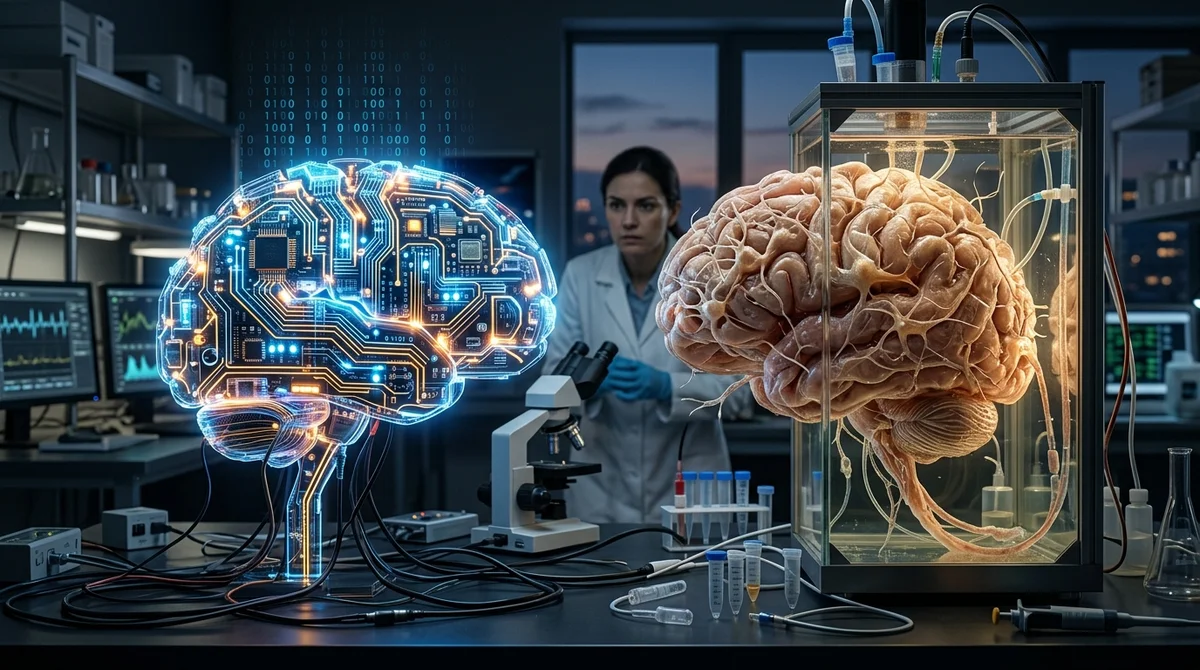
The new AGI debate is not about whether a machine will get smarter, but about whether it will have an inner experience. The article's author argues that digital systems can build up intelligence, but that does not bring them any closer to consciousness.
Protein and life
The author's starting point is deliberately down to earth: rather than speculate about hypothetical forms of mind, he proposes looking at what science already knows. All observed forms of life are tied to protein and cellular organization. Hence the return to the classical definition of life that Friedrich Engels formulated back in 1883. What matters is not only the protein basis itself but also constant metabolism, without which a system cannot sustain itself as alive.
Even the virus paradox, usually raised against this approach, works in favor of the argument here. A virion contains protein, but outside a cell it shows no signs of life and begins to behave as a living thing only inside the host's metabolic system.
From this the author draws a cautious but firm conclusion: protein is probably necessary, though not sufficient on its own. We can imagine life on another substrate, but for now that is imagination, not confirmed fact.
He ties this thesis to the recent AI agenda. When Demis Hassabis and John Jumper received the Nobel Prize in Chemistry on 9 October 2024 for AlphaFold2, it was more than an award for a powerful algorithm. In the author's logic, it is a reminder that AI's most visible breakthrough came not from building a conscious machine but from studying proteins, the material basis of the life we know.
Intelligence without experience
The next step is to separate intelligence from consciousness, which public conversations about AGI constantly blur. The author draws on David Chalmers's distinction between the "easy" problems and the "hard" problem of consciousness. The easy problems concern information processing: how a system recognizes patterns, responds to stimuli and plans actions. The hard problem is different: why subjective experience arises at all, the qualia without which there is no inner world. This is where, in the author's view, engineering ends and philosophy begins.
A simpler empirical fact also applies: all known bearers of consciousness are living beings. We have no confirmed example of a computer, a rock or any other non-living system having subjective experience. This is not a strict prohibition or a final proof, but it is a very stable correlation. So even if AGI learns to solve more tasks, computing power alone does not answer whether a system experiences pain, color or time.
The author especially disputes the techno-optimist reading of DeepMind's statements. When Demis Hassabis spoke in February 2026 about continual learning, long-term planning and consistency as properties of a future AGI, he was talking about intelligence, not consciousness. The author draws the same line through mathematics: a machine can prove, calculate and search through options, but so far it shows no intuition, the ability to "see" a beautiful idea before a formal proof. In this sense AI remains a very powerful problem solver, not a bearer of inner experience.
Why analog matters
If we nonetheless grant that consciousness could theoretically arise outside a biological brain, then architecture becomes the deciding question. The author considers digital computers too far from the brain in their basic operating principles. The brain uses continuous signals, ionic currents and a tight coupling of memory and computation. A classical digital machine is built differently. He therefore calls a direct comparison between the brain and an ordinary computer a crude oversimplification:
- discrete states 0 and 1 instead of continuous transitions
- rigid clock synchronization instead of asynchronous biological dynamics
- separation of memory and processor in the von Neumann style
- constant data shuffling instead of computing where the information is stored
This leads to the article's main engineering conclusion: if non-protein consciousness is possible at all, it would more likely require analog or neuromorphic systems than ordinary GPUs and TPUs. The author lists memristors, photonic chips and architectures such as SpiNNaker2 as candidates. What they share is an attempt to get closer to how the brain actually works. It is no accident that researchers of such systems increasingly speak of ionic, rather than purely electronic, computing logic.
"Ions are a better medium than electrons for embodying the principles
of the brain."
Against this background, a forecast of imminent AGI no longer looks like an automatic route to a conscious machine. Yes, digital models will get better at writing text, winning games and helping with science. But the author's thesis is different: intelligence can be scaled digitally, while consciousness, if it ever arises outside biology, will need a completely different substrate and a completely different physics of computation. Power alone, in his view, is not enough.
What this means
For the AI industry this is an important clarification: even a very strong AGI is not the same as a conscious being. The discussion is gradually shifting from "how many more GPUs do we need" to "which architecture can produce subjective experience at all," and the market has no convincing answer to that yet. That is why the AGI debate increasingly comes down not to software but to the material basis of computation.
- Nov 2, 2026Karpathy builds a YouTube clone with 6454 videos from Hacker News recommendations in two hours
- Nov 2, 2026Karpathy used Claude to build HackerTube from 6,454 videos recommended on Hacker News
- Nov 2, 2026Anthropic needs to grow revenue 32% a year to cover $850 billion in contracts
- Nov 2, 2026Bun creator uses Claude Code to port 750K lines from Zig to Rust in 11 days
Key Questions Answered
What are the key details on Protein and life?
The author's starting point is deliberately down to earth: rather than speculate about hypothetical forms of mind, he proposes looking at what science already knows. All observed forms of life are tied to protein and cellular organization. Hence the return to the classical definition of life that Friedrich Engels formulated back in 1883. What matters is not only the protein basis itself but also constant metabolism, without which a system cannot sustain itself as alive. Even the virus paradox, usually raised against this approach, works in favor of the argument here. A viri
What are the key details on Intelligence without experience?
The next step is to separate intelligence from consciousness, which public conversations about AGI constantly blur. The author draws on David Chalmers's distinction between the "easy" problems and the "hard" problem of consciousness. The easy problems concern information processing: how a system recognizes patterns, responds to stimuli and plans actions. The hard problem is different: why subjective experience arises at all, the qualia without which there is no inner world. This is where, in the author's view, engineering ends and philosophy begins. A simpler empirical fact
Why analog matters?
If we nonetheless grant that consciousness could theoretically arise outside a biological brain, then architecture becomes the deciding question. The author considers digital computers too far from the brain in their basic operating principles. The brain uses continuous signals, ionic currents and a tight coupling of memory and computation. A classical digital machine is built differently. He therefore calls a direct comparison between the brain and an ordinary computer a crude oversimplification: discrete states 0 and 1 instead of continuous transitions rigid clock synchro
Test Frontier LLMs & Autonomous Agents in One Workspace
Run Claude Opus 5.5, GPT-6, Gemini 3.1, and DeepSeek side-by-side in Nomad AI (nomadnet.ai) — unified model routing, deep research, and multimodal workflows under one subscription.
The AI world, distilled — once a week
Seven stories that actually mattered, hand-picked. No noise, no reposts, no press releases.
Done! Check your inbox for a confirmation.