Superintelligence Forecasts and the Saving Grace of the "Human Factor" in the AI Era
The latest Import AI roundup examines timelines for the technological singularity and new methods for evaluating machine learning. A notable highlight is AI's progress in proving advanced mathematical theorems, which widens the range of uses for these models. Meanwhile, The Economist tries to calm labor-market fears: automation will not lead to mass unemployment as long as demand for a "human touch" persists. Consumers value personal contact over algorithmic precision, which creates a natural barrier to replacing people entirely with robots in services and creative professions.
AI-processed from Import AI; edited by Hamidun News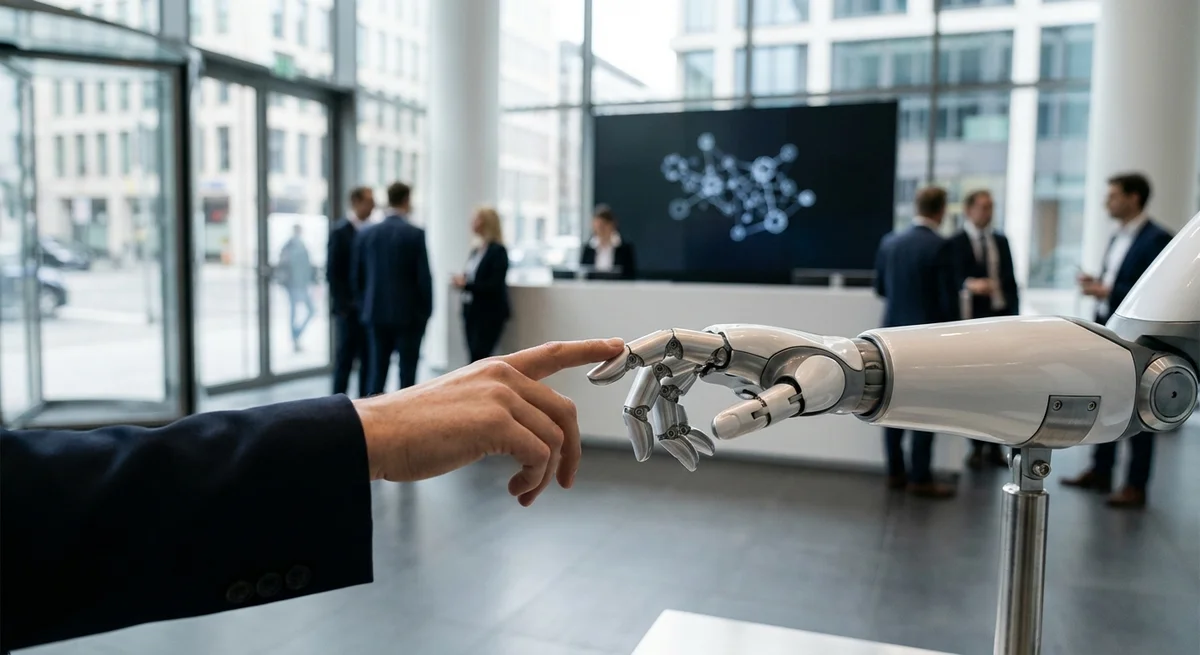
Superintelligence Forecasts and the Saving Grace of the "Human Factor" in the AI Era
In the fast-moving world of artificial intelligence (AI), two opposing but equally important trends are occupying researchers and the public. On one side, forecasts are growing bolder about reaching the technological singularity, a hypothetical moment when AI surpasses human intelligence, which could lead to unpredictable consequences. On the other, economic and social analysts offer a more reassuring outlook, stressing the lasting value of the "human factor" as automation expands.
The latest Import AI issue, devoted to the newest advances in AI, covers both the question of when the so-called technological singularity might arrive and new, more precise methods for measuring progress in machine learning. One of the most impressive successes it notes is AI's progress in proving advanced mathematical theorems. This is not merely an academic curiosity: such results show that AI models can not only process huge volumes of data but also carry out complex logical reasoning, extending the potential applications of these models far beyond today's tasks.
Meanwhile, The Economist, a respected publication, is trying to ease fears of mass AI-driven unemployment. According to its analysis, even as automation grows more sophisticated, it will not necessarily lead to the complete displacement of human labor. The key restraining factor is the persistently high demand for a "human approach." Consumers still value personal contact, empathy and intuition, which algorithms cannot yet fully reproduce, even when algorithms offer flawless accuracy. This "human factor" becomes a natural barrier to replacing people entirely with robots, especially in customer service, creative professions and fields where interpersonal interaction plays a decisive role.
We are thus looking at a paradoxical situation. On one hand, AI is rapidly approaching levels of intellectual power that once seemed like science fiction, calling into question the very notion of human uniqueness. On the other, it is precisely these human qualities (the capacity for compassion, creativity, ethical judgment) that become more valuable as machines can perform routine and even complex tasks with high efficiency. This opens a new field for human-machine interaction, in which AI can become a powerful tool that complements human abilities rather than replacing them.
In conclusion, a future in which AI reaches superintelligence remains a subject of speculation and active research. Yet even in that hypothetical scenario, and all the more so in the present, the value of human contribution, a unique perspective and the capacity for genuine connection will likely continue to play a defining role. Understanding and cultivating these human qualities, and finding synergy between humans and machines, appear to be key tasks in building a sustainable and prosperous future in the age of artificial intelligence.
- Oct 28, 2026Anthropic reveals how it builds Claude with Claude: the brain separate from the hands
- Oct 28, 2026Bayer Launches Multi-Agent Engine on AgentCore: 80% of Questions Handled Without Engineers
- Oct 28, 2026Liquid AI releases LFM2.5-24B-A2B: an agent model with 2B active parameters
- Oct 28, 2026AgentOrch: Pre-Planned AI Agents Now Trail Step-by-Step Execution by Just 8.5 Points
Test Frontier LLMs & Autonomous Agents in One Workspace
Run Claude Opus 5.5, GPT-6, Gemini 3.1, and DeepSeek side-by-side in Nomad AI (nomadnet.ai) — unified model routing, deep research, and multimodal workflows under one subscription.
The AI world, distilled — once a week
Seven stories that actually mattered, hand-picked. No noise, no reposts, no press releases.
Done! Check your inbox for a confirmation.