Nvidia turns OpenClaw into an enterprise platform with sandboxing and local AI models
Nvidia has launched NemoClaw, an enterprise layer for OpenClaw, one of the fastest-growing open-source AI agents of 2026. A one-command install adds sandbox isolation, access policies, privacy guardrails and local execution of Nemotron models. The idea is simple: leave the agent useful access to files and the network, but keep it out of places where the risk is too high for a business.
AI-processed from TNW; edited by Hamidun News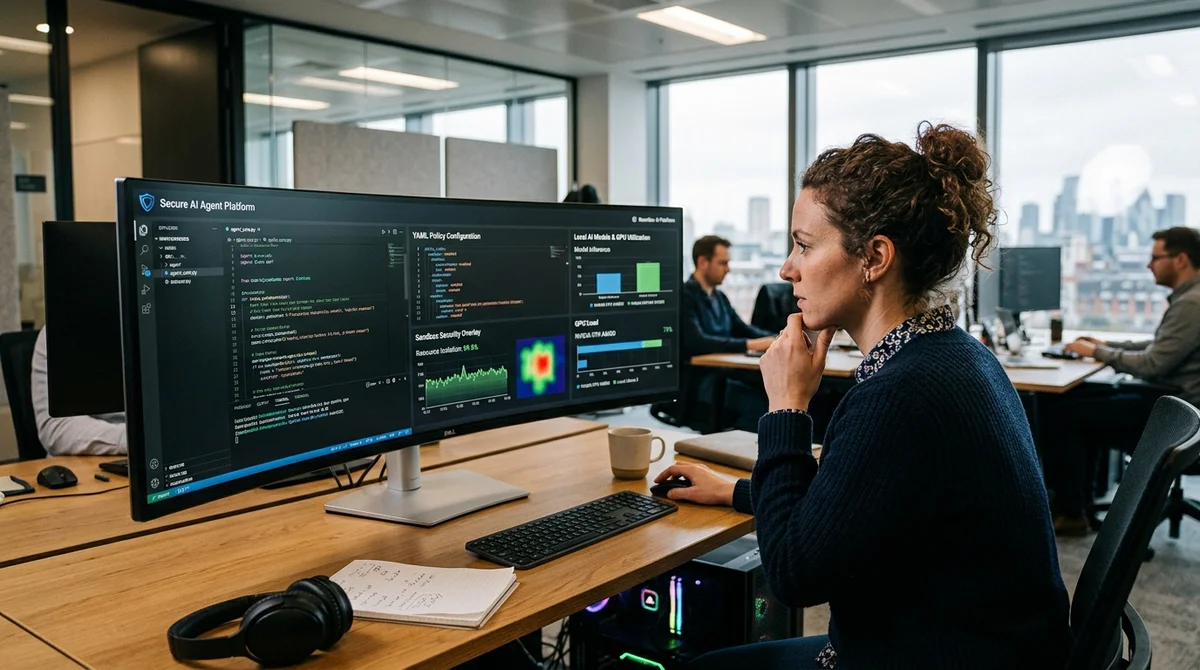
Nvidia has unveiled NemoClaw, a stack for OpenClaw that moves the popular open-source AI agent from experiment to a more enterprise-ready format. A one-command install adds sandbox security, privacy guardrails and local models, so the agent can work with real data without full access to the entire system.
From hobby project to platform
OpenClaw launched on January 25, 2026. According to Austrian developer Peter Steinberger, he built the first version in about an hour. The project then took off almost instantly: within weeks, its repository became one of the fastest-growing in GitHub history.
Users were drawn by a simple idea: a local AI agent that can sort through files, write code and browse the web without sending the entire data stream to the cloud.
That is exactly where the problem for the enterprise market lay. What developers and power users like rarely satisfies security teams: an agent needs broad access to be useful, but the same access makes it dangerous in a production environment.
At the GTC conference in San Jose, Nvidia showed its answer to this conflict. NemoClaw installs on top of OpenClaw with a single command and adds the infrastructure layer of privacy and security without which large companies usually don't even start a pilot.
What's inside NemoClaw
The core component of the stack is OpenShell, a new open-source runtime that isolates agents at the process level. It introduces policy-based control over file access, network connections and data handling. Policies are written in YAML, so a team can, for example, allow an agent to reach only one cloud AI service and block everything else.
OpenShell is part of the Nvidia Agent Toolkit, a set of models, runtimes and templates for building long-running autonomous agents.
Alongside OpenShell, Nvidia adds several practical features to NemoClaw for enterprise scenarios:
- local execution of Nemotron models on available Nvidia hardware, from GeForce RTX to DGX
- a privacy router for calling external frontier models without removing guardrails
- compatibility not only with Nvidia's own models but also with providers such as OpenAI and Anthropic
- a single way to stand up an environment quickly, without manually assembling the sandbox, models and network restrictions
According to Nvidia, this combination lets an agent learn new skills and perform useful tasks without stepping outside predefined boundaries. For companies, that matters more than "yet another agent": they need not only intelligence but also predictable behavior in their infrastructure, clear network rules, and the ability to decide which tasks stay local and which can be safely sent to an external API.
Where the main risk lies
Early versions of OpenClaw already had well-documented vulnerabilities, especially around prompt injection and overly permissive file access. Some of the problems have been fixed, but the fundamental tension has not gone away: an autonomous agent must have access to be useful, while a business cannot let it roam the system unchecked.
Nvidia is trying to close this gap not at the application level but at the infrastructure level, where it is easier to enforce policies independently of any specific agent.
"OpenClaw is the operating system for personal AI,"
Jensen Huang said on stage.
That ambition sounds sweeping, but Nvidia itself is not yet selling NemoClaw as a fully mature solution. The product is in early access and is explicitly labeled alpha, so rough edges are to be expected. In parallel, the company is working on OpenShell compatibility with tools from Cisco, CrowdStrike, Google and Microsoft Security. Analysts at Futurum Research, meanwhile, caution that a sandbox layer alone is not enough if governance, security and accountability are not built into the entire lifecycle of developing and operating agents.
What this means
Nvidia is expanding its role in the AI market: the company used to be nearly essential hardware for training and inference, and now it wants to become the base software layer for agentic systems as well. If NemoClaw genuinely makes secure local deployment and access control easier, OpenClaw has a chance to move out of the dev environment and into enterprise pilots.
But the market will look past the demo to stability, integration with the security stack and real manageability in production.
- Nov 1, 2026Local models lose to Opus and Codex: 0.21 on a MacBook versus 1.00 for Codex
- Nov 1, 2026Habr author fine-tunes YOLOv8l on dental X-rays and pushes mAP50 to 0.642
- Nov 1, 2026Voice bots built on LLMs turn to Jev, a fast classifier, for decisions in 200–500 ms
- Nov 1, 2026MoneyGate safety layer blocked all 42 fraudulent requests to local AI models
Key Questions Answered
What are the key details on From hobby project to platform?
OpenClaw launched on January 25, 2026. According to Austrian developer Peter Steinberger, he built the first version in about an hour. The project then took off almost instantly: within weeks, its repository became one of the fastest-growing in GitHub history. Users were drawn by a simple idea: a local AI agent that can sort through files, write code and browse the web without sending the entire data stream to the cloud. That is exactly where the problem for the enterprise market lay. What developers and power users like rarely satisfies security teams: an agent needs broad
What's inside NemoClaw?
The core component of the stack is OpenShell, a new open-source runtime that isolates agents at the process level. It introduces policy-based control over file access, network connections and data handling. Policies are written in YAML, so a team can, for example, allow an agent to reach only one cloud AI service and block everything else. OpenShell is part of the Nvidia Agent Toolkit, a set of models, runtimes and templates for building long-running autonomous agents. Alongside OpenShell, Nvidia adds several practical features to NemoClaw for enterprise scenarios: local ex
Where the main risk lies?
Early versions of OpenClaw already had well-documented vulnerabilities, especially around prompt injection and overly permissive file access. Some of the problems have been fixed, but the fundamental tension has not gone away: an autonomous agent must have access to be useful, while a business cannot let it roam the system unchecked. Nvidia is trying to close this gap not at the application level but at the infrastructure level, where it is easier to enforce policies independently of any specific agent. "OpenClaw is the operating system for personal AI," Jensen Huang said o
Build & Ship Production AI Agents Without Boilerplate Code
Start your free 72-hour trial at Hamidun Academy (academy.hamidun.com) — interactive lessons on Claude Code & Cursor, live Tech Radar, and production agent templates.
The AI world, distilled — once a week
Seven stories that actually mattered, hand-picked. No noise, no reposts, no press releases.
Done! Check your inbox for a confirmation.