Samsung to spend $73 billion on chip capacity and R&D in 2026
Samsung plans to spend more than 110 trillion won, or $73.3 billion, on capital expenditure and research in 2026. The main focus is expanding memory production capacity and finding new AI-related growth areas. It is one of the strongest signals yet that the race to build infrastructure for artificial intelligence is only picking up speed.
AI-processed from Bloomberg Tech; edited by Hamidun News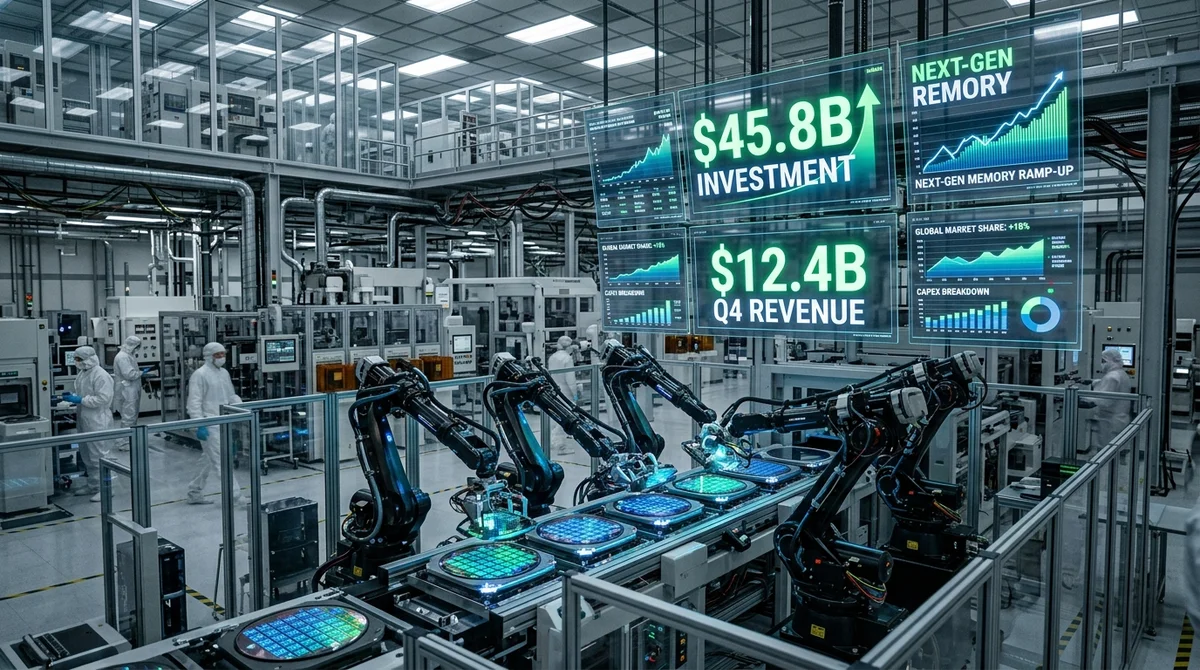
Samsung Electronics plans to invest more than 110 trillion won, or about $73.3 billion, in capital expenditure and research in 2026. The company is betting on two fronts at once: expanding memory output and seeking new opportunities in AI-related fields.
Where the money will go
The planned budget looks like one of Samsung's largest investment packages in recent years. It covers not only building and upgrading production capacity but also research spending meant to support the next growth cycle.
At the center of the plan is more capacity in memory chips, where demand is especially sensitive to the growth of data centers, AI services and more powerful computing infrastructure. The decision ties together current demand and preparation for the next technology cycle.
For the market, it signals that Samsung is not counting on a short-lived burst of interest in AI, but preparing for a long period of elevated demand for semiconductors. When a company of this size commits tens of billions of dollars in advance to plants, equipment and R&D, it is effectively confirming that AI infrastructure is no longer a side business but one of the main centers of capital in the tech industry and in the strategies of the world's largest tech companies.
- Samsung is earmarking more than 110 trillion won for capital expenditure and research in 2026
- The key production priority is expanding memory capacity
- A separate focus is research and new AI-related areas
- The investment is designed for a long demand cycle, not a one-off launch
Why memory matters
AI is usually discussed in terms of models, chatbots and apps, but the foundation of this market is hardware. The more models are trained and used, the heavier the load on servers, accelerators and memory subsystems. That is why expanding memory chip production is a strategic move: without enough memory capacity and speed, computing cannot be scaled the way the modern AI business requires. The entire upper layer of AI services is built on this base.
For Samsung, it is also a question of position in the global supply chain. Memory is one of the segments where the company has traditionally played a key role, which means it can convert the broader AI boom into direct revenue growth and technological influence. Even if specific AI products change quickly, the need for chips that can handle new workloads remains basic and long-term. So the investment in capacity looks less like a bet on a fashionable trend and more like an attempt to secure a fundamental place in the next stage of the market.
A bet on research
It matters that Samsung talks not only about expanding production but also about research. This points to a broader strategy: the company wants not just to make more components but also to look for new technology growth points where semiconductors, computing infrastructure and AI intersect. In this logic, R&D is not an appendix to manufacturing but a second, equal track meant to deliver future products and advantages.
This approach lowers the risk of ending up as a simple volume supplier. If the AI market shifts toward new architectures, more energy-efficient solutions or specialized systems, the winners will be those who can quickly adapt both production and their own designs. Samsung is clearly signaling that it wants to stay flexible: ramp up output where demand is already visible, and in parallel invest in areas that could become key in a few years.
What this means
Samsung's plan shows that the AI era is increasingly defined not only by software but also by industrial investment. For the market, it is another confirmation that the fight for AI leadership is waged not only in models but also in fabs, memory, equipment and research labs.
For businesses and investors, the takeaway is simple: AI should now be judged not only by the quality of its models but also by who controls scarce components and production capacity.
Key Questions Answered
Where the money will go?
The planned budget looks like one of Samsung's largest investment packages in recent years. It covers not only building and upgrading production capacity but also research spending meant to support the next growth cycle. At the center of the plan is more capacity in memory chips, where demand is especially sensitive to the growth of data centers, AI services and more powerful computing infrastructure. The decision ties together current demand and preparation for the next technology cycle. For the market, it signals that Samsung is not counting on a short-lived burst of inte
Why memory matters?
AI is usually discussed in terms of models, chatbots and apps, but the foundation of this market is hardware. The more models are trained and used, the heavier the load on servers, accelerators and memory subsystems. That is why expanding memory chip production is a strategic move: without enough memory capacity and speed, computing cannot be scaled the way the modern AI business requires. The entire upper layer of AI services is built on this base. For Samsung, it is also a question of position in the global supply chain. Memory is one of the segments where the company has
What are the key details on A bet on research?
It matters that Samsung talks not only about expanding production but also about research. This points to a broader strategy: the company wants not just to make more components but also to look for new technology growth points where semiconductors, computing infrastructure and AI intersect. In this logic, R&D is not an appendix to manufacturing but a second, equal track meant to deliver future products and advantages. This approach lowers the risk of ending up as a simple volume supplier. If the AI market shifts toward new architectures, more energy-efficient solutions or s
Test Frontier LLMs & Autonomous Agents in One Workspace
Run Claude Opus 5.5, GPT-6, Gemini 3.1, and DeepSeek side-by-side in Nomad AI (nomadnet.ai) — unified model routing, deep research, and multimodal workflows under one subscription.
The AI world, distilled — once a week
Seven stories that actually mattered, hand-picked. No noise, no reposts, no press releases.
Done! Check your inbox for a confirmation.