Guardian columnist Mike Pepi proposes a 1% tax on AI slop to protect creative work
Guardian columnist Mike Pepi proposes a simple policy move: a tax of about 1% on the largest AI companies that produce and distribute generative content. The idea is to return part of the money to journalists, musicians, publishers, local media and researchers, whose work became raw material for the models and whose audiences are now being diluted by a flood of cheap AI slop. Pepi presents it not as an attack on machine learning research, but as an attempt to put money back into culture, education and media.
AI-processed from Guardian; edited by Hamidun News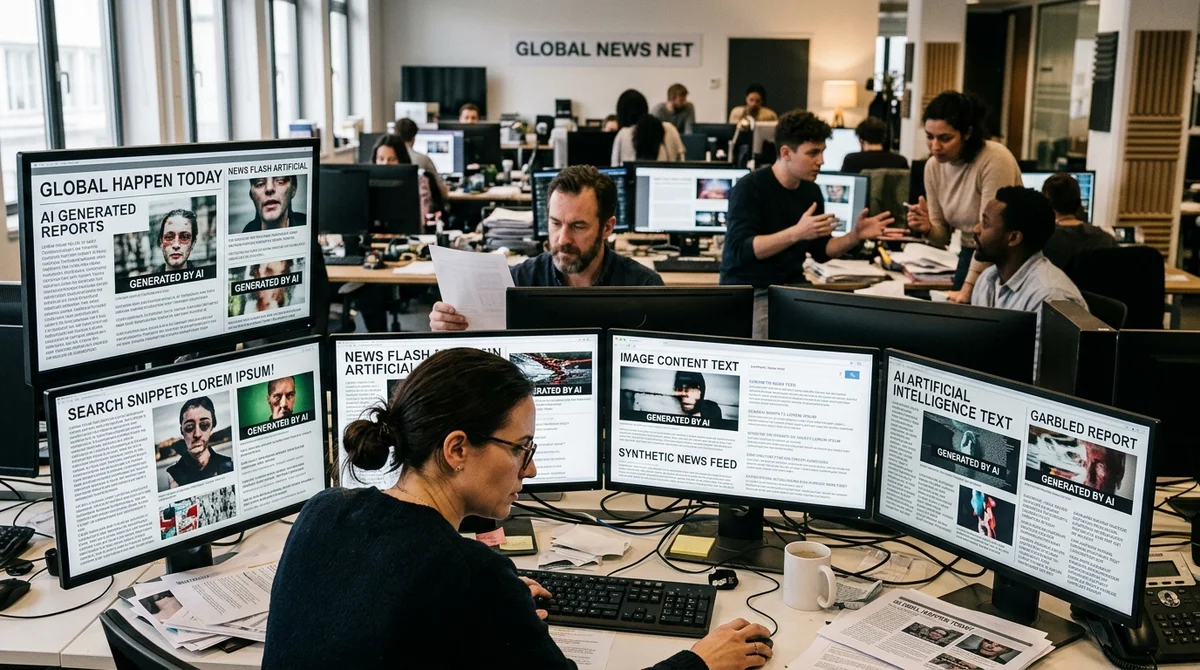
The Guardian has published a column with a radically simple proposal: impose a small tax on the largest AI companies for the flood of low-quality generative content the author calls AI slop. In Mike Pepi's view, this is not an attack on machine learning research but an attempt to put money back into the culture, education and media sectors that are already losing attention and revenue to machine-made fakes.
Why anxiety is growing
The debate did not come out of nowhere. Ahead of the US midterm elections, AI has become a political issue: according to an NBC News poll, 57% of registered voters believe the risks of AI outweigh its benefits. Pew Research separately recorded anxiety among young people: 61% of American adults under 30 think the further spread of AI will worsen people's capacity for creative thinking. A Quinnipiac poll is even harsher: 74% of respondents say the government is not regulating the industry enough.
The author links this reaction not only to fears about the technology, but also to how the industry sells its products. The main message of big AI companies, in his telling, is: adopt generative tools right now, or be left behind. Against that backdrop, promises of enormous productivity gains still look questionable. Pepi cites studies suggesting that AI's real effect on productivity is noticeably more modest than advertised, while the market has gained a new layer of bureaucracy: so-called workslop, where a model quickly produces text, presentations and reports that a human then has to fix anyway.
"AI slop is a bet that society will accept a worse fake in place of
human creativity."
How the tax works
In the column, AI slop means digital junk: cheap, mass-produced and often unreliable content created by generative systems. The author gives familiar examples: fake bands on streaming services, absurd hallucinated recipes, books on marketplaces assembled from prompts, and search results where AI answers push aside normal links and are often wrong. The problem, he argues, is not the existence of the tool as such but the economics of scale: machine copies fill distribution channels faster and more cheaply than human authors can produce work.
The proposal is simple. If a company creates, distributes or monetizes generative content, it pays an annual levy of roughly 1%. For Big Tech, which promises "abundance" thanks to AI, this is a small price, Pepi says. He also points out that the five largest public players, Nvidia, Google, Apple, Microsoft and Meta*, are together worth about $18 trillion. Even such a modest percentage, by his logic, would yield a substantial resource for culture and science.
He proposes sending the money to a public fund and then distributing it to those whose institutions and professions have come under pressure:
- local newspapers, radio and independent newsrooms
- artists, musicians, writers and designers
- educational programs and public cultural venues
- researchers working on new forms of creativity and technology
The text stresses that this is not about a blanket ban on AI or a pause in research. The author also argues with more abstract ideas such as universal basic income: even if automation hits some professions, simply handing money to consumers is not enough if cultural institutions keep losing audience, revenue and purpose. The logic of the tax is different: not to subsidize demand in general, but to compensate specific damage to the sectors from which generative models have already extracted value, both as training data and as user attention.
What it means
This is not a bill and not a consensus program, but a policy idea that tries to move the conversation about AI from fantasies about superintelligence to more down-to-earth ground. If generative models really are building businesses on large-scale replacement of human cognitive labor, the question is no longer only about product convenience but about the redistribution of value. For media, education and the creative industries, the approach matters because it offers, for the first time, a way to do more than complain about AI slop: it presents a concrete bill.
*Meta is designated an extremist organization and banned in Russia.
- Nov 1, 202616 models tested on 7 search tools: Exa averaged 10.5 out of 14, SearXNG about 3
- Nov 1, 2026Google's StreamVibe video agent beats other models by 10.7% on response timing and quality
- Nov 1, 2026OpenAI Rewrites GPT Behavior Rules: Five Values and a Chain of Command
- Nov 1, 2026Voice bots built on LLMs turn to Jev, a fast classifier, for decisions in 200–500 ms
Key Questions Answered
Why anxiety is growing?
The debate did not come out of nowhere. Ahead of the US midterm elections, AI has become a political issue: according to an NBC News poll, 57% of registered voters believe the risks of AI outweigh its benefits. Pew Research separately recorded anxiety among young people: 61% of American adults under 30 think the further spread of AI will worsen people's capacity for creative thinking. A Quinnipiac poll is even harsher: 74% of respondents say the government is not regulating the industry enough. The author links this reaction not only to fears about the technology, but also
How the tax works?
In the column, AI slop means digital junk: cheap, mass-produced and often unreliable content created by generative systems. The author gives familiar examples: fake bands on streaming services, absurd hallucinated recipes, books on marketplaces assembled from prompts, and search results where AI answers push aside normal links and are often wrong. The problem, he argues, is not the existence of the tool as such but the economics of scale: machine copies fill distribution channels faster and more cheaply than human authors can produce work. The proposal is simple. If a compa
What it means?
This is not a bill and not a consensus program, but a policy idea that tries to move the conversation about AI from fantasies about superintelligence to more down-to-earth ground. If generative models really are building businesses on large-scale replacement of human cognitive labor, the question is no longer only about product convenience but about the redistribution of value. For media, education and the creative industries, the approach matters because it offers, for the first time, a way to do more than complain about AI slop: it presents a concrete bill. Meta is design
Test Frontier LLMs & Autonomous Agents in One Workspace
Run Claude Opus 5.5, GPT-6, Gemini 3.1, and DeepSeek side-by-side in Nomad AI (nomadnet.ai) — unified model routing, deep research, and multimodal workflows under one subscription.
The AI world, distilled — once a week
Seven stories that actually mattered, hand-picked. No noise, no reposts, no press releases.
Done! Check your inbox for a confirmation.