1X opened a factory in California and wants to produce 10,000 home robots in a year
1X has opened a new 58,000-square-foot factory in California and wants to assemble 10,000 home robots in its first year. For the humanoid market, that is an important signal: the conversation is shifting from flashy demos to actual manufacturing, supply chains, and attempts to bring such robots into ordinary homes, not just warehouses and factories.
AI-processed from Bloomberg Tech; edited by Hamidun News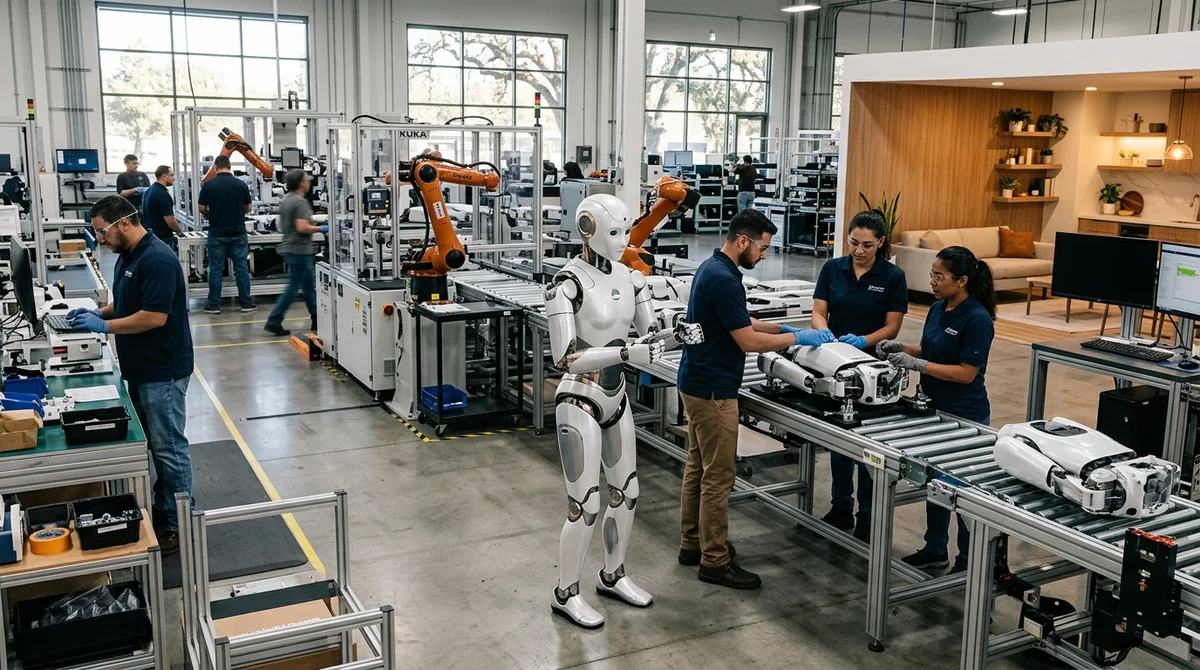
Norwegian startup 1X, backed by OpenAI, has opened a new factory in Hayward, California. The company is setting an ambitious goal: to produce 10,000 humanoid domestic robots in the first year and become one of the first players to bring this class of devices to the mass consumer market.
New Factory in the USA
The new 1X facility spans 58,000 square feet — about 5,400 square meters. For a young robotics company, this is no longer a laboratory or pilot shop, but a full-fledged production facility designed for serial assembly. The factory is located in Hayward, in the San Francisco Bay Area, where engineers, suppliers, and teams working at the intersection of hardware and artificial intelligence are concentrated.
The launch of such a facility in itself shows that 1X is betting not on rare demonstrations, but on releasing products in significant volumes. It is also important which market the company is targeting. Most discussions around humanoids typically involve industry, logistics, or warehouse scenarios, where the environment is more predictable.
1X, by contrast, is talking about home robots. This is a more complex goal: a home environment is chaotic, with many small objects, narrow passages, and unpredictable human actions. Therefore, opening a factory in the USA is not just an expansion of presence, but a signal that the company wants to accelerate the path from prototypes to real deliveries.
Betting on Scale
The plan to assemble 10,000 robots in the first year sounds like one of the most ambitious production targets in the humanoid segment. At this stage, it is no longer just about mechanics, grippers, or stable gait, but about the entire operating system of the business: component procurement, quality control, safety testing, service, and cost per unit. When a startup announces such figures, it essentially shifts the conversation from the level of "look what the robot can do" to "can this be mass-produced and at a predictable cost?"
To execute such a plan, the company will have to establish several processes in parallel, and failure of any one of them will quickly impact timelines and cost per unit. Mass production of a consumer robot always requires synchronization of hardware, software, logistics, and support at every stage. On paper, 10,000 units looks like a nice benchmark, but in reality it represents a long chain of technical and operational solutions.
- a stable supply chain for actuators, sensors, batteries, and electronics;
- a production line where robots can be assembled quickly and with minimal defects;
- a testing system that confirms device safety for a home environment;
- a service model, without which a mass-market consumer robot quickly becomes an expensive experiment.
This is where the hardest part usually begins for hardware startups. A pretty prototype can be shown on stage or in a video, but mass production requires a completely different discipline. You need a device that works the same way not in one demonstration house, but in thousands of different users' homes. For a home robot, this is a particularly harsh test, because people's expectations are higher: such a product must be not just technologically advanced, but reliable, safe, and useful enough for everyday tasks.
Why This Matters
The fact that 1X is backed by OpenAI amplifies attention to the project. For the market, it means the bet is not only on the body, actuators, and mechanics, but also on the software layer: spatial perception, command understanding, adaptation to a changing environment, and more natural human interaction. In the segment of home humanoids, it is precisely the combination of a physical robot and a strong AI model that could become the key differentiator between an impressive demonstration and a product people actually use.
If 1X can even come close to its stated volume, it will change the tone of the entire discussion around consumer robotics. Investors, competitors, and potential buyers will start looking not only at demonstration videos, but also at production rates, failure rates, maintenance costs, and what household tasks the robot actually solves. In other words, the humanoid market is gradually moving out of the stage of promises and entering a phase where production, economics, and operation become key.
What This Means
The launch of the factory and the plan for 10,000 devices show that the humanoid race is shifting from concepts to production. If 1X executes even a significant part of this plan, home robots will become not a distant glimpse of the future, but a much more tangible consumer product.
Need AI working inside your business — not just in your newsfeed?
I build production AI for companies — custom CRM, internal tools, autonomous agents, workflow automation. Owned by you, shaped to your process, no per-seat tax. Built by Zhemal Khamidun, CPO of AlpinaGPT (AI platform, 6,000+ users).
The AI world, distilled — once a week
Seven stories that actually mattered, hand-picked. No noise, no reposts, no press releases.
Done! Check your inbox for a confirmation.