Nvidia explains how DLSS 5 works: a 2D frame and motion vectors are enough
Nvidia has shared more detail on how DLSS 5 works. According to Jacob Freeman, the system does not receive a full 3D scene, only a 2D frame the game has already rendered, plus motion vectors. This explains why upscaling quality depends not only on the model, but also on how carefully the game passes along data about object motion. Put simply, DLSS does not draw a picture out of thin air. It reconstructs one from a limited but structured set of inputs.
AI-processed from 3DNews AI; edited by Hamidun News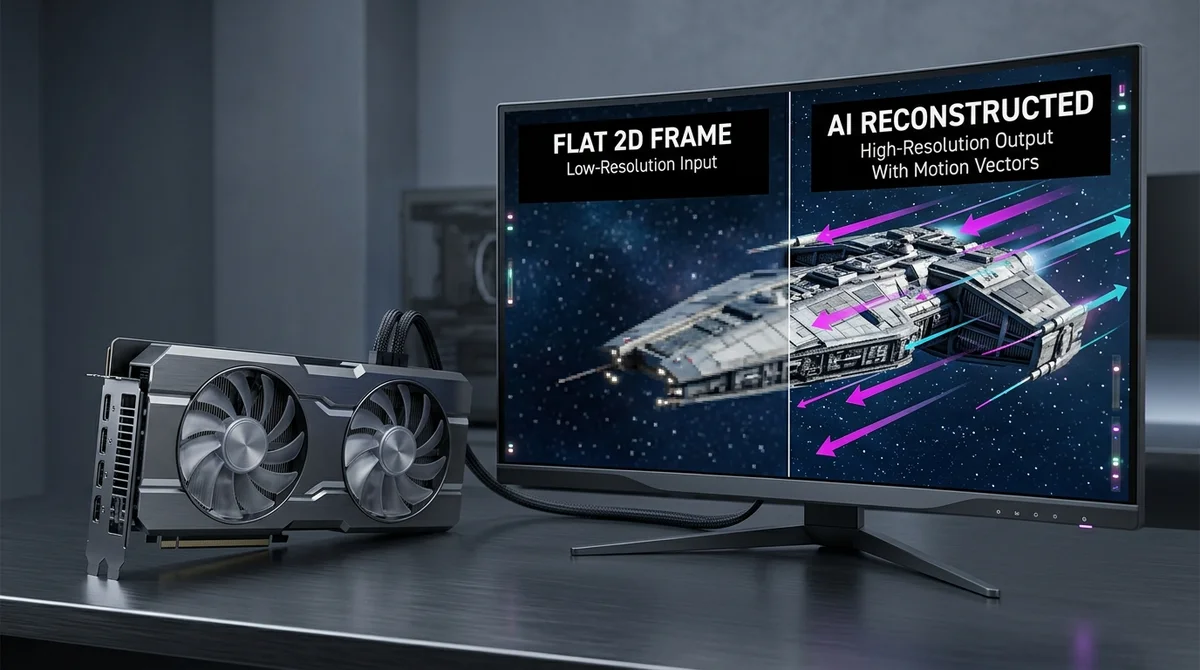
Nvidia has lifted the lid a little on the black box around DLSS 5. According to Jacob Freeman, the system does not receive a full 3D scene. Its input is an ordinary 2D frame already rendered by the game, plus object motion vectors.
What DLSS receives
This clarification matters for every debate about how exactly AI upscaling "draws" the missing pixels. Many people picture DLSS as a model that sees the game's entire world almost as well as the engine does. In practice, the setup is far more compact. The game first renders a frame at a lower resolution, then passes it to DLSS along with a motion map showing how objects and individual regions of the image shift from frame to frame. The neural network rebuilds a more detailed picture from that base.
This approach explains how the technology can noticeably improve sharpness without recomputing the scene at native resolution. The model does not need to rebuild the world's geometry from scratch or get all of the engine's internal data. It works as a reconstruction system: it looks for patterns, matches the current frame against the motion of elements, and predicts what the final result should look like at a higher resolution. That is why DLSS stays closely tied not only to the neural network itself, but also to how carefully the game prepares its source data.
"DLSS 5 takes a 2D frame and motion vectors as input."
Why motion vectors matter
Motion vectors are the key part of this scheme. They tell the system where objects are moving between adjacent frames, and how fast. Without them, the AI would have to guess almost blindly where a character's hand should end up, where a shadow has moved, or how to continue a thin line on a fast-moving object. The more accurate this data, the more stable the image looks in motion, whether the player is turning the camera, driving at high speed or in a firefight with plenty of effects on screen.
In practice, this brings several noticeable benefits:
- higher sharpness of fine detail without a full native-resolution render
- less flicker on thin lines, wires, grass and distant objects
- a more stable image in motion, not only in a static screenshot
- a performance gain, because the game does not have to compute every pixel at maximum quality
The reverse also follows: if a game builds poor motion vectors, the final result suffers too. So DLSS quality is determined not by a single "magic" Nvidia model, but by the combination of the algorithm, the engine and the specific implementation in each game.
Where the method reaches its limits
Nvidia's explanation is also useful because it sets boundaries for expectations. DLSS 5 does not "know" a scene the way the game engine does. It does not receive a ready-made three-dimensional model of the world in full, so in any complex situation it relies on incomplete, if very useful, information.
Hence the typical artifacts familiar to users of reconstruction technologies: smearing of small elements, ghosting trails on high-contrast edges, or instability in frames with very complex motion, transparency and many small effects.
At the same time, it is important not to confuse reconstruction with random painting-in. The point of DLSS is precisely that the system relies on real data from the game rather than simply "hallucinating" over the picture. But Freeman's explanation shows that even the strongest AI here remains dependent on the quality of the source frame and the auxiliary telemetry. In other words, DLSS 5 is not a "make it pretty out of nothing" button, but an advanced trade-off between performance and visual quality.
What this means
For players and developers, this is a useful signal: the main strength of DLSS 5 lies not in access to some hidden 3D magic, but in its ability to restore an image as efficiently as possible from a limited set of data. The better a game prepares the frame and motion vectors, the more convincing the result will be. That means the race for AI graphics quality depends more and more not only on Nvidia's model, but also on how disciplined the studios are when integrating the technology.
- Nov 2, 2026Anthropic needs to grow revenue 32% a year to cover $850 billion in contracts
- Nov 2, 2026TensorFold 1.2.0 boosts Qwen3.8-27B throughput on M3 Ultra by 44.2% at 16 streams
- Nov 1, 2026Local models lose to Opus and Codex: 0.21 on a MacBook versus 1.00 for Codex
- Nov 1, 2026Habr author fine-tunes YOLOv8l on dental X-rays and pushes mAP50 to 0.642
Key Questions Answered
What DLSS receives?
This clarification matters for every debate about how exactly AI upscaling "draws" the missing pixels. Many people picture DLSS as a model that sees the game's entire world almost as well as the engine does. In practice, the setup is far more compact. The game first renders a frame at a lower resolution, then passes it to DLSS along with a motion map showing how objects and individual regions of the image shift from frame to frame. The neural network rebuilds a more detailed picture from that base. This approach explains how the technology can noticeably improve sharpness w
Why motion vectors matter?
Motion vectors are the key part of this scheme. They tell the system where objects are moving between adjacent frames, and how fast. Without them, the AI would have to guess almost blindly where a character's hand should end up, where a shadow has moved, or how to continue a thin line on a fast-moving object. The more accurate this data, the more stable the image looks in motion, whether the player is turning the camera, driving at high speed or in a firefight with plenty of effects on screen. In practice, this brings several noticeable benefits: higher sharpness of fine de
Where the method reaches its limits?
Nvidia's explanation is also useful because it sets boundaries for expectations. DLSS 5 does not "know" a scene the way the game engine does. It does not receive a ready-made three-dimensional model of the world in full, so in any complex situation it relies on incomplete, if very useful, information. Hence the typical artifacts familiar to users of reconstruction technologies: smearing of small elements, ghosting trails on high-contrast edges, or instability in frames with very complex motion, transparency and many small effects. At the same time, it is important not to co
Test Frontier LLMs & Autonomous Agents in One Workspace
Run Claude Opus 5.5, GPT-6, Gemini 3.1, and DeepSeek side-by-side in Nomad AI (nomadnet.ai) — unified model routing, deep research, and multimodal workflows under one subscription.
The AI world, distilled — once a week
Seven stories that actually mattered, hand-picked. No noise, no reposts, no press releases.
Done! Check your inbox for a confirmation.