Nvidia unveils DLSS 5 with generative AI, and splits the gaming community
At its GTC conference, Nvidia unveiled DLSS 5, a new upscaling technology built on generative AI. CEO Jensen Huang called it the "GPT moment for graphics." Unlike earlier versions, DLSS 5 does not simply sharpen an image; it generates new pixels with a neural network. The first demos have already divided the community. Some are impressed by the realism, while others argue that AI has no business altering a game's authorial style.
AI-processed from The Verge; edited by Hamidun News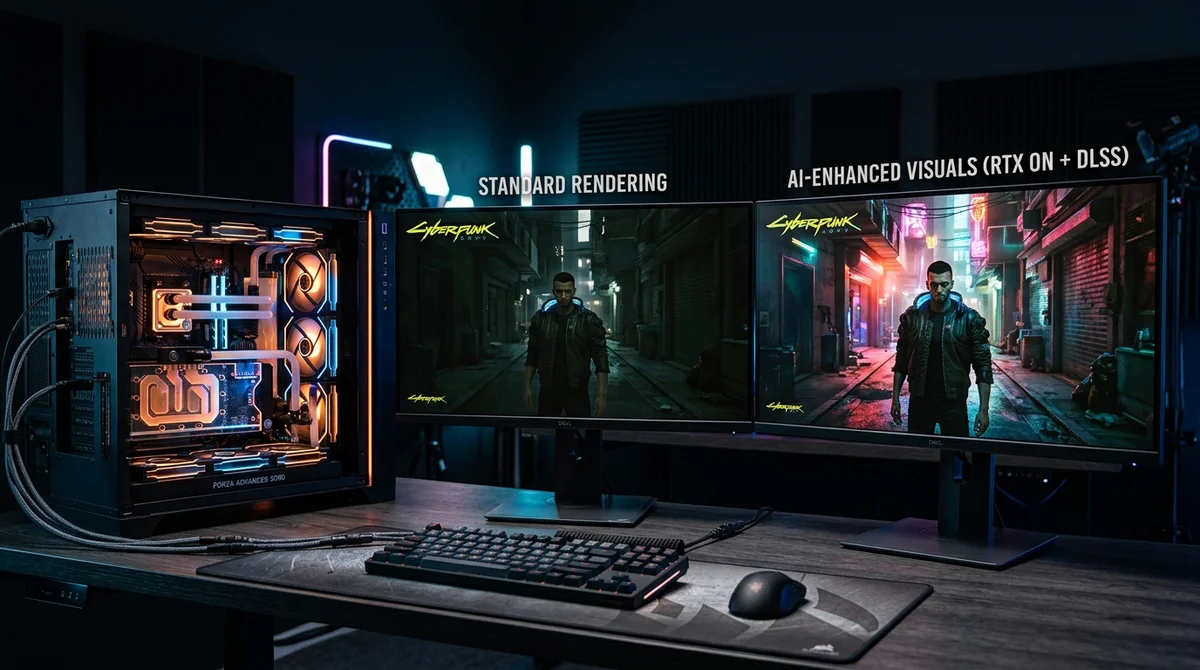
Nvidia announced DLSS 5 at its GTC conference, and it has quickly become one of the most discussed announcements in PC gaming in recent months. For the first time in the series, the technology uses a full generative neural network to create pixels in real time, rather than machine learning that only smooths and reconstructs an image. Nvidia CEO Jensen Huang called it the "GPT moment for graphics — a fusion of hand-crafted rendering and generative AI for a dramatic leap in visual realism." The reaction has been exactly what every "GPT moment" gets: part of the community is delighted, another part is alarmed.
Earlier versions of DLSS worked as upscalers: the game rendered at a lower resolution, and a neural network filled in the missing detail, pulling the final image toward native quality. That delivered high frame rates without noticeable losses.
DLSS 5 changes the logic fundamentally. Instead of reconstructing an image that has already been rendered, it generates new pixels, lighting and shadows from scratch, using generative models architecturally similar to those behind modern AI art services. According to Nvidia, this closes the gap between budget and high-end hardware far better than DLSS 3 or 4. In supported games, the visual improvement is promised to be noticeable immediately: more dynamic lighting, more detailed shadows, realistic reflections on surfaces.
Nvidia uses the term "Hand-Crafted + AI Pipeline": artists still set the base parameters of a scene, place the light sources and define the materials, while the neural network works on top, enhancing and extending the result. Developers will get fine-tuning tools to control how aggressively the AI intervenes in the artistic decisions of each scene.
This is where the controversy begins. Part of the gaming community, along with lighting artists, greeted the announcement with open skepticism. The main objection: a generative neural network, by definition, introduces changes to the image that the game's creators did not plan. Earlier DLSS versions restored pixels strictly based on an existing frame, whereas DLSS 5 effectively reinterprets the scene, adding its own view of how light and shadow should look. A game deliberately styled with a muted color palette or intentionally dark lighting risks looking brighter and more hyperrealistic under DLSS 5, but not the way its creators intended.
The term "slop", slang for faceless, characterless AI content, appeared in discussions on Reddit and Bluesky within the first hours after the announcement. Several developers voiced concern that players will see their work in a form they never authorized.
Supporters make a pragmatic case. For most players, performance gains and image quality matter more than philosophical debates about authenticity. DLSS 5 lets heavy AAA games run on mid-range hardware with a decent frame rate and an image that, at native resolution, would require a graphics card costing several thousand dollars. It is effectively a democratization of high-quality graphics: what used to be available only to owners of top-end GPUs moves closer to the mass market. Nvidia stresses that adopting DLSS 5 remains a deliberate choice for a studio, not a requirement.
DLSS 5 is a symptom of a broader shift: generative AI is moving into real time. What a year ago took minutes of rendering on server farms now runs live on consumer GPUs. For Nvidia it is a strategically important move: the more unique and powerful DLSS is, the more tightly the ecosystem is tied to GeForce cards.
The key question is whether studios and players will accept the logic of "AI as an extension of the artist," or whether DLSS 5 will turn out to be the setting that gets switched off first in the menu.
- Nov 1, 2026Local models lose to Opus and Codex: 0.21 on a MacBook versus 1.00 for Codex
- Nov 1, 2026Habr author fine-tunes YOLOv8l on dental X-rays and pushes mAP50 to 0.642
- Nov 1, 2026Voice bots built on LLMs turn to Jev, a fast classifier, for decisions in 200–500 ms
- Nov 1, 2026MoneyGate safety layer blocked all 42 fraudulent requests to local AI models
Test Frontier LLMs & Autonomous Agents in One Workspace
Run Claude Opus 5.5, GPT-6, Gemini 3.1, and DeepSeek side-by-side in Nomad AI (nomadnet.ai) — unified model routing, deep research, and multimodal workflows under one subscription.
The AI world, distilled — once a week
Seven stories that actually mattered, hand-picked. No noise, no reposts, no press releases.
Done! Check your inbox for a confirmation.