Capcom won't put generative AI in Resident Evil Requiem or its new games
Capcom has tried to calm concerns around Resident Evil Requiem after the DLSS 5 showcase. The company told investors it will not add generative-AI-created material to its games. The publisher is not abandoning AI tools themselves, though. It is testing them to speed up development in graphics, sound and programming. Separately, Capcom has already experimented with a system that generates ideas for game worlds and mechanics.
AI-processed from 3DNews AI; edited by Hamidun News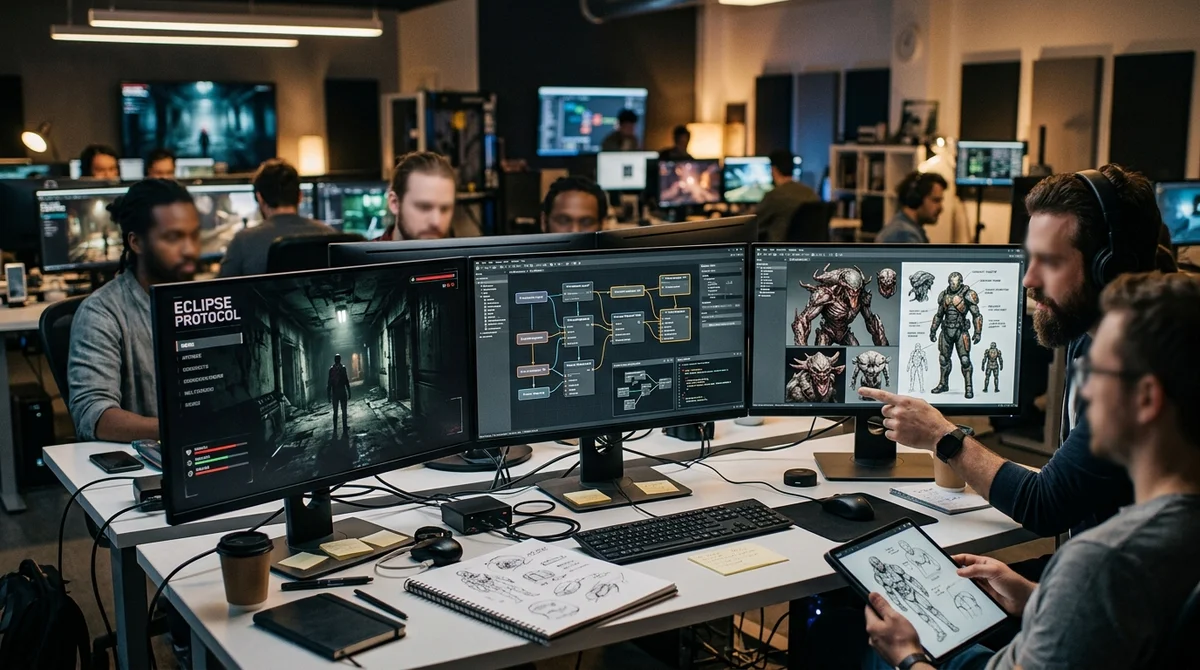
Capcom has reassured fans and some of its own employees: the publisher does not plan to put AI-generated material into Resident Evil Requiem, Pragmata or other future games. But it is not giving up on generative AI entirely. It views the technology as an internal tool for speeding up development.
Where the dispute came from
The trigger was a recent DLSS 5 demonstration, in which Resident Evil Requiem appeared among Nvidia's partners. According to industry outlets, talk then started inside Capcom about whether the company was changing course and planning to push generative AI more actively into final game content. For a studio with a fairly strict attitude toward such technologies, this looked like a notable signal, and the reaction from employees and players was nervous. That was especially so because Capcom had not previously been associated with making neural networks part of its creative output.
The backdrop around DLSS 5 made things worse. The technology has already been criticized for potentially altering a game's visual style and making the image look too "plastic" and generic. Against that background, many read Capcom's presence at the presentation not as an ordinary technical partnership but as a possible hint at broader AI integration in development. So the company's statement to investors effectively answered not only the market but also its own team, which wanted to know where the red line lies.
What Capcom said
In a Q&A session for investors published on March 23, Capcom stated its position quite directly: material created by generative AI will not be put into game content. This is the key part of the story, because it separates the company's current approach from the scenario critics feared, in which neural-network assets go straight into release versions of games and shape their artistic look.
"We will not put generative-AI-created material into game content."
Capcom is not, however, opposed to the technology as such. The company stressed separately that generative AI can be useful as a support tool for improving efficiency and productivity within the production process. In other words, this is not about replacing artists, composers or programmers with a neural network, but about speeding up routine stages, cutting the time spent on some internal tasks and relieving teams where it does not directly affect the final authorial result.
Where AI is used
Capcom is currently checking in which areas generative AI actually saves time without hurting quality. The company explicitly lists several areas where the technology is treated not as a source of finished content for the player but as part of an internal pipeline. The focus, in other words, has shifted from public output to behind-the-scenes processes, which usually stay invisible to the audience but strongly affect production schedules and costs.
- preliminary graphics drafts and utility materials
- help with sound work and individual production tasks
- support for programmers in technical and routine stages
- idea generation at the early stage of designing the world and mechanics
Capcom has tested this approach before. According to the company, it built a prototype AI system on Google Cloud that helps flesh out ideas for the structure of the game world and basic mechanics faster. This does not mean a game is assembled automatically from a text prompt, but it shows where the industry is steering generative AI first: not into final assets, but into pre-production, rough preparation and internal organization of development. In effect, the publisher is trying to give the model the role of accelerator, not co-author.
What this means
Capcom has chosen a cautious middle path: no neural-network material in the game itself, but active experiments with AI inside the studio. For the market, this is an important signal: even large publishers that are not ready to hand the creative side to generative models still see them as a way to cut the cost and time of individual production stages. This kind of compromise looks likely to become the most realistic scenario for the games industry in the coming years.
- Nov 1, 202616 models tested on 7 search tools: Exa averaged 10.5 out of 14, SearXNG about 3
- Nov 1, 2026Google's StreamVibe video agent beats other models by 10.7% on response timing and quality
- Nov 1, 2026OpenAI Rewrites GPT Behavior Rules: Five Values and a Chain of Command
- Nov 1, 2026Voice bots built on LLMs turn to Jev, a fast classifier, for decisions in 200–500 ms
Key Questions Answered
Where the dispute came from?
The trigger was a recent DLSS 5 demonstration, in which Resident Evil Requiem appeared among Nvidia's partners. According to industry outlets, talk then started inside Capcom about whether the company was changing course and planning to push generative AI more actively into final game content. For a studio with a fairly strict attitude toward such technologies, this looked like a notable signal, and the reaction from employees and players was nervous. That was especially so because Capcom had not previously been associated with making neural networks part of its creative ou
What Capcom said?
In a Q&A session for investors published on March 23, Capcom stated its position quite directly: material created by generative AI will not be put into game content. This is the key part of the story, because it separates the company's current approach from the scenario critics feared, in which neural-network assets go straight into release versions of games and shape their artistic look. "We will not put generative-AI-created material into game content." Capcom is not, however, opposed to the technology as such. The company stressed separately that generative AI can be use
Where AI is used?
Capcom is currently checking in which areas generative AI actually saves time without hurting quality. The company explicitly lists several areas where the technology is treated not as a source of finished content for the player but as part of an internal pipeline. The focus, in other words, has shifted from public output to behind-the-scenes processes, which usually stay invisible to the audience but strongly affect production schedules and costs. preliminary graphics drafts and utility materials help with sound work and individual production tasks support for programmers
Test Frontier LLMs & Autonomous Agents in One Workspace
Run Claude Opus 5.5, GPT-6, Gemini 3.1, and DeepSeek side-by-side in Nomad AI (nomadnet.ai) — unified model routing, deep research, and multimodal workflows under one subscription.
The AI world, distilled — once a week
Seven stories that actually mattered, hand-picked. No noise, no reposts, no press releases.
Done! Check your inbox for a confirmation.