Huawei launches Ascend 950PR: new AI chip claimed to beat Nvidia H20 in China
Huawei is starting shipments of its new Ascend 950PR accelerator, going head to head with Nvidia's H20 in the Chinese market. According to the company, the chip is almost three times faster in FP4 compute and ships with Huawei's own HBM memory. Against the backdrop of US sanctions, this is more than just a new GPU: it is an attempt by China to strengthen its local AI infrastructure without relying on American supply.
AI-processed from CNews AI; edited by Hamidun News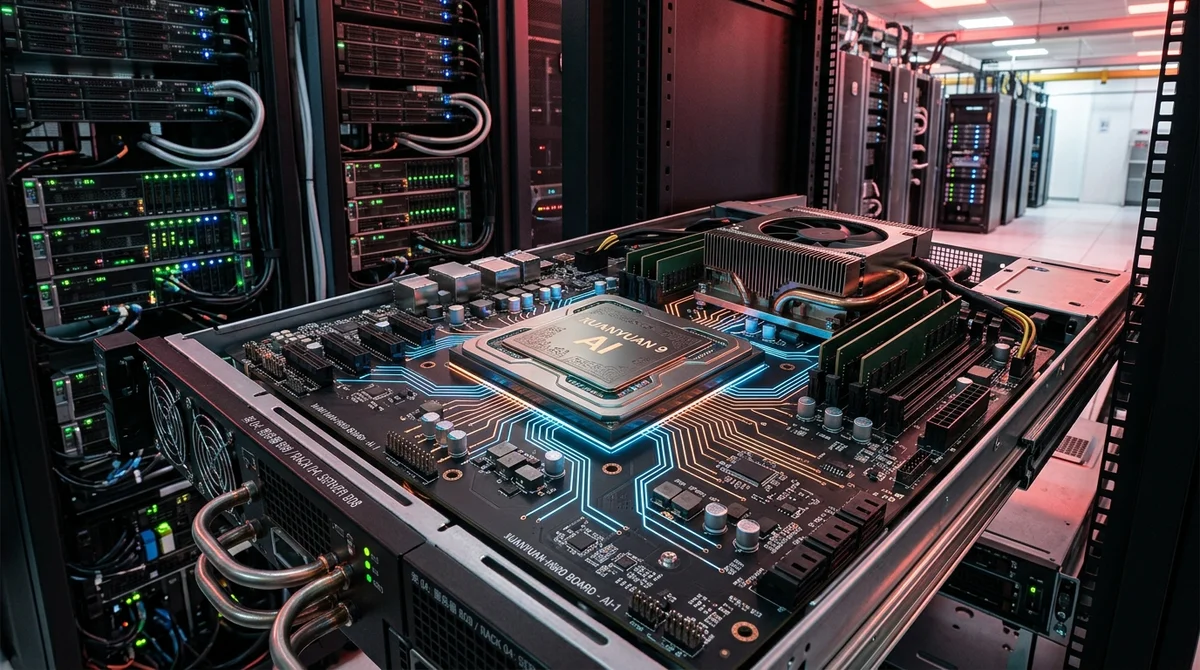
Huawei has announced that it will begin shipping its new Ascend 950PR AI accelerator by the end of March 2026. The company claims it outperforms the Nvidia H20 on a number of parameters. Nvidia built the H20 specifically for the Chinese market to comply with US export restrictions.
A new round of competition
The story matters for more than the hardware itself. The H20 was a compromise product from Nvidia for China: powerful enough for local demand, yet fitted within the bounds of US restrictions, which is exactly why it quickly became a prominent option for local data centers. Against that backdrop, the Ascend 950PR looks like Huawei's attempt to close the window of opportunity and offer large Chinese customers its own alternative, with no dependence on US supply.
This is a segment where demand is growing faster than supply: models are getting heavier, inference is getting more expensive, and access to advanced accelerators remains politically sensitive. So for the Chinese market, it is not enough to simply get one more GPU; it needs a stable local chain, from the compute chip to memory and server integration. That matters for both model training and enterprise inference. The Ascend 950PR launch hits precisely this nerve.
What Huawei is betting on
Huawei's main thesis is performance. According to the developers, the Ascend 950PR is almost three times faster than the Nvidia H20 in FP4 compute. This is not a universal "faster at everything" figure but a specific metric, particularly relevant for some modern AI workloads where companies aggressively cut precision to gain speed and lower cost. Even so, the claim is a strong one: Huawei is showing it is ready to argue not only about import substitution but also about real efficiency.
- Almost triple the FP4 performance, according to Huawei
- Its own HBM memory, with no reliance on an outside supplier
- A stronger position in the AI server market
- Less dependence on restricted supplies of foreign GPUs
The in-house HBM memory gets particular emphasis. With HBM in short supply, this is not just a technical detail but a strategic asset: without such memory, a modern AI accelerator loses a significant part of its value. If Huawei can indeed equip the new chip with its own HBM, it gains an advantage on two levels at once: cost and supply stability. For enterprise customers, in the coming quarters and new tender cycles, this may matter no less than the benchmarks themselves.
Why it matters
For China, the Ascend 950PR is a signal that local manufacturers are gradually shifting from catch-up assembly to an offensive in specific product niches. Where availability used to be the main argument for Chinese solutions, the focus is now on a combination of performance, a controlled supply chain and political predictability. For cloud providers, government bodies and large corporations, this lowers the risk that critical AI infrastructure runs into external bans.
But Nvidia retains an important advantage: its ecosystem. One strong chip is not enough without mature software, optimization tools, libraries and workflows developers are used to. So the real test for the Ascend 950PR will begin not with the first shipments but when customers try to migrate inference and model training to it at scale. If Huawei can make migration easier, the release will have an effect far wider than a hardware announcement.
What it means
The Ascend 950PR shows that US sanctions have not stopped China's AI chip race but have accelerated the creation of homegrown alternatives. For the market, that is bad news for Nvidia's monopoly and good news for companies that need a more predictable, locally available compute base for AI over the coming years.
- Nov 2, 2026Anthropic needs to grow revenue 32% a year to cover $850 billion in contracts
- Nov 2, 2026TensorFold 1.2.0 boosts Qwen3.8-27B throughput on M3 Ultra by 44.2% at 16 streams
- Nov 1, 2026Local models lose to Opus and Codex: 0.21 on a MacBook versus 1.00 for Codex
- Nov 1, 2026Habr author fine-tunes YOLOv8l on dental X-rays and pushes mAP50 to 0.642
Key Questions Answered
What are the key details on A new round of competition?
The story matters for more than the hardware itself. The H20 was a compromise product from Nvidia for China: powerful enough for local demand, yet fitted within the bounds of US restrictions, which is exactly why it quickly became a prominent option for local data centers. Against that backdrop, the Ascend 950PR looks like Huawei's attempt to close the window of opportunity and offer large Chinese customers its own alternative, with no dependence on US supply. This is a segment where demand is growing faster than supply: models are getting heavier, inference is getting more
What Huawei is betting on?
Huawei's main thesis is performance. According to the developers, the Ascend 950PR is almost three times faster than the Nvidia H20 in FP4 compute. This is not a universal "faster at everything" figure but a specific metric, particularly relevant for some modern AI workloads where companies aggressively cut precision to gain speed and lower cost. Even so, the claim is a strong one: Huawei is showing it is ready to argue not only about import substitution but also about real efficiency. Almost triple the FP4 performance, according to Huawei Its own HBM memory, with no relian
Why it matters?
For China, the Ascend 950PR is a signal that local manufacturers are gradually shifting from catch-up assembly to an offensive in specific product niches. Where availability used to be the main argument for Chinese solutions, the focus is now on a combination of performance, a controlled supply chain and political predictability. For cloud providers, government bodies and large corporations, this lowers the risk that critical AI infrastructure runs into external bans. But Nvidia retains an important advantage: its ecosystem. One strong chip is not enough without mature soft
Test Frontier LLMs & Autonomous Agents in One Workspace
Run Claude Opus 5.5, GPT-6, Gemini 3.1, and DeepSeek side-by-side in Nomad AI (nomadnet.ai) — unified model routing, deep research, and multimodal workflows under one subscription.
The AI world, distilled — once a week
Seven stories that actually mattered, hand-picked. No noise, no reposts, no press releases.
Done! Check your inbox for a confirmation.