Huawei unveils Atlas 350, claims it outperforms Nvidia H20 in AI inference
Huawei has unveiled the Atlas 350, an AI accelerator for inference workloads, and immediately benchmarked it against the Nvidia H20, claiming higher compute power for the Chinese market. The card is built on the Ascend 950PR chip and is part of Huawei's broader push to expand its line of in-house semiconductors. For China's AI ecosystem, it is a signal that a local alternative to Nvidia is getting more serious.
AI-processed from 3DNews AI; edited by Hamidun News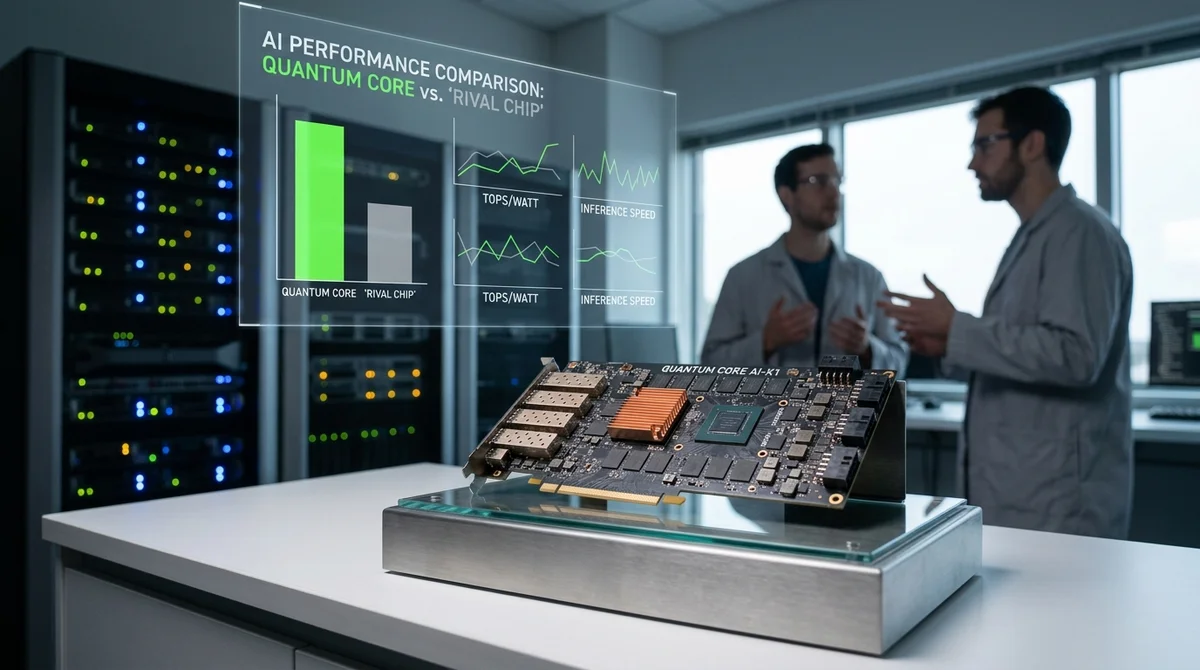
Huawei has unveiled the Atlas 350 accelerator card for AI inference and claims it outperforms the Nvidia H20, the chip aimed at the Chinese market, in compute power. The device is built on the Ascend 950PR chip and is another step in Huawei's expansion of its own AI hardware lineup.
Huawei's new accelerator
The announcement focuses not on versatility but on a specific job: the Atlas 350 is designed for inference, meaning running already-trained models in real services. Inference is what determines how quickly and cheaply an AI product responds to users, handles requests and scales under load. That makes the comparison with the Nvidia H20 look less like an abstract marketing gesture and more like an attempt to show Huawei is ready to compete in the most applied part of AI infrastructure.
The link to the Ascend 950PR chip matters too. Huawei is clearly building not a set of disconnected devices but an entire hardware platform around its own semiconductors. For enterprise customers and developers, that usually means a more predictable ecosystem: the accelerator, the underlying chip and the accompanying stack evolve within a single product line. The broader the lineup, the easier it is for the company to pitch its offerings not as one-off products but as a full alternative to foreign suppliers.
The Ascend bet
The Atlas 350 fits into Huawei's wider strategy: the company is steadily building up its AI offerings on its own chips. The announcement stresses that this direction gained momentum after notable progress in semiconductor development, including the Ascend family, without using American technology. For Huawei this is not just an image talking point. It is an attempt to control a critical layer of the AI chain, from the compute base to finished systems that can be deployed in data centers and enterprise products.
Several practical signals can be drawn from the announcement:
- Huawei is strengthening its AI inference business
- The Ascend line is becoming the center of the whole strategy
- The company is betting on its own component base
- Competition with Nvidia is moving into the applied segment
- The Chinese market gets one more local option for AI workloads
This matters for the market also because Huawei no longer looks like a player merely catching up with the leaders in individual product categories. When a company launches a new accelerator and immediately compares it with a specific Nvidia product, it sets the terms of the debate itself: the discussion is no longer about whether Huawei is present in the segment, but about relative performance. For customers, that shifts the perspective: the choice is no longer "is there an alternative?" but "how cost-effective and mature is it?"
The market versus Nvidia
Comparing specifically with the Nvidia H20 for the Chinese market makes the announcement politically and commercially precise. The H20 is a benchmark for customers who need a strong accelerator for AI tasks within the Chinese ecosystem. If Huawei can indeed deliver higher compute power in this class, that improves its chances not only in individual tenders but also in long-term infrastructure projects, where supply stability, compatibility and the development of a local stack matter.
Even without all the details disclosed, Huawei's aim is clear. The company is reinforcing the idea that China's AI market can rely not only on foreign solutions but also on its own hardware platform. This is especially sensitive for developers of large models, cloud services and enterprise deployments: the more local accelerators reach the production tier, the more realistic an independent ecosystem becomes, one where critical compute infrastructure does not depend on a single foreign vendor.
What this means
The Atlas 350 matters as more than another accelerator in Huawei's catalog. It signals that competition in AI hardware is shifting from big promises to a fight over real-world inference, where performance, availability and control over one's own technology chain count. If Huawei confirms its claims in practice, the balance of power in China's AI market could change noticeably.
- Nov 2, 2026TensorFold 1.2.0 boosts Qwen3.8-27B throughput on M3 Ultra by 44.2% at 16 streams
- Nov 1, 2026Local models lose to Opus and Codex: 0.21 on a MacBook versus 1.00 for Codex
- Nov 1, 2026Habr author fine-tunes YOLOv8l on dental X-rays and pushes mAP50 to 0.642
- Nov 1, 2026Voice bots built on LLMs turn to Jev, a fast classifier, for decisions in 200–500 ms
Key Questions Answered
What are the key details on Huawei's new accelerator?
The announcement focuses not on versatility but on a specific job: the Atlas 350 is designed for inference, meaning running already-trained models in real services. Inference is what determines how quickly and cheaply an AI product responds to users, handles requests and scales under load. That makes the comparison with the Nvidia H20 look less like an abstract marketing gesture and more like an attempt to show Huawei is ready to compete in the most applied part of AI infrastructure. The link to the Ascend 950PR chip matters too. Huawei is clearly building not a set of disc
What are the key details on The Ascend bet?
The Atlas 350 fits into Huawei's wider strategy: the company is steadily building up its AI offerings on its own chips. The announcement stresses that this direction gained momentum after notable progress in semiconductor development, including the Ascend family, without using American technology. For Huawei this is not just an image talking point. It is an attempt to control a critical layer of the AI chain, from the compute base to finished systems that can be deployed in data centers and enterprise products. Several practical signals can be drawn from the announcement: H
What are the key details on The market versus Nvidia?
Comparing specifically with the Nvidia H20 for the Chinese market makes the announcement politically and commercially precise. The H20 is a benchmark for customers who need a strong accelerator for AI tasks within the Chinese ecosystem. If Huawei can indeed deliver higher compute power in this class, that improves its chances not only in individual tenders but also in long-term infrastructure projects, where supply stability, compatibility and the development of a local stack matter. Even without all the details disclosed, Huawei's aim is clear. The company is reinforcing t
Test Frontier LLMs & Autonomous Agents in One Workspace
Run Claude Opus 5.5, GPT-6, Gemini 3.1, and DeepSeek side-by-side in Nomad AI (nomadnet.ai) — unified model routing, deep research, and multimodal workflows under one subscription.
The AI world, distilled — once a week
Seven stories that actually mattered, hand-picked. No noise, no reposts, no press releases.
Done! Check your inbox for a confirmation.