Silicon Valley and the Trump administration put their alliance to the test at a Washington AI summit
On March 24, Washington will host a summit where the alliance between Silicon Valley and the Trump administration will come under particular scrutiny. Tech companies will argue for US leadership in AI, but fears about job losses, the concentration of power among big players and the use of artificial intelligence in the war in Iran are already reshaping the debate. For the industry, this is no longer a promotional event. It is a political test.
AI-processed from Bloomberg Tech; edited by Hamidun News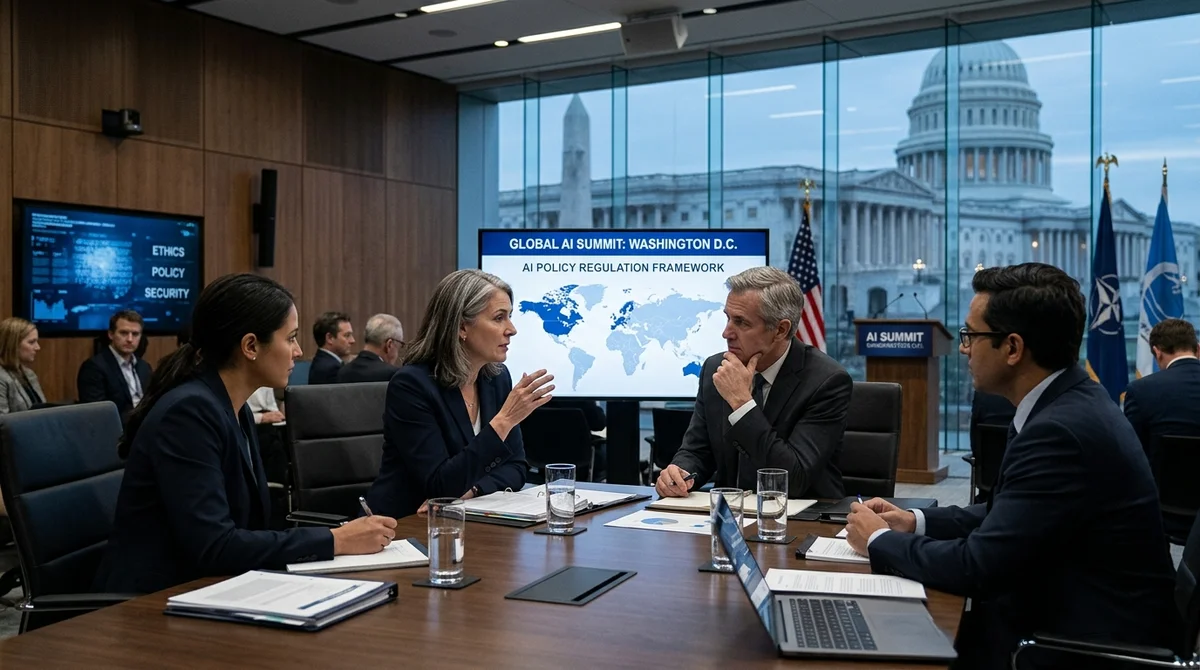
On Tuesday, March 24, 2026, Washington will host a summit that will put the alliance between Silicon Valley and the administration of Donald Trump on particularly clear display. But the conversation about US leadership in artificial intelligence will no longer unfold in an atmosphere comfortable for the industry: the agenda includes anxiety over AI's impact on employment and its role in the war in Iran.
The Washington summit
For technology companies, the meeting is a chance to show publicly that they speak the same language as the White House. Business leaders are heading to the capital with a clear thesis: the US must keep first place in the AI race, and therefore must not strangle the industry with premature restrictions. At such events the usual argument is that faster decisions on AI are a matter not only of economics but of national competitiveness.
But that thesis is no longer heard in a vacuum. Not long ago, political rhetoric mostly pitched AI as an engine of growth and innovation. Now the conversation has hardened. The public increasingly asks how many jobs will disappear, who will benefit from automation, and where the line runs between civilian use of the technology and its role in military conflicts.
That is why the Washington summit is becoming more than an industry meeting: it is a test of how durable this alliance is.
Pressure on the industry
The main problem for tech leaders is that the debate over AI has moved beyond labs, venture funds and corporate presentations. The technology's economic effect is no longer seen as a distant prospect but as a process that already affects the labor market. Automating intellectual tasks promises efficiency gains, but it also heightens fear of layoffs, redistribution of income and the concentration of power in a few large players that control models, compute and data.
Several themes come to the fore under this pressure:
- the risk of displacement for some office and service professions;
- the concentration of resources in a limited circle of large AI companies;
- weak transparency about how AI systems make decisions;
- the use of AI in a military context, including the conflict involving Iran.
The military dimension sharpens the dispute further. When artificial intelligence appears in the context of war, it stops being merely a business tool or a technology platform. The public debate then quickly shifts from convenience and productivity to questions of responsibility, control and acceptable limits. For the industry, this is an uncomfortable frame: it is easier to talk about US leadership than to answer what price society is willing to pay for it.
The alliance with the White House
For the Trump administration, closeness to Silicon Valley also makes practical sense. The White House gets support from the sector that sets the pace of the technology agenda, and business gets a direct channel of influence on federal decisions. This link lets both sides present US leadership in AI as a shared national task.
But the closer the political alliance, the harder it is for companies to keep the image of neutral innovators while conflict builds around the technology. That is why the summit is a test not only for the industry but for the whole political construct around AI. If company leaders cannot convincingly show that American leadership is compatible with economic guarantees and public oversight, the pressure on them will grow. The center of the discussion would then shift: instead of speeding up AI adoption, questions of oversight, restrictions and direct accountability for consequences would take precedence.
What it means
The Washington summit shows that the era of unconditional enthusiasm for AI is ending. Rhetoric about innovation and the global race is no longer enough: tech companies will have to prove economic benefit, answer public fears and explain where they draw the red line between developing AI and using it in war.
Key Questions Answered
What are the key details on The Washington summit?
For technology companies, the meeting is a chance to show publicly that they speak the same language as the White House. Business leaders are heading to the capital with a clear thesis: the US must keep first place in the AI race, and therefore must not strangle the industry with premature restrictions. At such events the usual argument is that faster decisions on AI are a matter not only of economics but of national competitiveness. But that thesis is no longer heard in a vacuum. Not long ago, political rhetoric mostly pitched AI as an engine of growth and innovation. Now
What are the key details on Pressure on the industry?
The main problem for tech leaders is that the debate over AI has moved beyond labs, venture funds and corporate presentations. The technology's economic effect is no longer seen as a distant prospect but as a process that already affects the labor market. Automating intellectual tasks promises efficiency gains, but it also heightens fear of layoffs, redistribution of income and the concentration of power in a few large players that control models, compute and data. Several themes come to the fore under this pressure: the risk of displacement for some office and service prof
What are the key details on The alliance with the White House?
For the Trump administration, closeness to Silicon Valley also makes practical sense. The White House gets support from the sector that sets the pace of the technology agenda, and business gets a direct channel of influence on federal decisions. This link lets both sides present US leadership in AI as a shared national task. But the closer the political alliance, the harder it is for companies to keep the image of neutral innovators while conflict builds around the technology. That is why the summit is a test not only for the industry but for the whole political construct a
Test Frontier LLMs & Autonomous Agents in One Workspace
Run Claude Opus 5.5, GPT-6, Gemini 3.1, and DeepSeek side-by-side in Nomad AI (nomadnet.ai) — unified model routing, deep research, and multimodal workflows under one subscription.
The AI world, distilled — once a week
Seven stories that actually mattered, hand-picked. No noise, no reposts, no press releases.
Done! Check your inbox for a confirmation.