API, MCP and MCP Gateways: How Interfaces and Protocols for AI Systems Differ
API and MCP often sound like synonyms, but in practice they solve different problems. An API connects applications and services, while MCP lets an AI model understand tools, data and actions in a single format. On top of that comes the MCP Gateway: it centralizes access, security and the connection of models to existing corporate systems.
AI-processed from AI News; edited by Hamidun News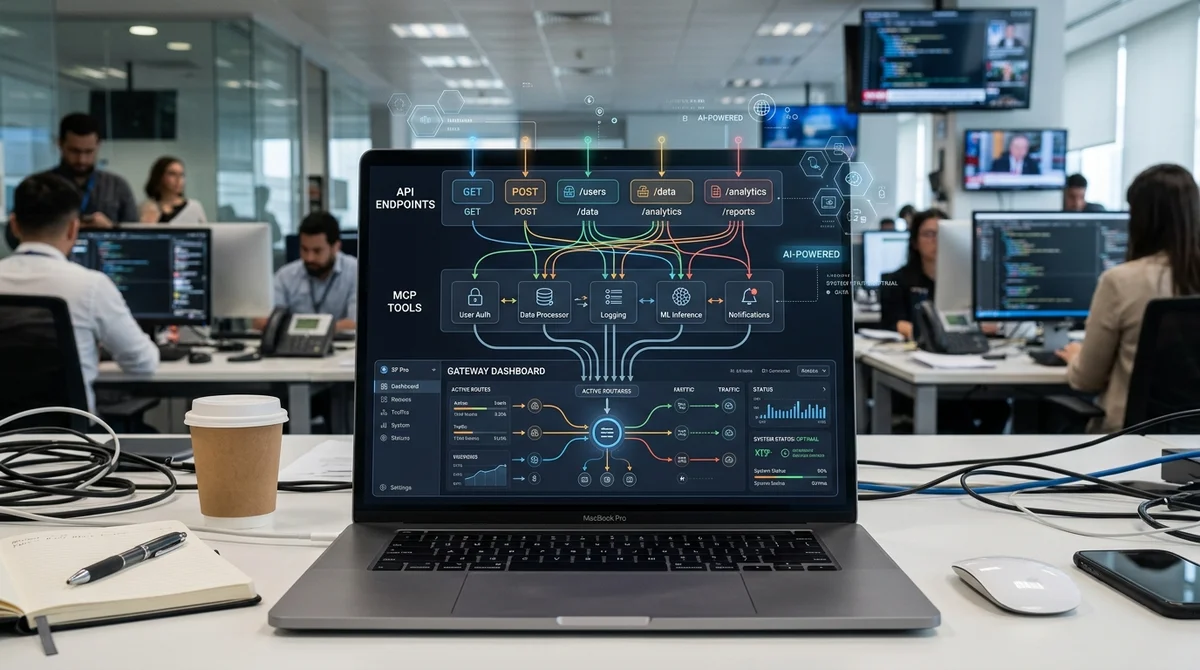
API and MCP often sound like interchangeable terms, especially in conversations about AI agents, corporate data and automation. But there is an important difference: an API connects software systems, while MCP gives a model an understandable way to work with tools, resources and actions.
Why people confuse them
The confusion arises because both API and MCP help systems exchange information. At a basic level that is true: in both cases there is a formal description of how one side can request data or perform an action on the other.
But APIs were historically created for developers and ordinary applications. An API is a contract between services: which methods exist, which parameters must be passed, how responses are structured, how authorization works and what to do on error.
MCP solves a different problem. It does not replace a service's internal logic and does not make the API obsolete. Instead, it adds a layer through which an AI client or model receives a standardized description of available capabilities. In other words, instead of a set of scattered integrations, the model sees clear tools and resources in a single format.
That is why having an API does not mean an AI agent can use the service reliably and safely without additional adaptation.
Where the line falls
Put simply, APIs are built for programs, while MCP is built for programs interacting with models. An ordinary application can hard-code the address of the endpoint it needs, the request format and the list of required parameters. A model cannot work that way: it first has to understand which tools are available, what exactly each one does and which arguments are valid.
MCP provides exactly this description layer, so the AI system does not have to guess from documentation or rely on brittle custom integrations.
- An API describes the specific methods and contracts of an individual service.
- MCP describes tools, resources and actions in a form a model can understand.
- An API usually requires manual integration for each product and its documentation.
- MCP lets a single AI client work with different sources under more uniform rules.
- In many cases, an MCP server still calls ordinary APIs internally.
The key takeaway: these are not competitors but different levels of architecture. The API remains the foundation, because real services return data, execute commands and deliver results through it. MCP is needed where a model sits on top of those services and requires a safe, predictable and standardized way to choose tools. For developers this means less throwaway code, and for users, more stable AI assistants.
Why you need a Gateway
When the number of tools grows, another layer appears: the MCP Gateway. Its job is to avoid connecting every model directly to dozens of heterogeneous systems and instead consolidate access in one place. Such a gateway can act as an intermediary between AI clients, MCP servers and a company's existing APIs. As a result, the team does not rewrite all its corporate services from scratch, but gradually wraps them in a compatible format and manages access centrally.
The practical value of a gateway lies in management and security. It makes it easier to configure authentication, logging, limits, request routing and access rules for different teams or scenarios.
But a gateway does not solve everything automatically. If tool descriptions are poorly written, permissions are too broad or old APIs behave unstably, the AI layer inherits the same problems. A good gateway is therefore not just a pass-through, but a quality-control point for the entire integration.
What this means
For the market, this is a signal that AI integrations are moving from scattered experiments to a clearer architecture. APIs are not going anywhere: they will remain the basis of service-to-service interaction. But MCP is becoming a convenient superstructure that makes those capabilities understandable to models, and the MCP Gateway helps connect them to real business systems without a complete overhaul of the existing stack.
- Nov 2, 2026Arca gives AI agents finance tasks lasting up to 10 days, but leaves the trades to humans
- Nov 2, 2026DeepSeek open-sources Super-agent prototype: p95 task completion time of 15.7 minutes vs. 29.5
- Nov 2, 2026Bun creator uses Claude Code to port 750K lines from Zig to Rust in 11 days
- Nov 2, 2026Microsoft releases 4B model Mage-VL-Cowork, which solves 66.0% of OSWorld-Verified tasks
Key Questions Answered
Why people confuse them?
The confusion arises because both API and MCP help systems exchange information. At a basic level that is true: in both cases there is a formal description of how one side can request data or perform an action on the other. But APIs were historically created for developers and ordinary applications. An API is a contract between services: which methods exist, which parameters must be passed, how responses are structured, how authorization works and what to do on error. MCP solves a different problem. It does not replace a service's internal logic and does not make the API ob
Where the line falls?
Put simply, APIs are built for programs, while MCP is built for programs interacting with models. An ordinary application can hard-code the address of the endpoint it needs, the request format and the list of required parameters. A model cannot work that way: it first has to understand which tools are available, what exactly each one does and which arguments are valid. MCP provides exactly this description layer, so the AI system does not have to guess from documentation or rely on brittle custom integrations. An API describes the specific methods and contracts of an indivi
Why you need a Gateway?
When the number of tools grows, another layer appears: the MCP Gateway. Its job is to avoid connecting every model directly to dozens of heterogeneous systems and instead consolidate access in one place. Such a gateway can act as an intermediary between AI clients, MCP servers and a company's existing APIs. As a result, the team does not rewrite all its corporate services from scratch, but gradually wraps them in a compatible format and manages access centrally. The practical value of a gateway lies in management and security. It makes it easier to configure authentication,
Build & Ship Production AI Agents Without Boilerplate Code
Start your free 72-hour trial at Hamidun Academy (academy.hamidun.com) — interactive lessons on Claude Code & Cursor, live Tech Radar, and production agent templates.
The AI world, distilled — once a week
Seven stories that actually mattered, hand-picked. No noise, no reposts, no press releases.
Done! Check your inbox for a confirmation.