Google Gemma 4 Forces Companies to Rethink AI Control on Local Devices
Google Gemma 4 has sharpened an old corporate security problem: AI models increasingly run not in the cloud but directly on employee laptops. That breaks the familiar control scheme built on API gateways and CASB. For banks, healthcare and other regulated industries, the risk is that a local agent can process sensitive data with no logs, no audit trail and no visibility for security teams.
AI-processed from AI News; edited by Hamidun News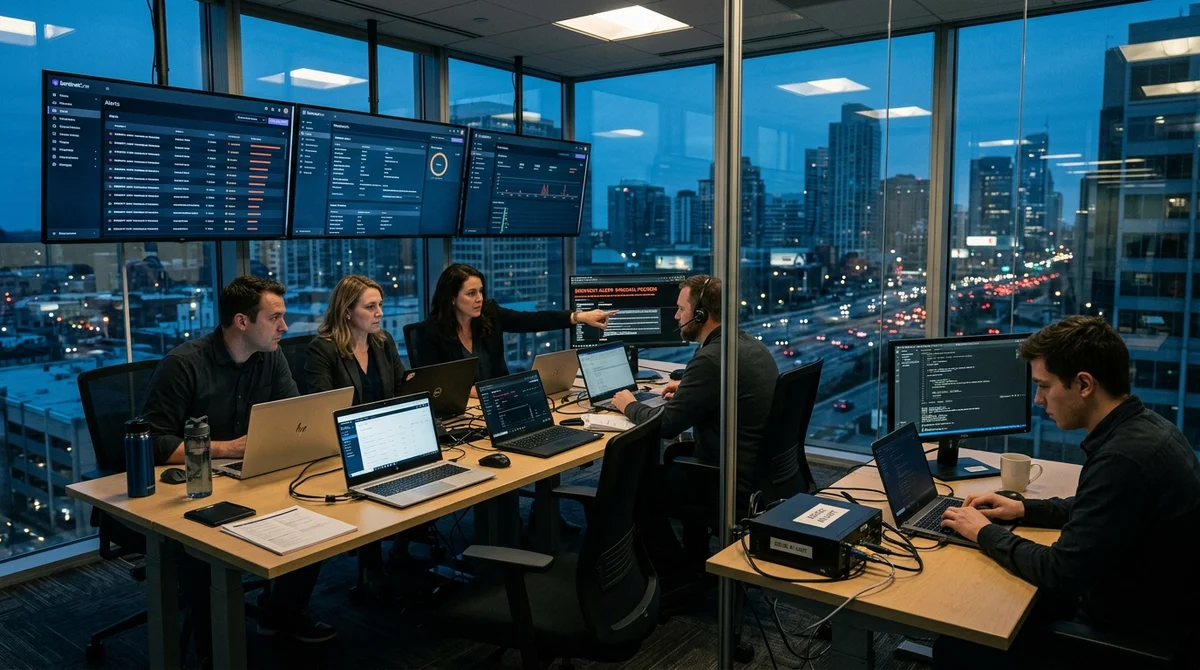
Google Gemma 4 has made life harder for corporate security teams: open-weight models can now run directly on employee laptops, bypassing cloud gateways and the usual control points. For CISOs this is not just another model but a change in the architecture of risk itself: inference and agentic workflows are moving to endpoint devices.
The perimeter no longer protects
For the past two years, many companies built their defenses on a simple assumption: if employees use external LLMs, all traffic can be routed through corporate gateways, CASB and logging systems. That approach worked as long as generative AI lived mostly in the cloud.
The release of Google Gemma 4 changes that. The open-weight model, licensed under Apache 2.0, can be downloaded, deployed locally and turned into a standalone compute node on an ordinary work laptop, one that does not need to talk constantly to external infrastructure.
Google reinforced this shift not only with the model itself but with companion tools such as Google AI Edge Gallery and the LiteRT-LM library. They simplify local deployment, speed up inference and help build more structured agentic workflows. As a result, a local agent can read instructions, plan several steps in a row and perform tasks on the device without the usual network footprint. For a security team this is a painful scenario: if requests never leave the machine, the network perimeter simply cannot see what is happening.
"What exactly is running on endpoint devices right now?" is the
question CISOs will now inevitably face.
Audit and compliance
The main problem with local inference is not that data necessarily leaves the company, but that observability disappears. When an engineer processes a sensitive document with a local agent, the central security dashboard may receive no signals at all. There is no request to an external API, no entry in a cloud log, no clear chain of events for a later investigation. This is especially dangerous in environments where what matters is not just that data is protected, but being able to prove how exactly the system behaved.
- Network traffic may not appear at all if the model runs offline
- Centralized logs do not capture the agent's steps on the device
- A local agent can read files, access databases and run commands
- Errors, leaks and hallucinations are harder to investigate after the fact
Banks, insurers and healthcare are hit hardest. Financial organizations have already invested millions in controlling API calls to generative models to meet regulators' requirements. But if a trading strategy, internal risk scoring or client data is processed by a local agent without logging, the company loses both technical visibility and its compliance perimeter. In healthcare the situation is similar: even if patient data physically never leaves the laptop, the lack of verifiable audit undermines the basic requirements for handling medical information.
Control instead of bans
Management's instinctive reaction at such a moment is to add more approvals, review committees and prohibitive policies. But the article's author calls this a management trap: bureaucracy rarely stops a developer facing a tight deadline. Much more often it pushes experiments into the shadows, where a new layer of shadow IT emerges, this time built not around SaaS services but around autonomous local agents. On paper control grows stronger; in practice the company loses what transparency it had left and ends up with an even less manageable environment.
So the focus shifts from banning the model to controlling intent and access. Even a locally run Gemma 4 agent still runs into system permissions: access to files, corporate databases, internal repositories and shell commands. That layer must become the new digital perimeter. CTOs and CISOs will have to deploy endpoint tools that can spot anomalous local inference, track unauthorized GPU load and tell a developer's ordinary work apart from an autonomous agent that sweeps through the file structure en masse to fulfill a prompt.
What this means
The era in which corporate AI could be controlled only through cloud gateways is ending. Google Gemma 4 shows that powerful agentic models are quickly moving onto employee devices, and with that the whole logic of security changes. The winners will be the companies that learn to see not only network traffic but the real behavior of local AI systems on endpoints.
- Nov 1, 202616 models tested on 7 search tools: Exa averaged 10.5 out of 14, SearXNG about 3
- Nov 1, 2026Google's StreamVibe video agent beats other models by 10.7% on response timing and quality
- Nov 1, 2026OpenAI Rewrites GPT Behavior Rules: Five Values and a Chain of Command
- Nov 1, 2026Voice bots built on LLMs turn to Jev, a fast classifier, for decisions in 200–500 ms
Key Questions Answered
What are the key details on The perimeter no longer protects?
For the past two years, many companies built their defenses on a simple assumption: if employees use external LLMs, all traffic can be routed through corporate gateways, CASB and logging systems. That approach worked as long as generative AI lived mostly in the cloud. The release of Google Gemma 4 changes that. The open-weight model, licensed under Apache 2.0, can be downloaded, deployed locally and turned into a standalone compute node on an ordinary work laptop, one that does not need to talk constantly to external infrastructure. Google reinforced this shift not only wit
What are the key details on Audit and compliance?
The main problem with local inference is not that data necessarily leaves the company, but that observability disappears. When an engineer processes a sensitive document with a local agent, the central security dashboard may receive no signals at all. There is no request to an external API, no entry in a cloud log, no clear chain of events for a later investigation. This is especially dangerous in environments where what matters is not just that data is protected, but being able to prove how exactly the system behaved. Network traffic may not appear at all if the model runs
What are the key details on Control instead of bans?
Management's instinctive reaction at such a moment is to add more approvals, review committees and prohibitive policies. But the article's author calls this a management trap: bureaucracy rarely stops a developer facing a tight deadline. Much more often it pushes experiments into the shadows, where a new layer of shadow IT emerges, this time built not around SaaS services but around autonomous local agents. On paper control grows stronger; in practice the company loses what transparency it had left and ends up with an even less manageable environment. So the focus shifts fr
Test Frontier LLMs & Autonomous Agents in One Workspace
Run Claude Opus 5.5, GPT-6, Gemini 3.1, and DeepSeek side-by-side in Nomad AI (nomadnet.ai) — unified model routing, deep research, and multimodal workflows under one subscription.
The AI world, distilled — once a week
Seven stories that actually mattered, hand-picked. No noise, no reposts, no press releases.
Done! Check your inbox for a confirmation.