Nvidia B300 Servers in China Climb to $1 Million Amid Export Curbs and Frenzied Demand
Nvidia B300 servers in China now cost about 7 million yuan, roughly $1 million and almost double the US price. Since the end of last year the price has risen from 4 million yuan, as export controls tightened, a Supermicro co-founder was arrested, and Chinese AI companies kept demanding compute. Those companies need the computing power but do not want to hold restricted hardware on their own balance sheets.
AI-processed from TNW; edited by Hamidun News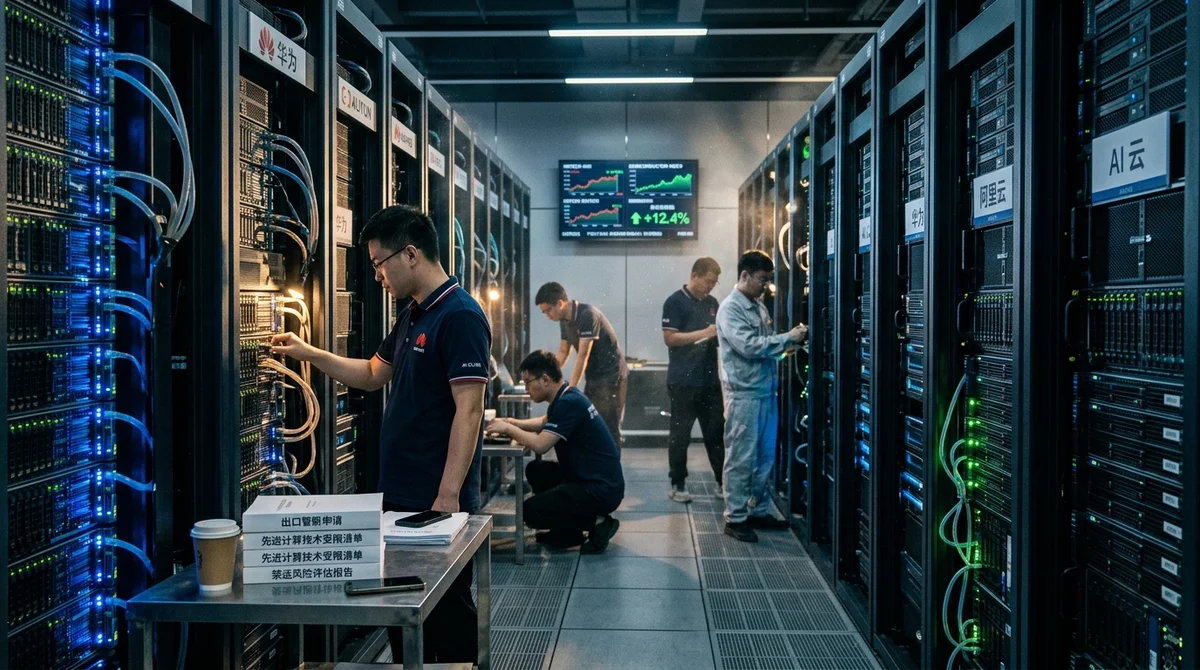
Nvidia B300 servers for AI workloads in China have risen to roughly 7 million yuan, or about $1 million. That is almost double the US price and noticeably more than at the end of last year, when such systems cost around 4 million yuan.
Why the price soared
The increase has not one cause but several. According to the source material, at the end of last year B300 systems could still be found on the Chinese market for about 4 million yuan; now the figure is 7 million. For the server market this is a jump that ordinary shortages alone can hardly explain: buyers are paying not just for hardware, but for the ability to get it under restrictions.
Tighter export controls, stricter enforcement and the arrest of a Supermicro co-founder are all pushing prices up at once. When shipments of sensitive equipment draw extra attention from regulators and partners, every deal gets harder. Logistics, counterparty checks and paperwork cost more, and so does the risk that the supply chain can break at any moment. In such an environment, the premium for access quickly becomes the main part of the price.
Who is willing to pay
Demand has not gone anywhere. Chinese AI companies still need computing power to train models, run inference and launch new services. The material stresses one important point: many players do not want to hold restricted hardware on their own balance sheets.
That changes the mechanics of the market. Instead of a plain purchase, a more complex access scheme emerges, running through intermediaries, partners and entities that take on part of the operational risk. In effect, the price of such a deal is made up of several components:
- the Nvidia B300 server itself and its scarcity
- the ability to close a deal under heightened controls
- intermediary services and extra operational overhead
- reduced risk for a company that does not want to hold such hardware on its own balance sheet
- speed of access to compute, when an AI product launch cannot be postponed
When companies have money but no easy path to the hardware they need, the market almost always responds with higher prices. That is especially true for top-tier AI systems, where a delay of a few months can mean losing the race for models, customers and revenue. So the high B300 price looks less like an anomaly and more like a sign that demand has proved sturdier than any barrier. That is also why even formally similar configurations can differ in price several times over between markets.
Price as an indicator
The B300 story shows that export restrictions do not necessarily kill a market instantly. Often something else happens: supply becomes less direct, less transparent and noticeably more expensive. As a result, the final price reflects not only the server's specifications but also the cost of working around organizational bottlenecks. The more pressure on the supply channel, the larger the premium for access. In this sense, the B300 also becomes a marker of how expensive access to cutting-edge AI hardware has become.
For Nvidia the situation cuts both ways. On one hand, demand for its accelerators and server products remains so high that even a near-million-dollar price in China does not stop the market. On the other, the price gap between the US and China shows how strongly geopolitics and regulation affect the real cost of AI infrastructure. For buyers this is no longer just a hardware purchase, but a strategic decision with legal, financial and operational consequences.
What this means
The jump in Nvidia B300 prices in China shows a simple thing: in AI infrastructure today, it is not only performance that is expensive but access to it. If the restrictions remain, the market will keep overpaying for scarce hardware, and companies will look harder for arrangements that deliver compute faster and with less risk to their own balance sheets. For the whole market, it is a signal that the fight for GPUs and servers is increasingly a fight for supply channels.
- Nov 1, 2026Local models lose to Opus and Codex: 0.21 on a MacBook versus 1.00 for Codex
- Nov 1, 2026Habr author fine-tunes YOLOv8l on dental X-rays and pushes mAP50 to 0.642
- Nov 1, 2026Voice bots built on LLMs turn to Jev, a fast classifier, for decisions in 200–500 ms
- Nov 1, 2026MoneyGate safety layer blocked all 42 fraudulent requests to local AI models
Key Questions Answered
Why the price soared?
The increase has not one cause but several. According to the source material, at the end of last year B300 systems could still be found on the Chinese market for about 4 million yuan; now the figure is 7 million. For the server market this is a jump that ordinary shortages alone can hardly explain: buyers are paying not just for hardware, but for the ability to get it under restrictions. Tighter export controls, stricter enforcement and the arrest of a Supermicro co-founder are all pushing prices up at once. When shipments of sensitive equipment draw extra attention from re
Who is willing to pay?
Demand has not gone anywhere. Chinese AI companies still need computing power to train models, run inference and launch new services. The material stresses one important point: many players do not want to hold restricted hardware on their own balance sheets. That changes the mechanics of the market. Instead of a plain purchase, a more complex access scheme emerges, running through intermediaries, partners and entities that take on part of the operational risk. In effect, the price of such a deal is made up of several components: the Nvidia B300 server itself and its scarcit
What are the key details on Price as an indicator?
The B300 story shows that export restrictions do not necessarily kill a market instantly. Often something else happens: supply becomes less direct, less transparent and noticeably more expensive. As a result, the final price reflects not only the server's specifications but also the cost of working around organizational bottlenecks. The more pressure on the supply channel, the larger the premium for access. In this sense, the B300 also becomes a marker of how expensive access to cutting-edge AI hardware has become. For Nvidia the situation cuts both ways. On one hand, deman
Test Frontier LLMs & Autonomous Agents in One Workspace
Run Claude Opus 5.5, GPT-6, Gemini 3.1, and DeepSeek side-by-side in Nomad AI (nomadnet.ai) — unified model routing, deep research, and multimodal workflows under one subscription.
The AI world, distilled — once a week
Seven stories that actually mattered, hand-picked. No noise, no reposts, no press releases.
Done! Check your inbox for a confirmation.