Nvidia B300 Servers in China Hit $1 Million as Shortages and Gray-Market Crackdown Bite
In China, the gray-market price of Nvidia B300 servers has nearly doubled to $1 million. Two factors are behind it: US export restrictions and a tougher crackdown on smuggling, which carried a critical share of supply. For the local AI market, that means costlier access to compute and pressure on launch timelines for new models.
AI-processed from 3DNews AI; edited by Hamidun News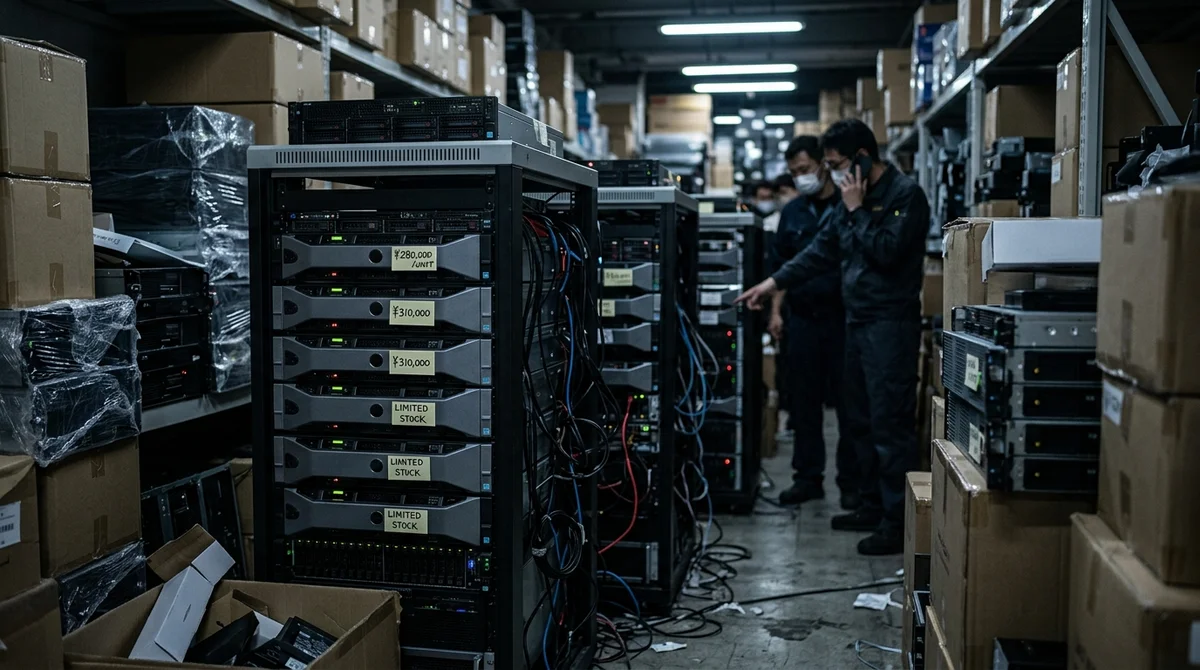
Nvidia servers built on the B300 have become sharply more expensive in China. With US export restrictions in place and gray-market supply running short, some systems are now priced at around $1 million. For China's AI market, this is not just a price spike but a sign that access to compute infrastructure is becoming an ever tighter bottleneck.
Why servers are getting pricier
The main driver is a mix of limited supply and very high demand. The US keeps tightening export rules for advanced AI chips, so direct, stable shipments of such hardware to China remain difficult. Against this backdrop, any server with current Nvidia accelerators automatically becomes a scarce good, and its price climbs faster than the market can adapt. Every available system becomes a target for instant resale and extra markup.
The AI boom itself adds pressure. Chinese companies need compute to train models, run inference and launch new services, and demand for these resources remains frenzied. A high price once looked like a temporary premium on a rare item; now it increasingly looks like the new normal for hardware whose availability is limited not only by money but by politics. For those who need to scale now, the choice often comes down to overpaying or postponing the project.
The gray market is shrinking
A critical share of this hardware's supply to China came through the gray market. While those channels worked, companies could at least partly cover the shortfall despite formal restrictions. But since the smuggling crackdown tightened, the flow of equipment has narrowed and each available system has become more valuable.
As a result, the price of Nvidia B300-based servers has nearly doubled and reached $1 million. Several factors are pushing on the final price at once:
- US export restrictions
- a shortage of new shipments to China
- a decline in gray-market imports
- higher risks for intermediaries and logistics
- frenzied demand for AI compute
The gray market has always been expensive and unstable, but now it is also narrower. Buyers pay not only for the hardware but for the very chance of getting it within a reasonable time. The riskier the supply chain, the more the markup grows at every stage, from locating the equipment to final delivery to the end customer.
Consequences for Chinese AI
This price jump hits not only budgets but also the pace of development. Large players can still afford to overpay for compute when strategic AI projects are at stake. For mid-sized companies, research teams and startups the situation looks harder: launching new models, expanding clusters and testing more complex scenarios are becoming noticeably more expensive.
There is a second effect: the market is starting to split by access to infrastructure. Competition used to revolve mainly around model quality, speed of shipping products and data; now hardware availability increasingly decides the outcome. In this environment, the advantage goes to those who locked in supply channels early, have larger budgets, or can switch faster to domestic alternatives.
The server price rise also shows that the problem has long outgrown a single model or chip line. For China's AI sector, compute infrastructure is turning into a strategic resource, and any supply disruption immediately shows up in price, timelines and the scale of development.
What this means
The Nvidia B300 story illustrates a simple point: in the AI race, the winner is not only whoever has better models but whoever has access to hardware. As long as export barriers remain and gray channels narrow, the compute shortage in China will stay one of the main limits on market growth.
- Nov 1, 2026Local models lose to Opus and Codex: 0.21 on a MacBook versus 1.00 for Codex
- Nov 1, 2026Habr author fine-tunes YOLOv8l on dental X-rays and pushes mAP50 to 0.642
- Nov 1, 2026Voice bots built on LLMs turn to Jev, a fast classifier, for decisions in 200–500 ms
- Nov 1, 2026MoneyGate safety layer blocked all 42 fraudulent requests to local AI models
Key Questions Answered
Why servers are getting pricier?
The main driver is a mix of limited supply and very high demand. The US keeps tightening export rules for advanced AI chips, so direct, stable shipments of such hardware to China remain difficult. Against this backdrop, any server with current Nvidia accelerators automatically becomes a scarce good, and its price climbs faster than the market can adapt. Every available system becomes a target for instant resale and extra markup. The AI boom itself adds pressure. Chinese companies need compute to train models, run inference and launch new services, and demand for these resou
What are the key details on The gray market is shrinking?
A critical share of this hardware's supply to China came through the gray market. While those channels worked, companies could at least partly cover the shortfall despite formal restrictions. But since the smuggling crackdown tightened, the flow of equipment has narrowed and each available system has become more valuable. As a result, the price of Nvidia B300-based servers has nearly doubled and reached $1 million. Several factors are pushing on the final price at once: US export restrictions a shortage of new shipments to China a decline in gray-market imports higher risks
What are the key details on Consequences for Chinese AI?
This price jump hits not only budgets but also the pace of development. Large players can still afford to overpay for compute when strategic AI projects are at stake. For mid-sized companies, research teams and startups the situation looks harder: launching new models, expanding clusters and testing more complex scenarios are becoming noticeably more expensive. There is a second effect: the market is starting to split by access to infrastructure. Competition used to revolve mainly around model quality, speed of shipping products and data; now hardware availability increasin
Test Frontier LLMs & Autonomous Agents in One Workspace
Run Claude Opus 5.5, GPT-6, Gemini 3.1, and DeepSeek side-by-side in Nomad AI (nomadnet.ai) — unified model routing, deep research, and multimodal workflows under one subscription.
The AI world, distilled — once a week
Seven stories that actually mattered, hand-picked. No noise, no reposts, no press releases.
Done! Check your inbox for a confirmation.