Halter raises $220M to take its smart cow collars global
New Zealand's Halter has raised $220M to scale its smart collars for cows. The company wants to expand on farms and ranches around the world, betting on more digital herd management. The round shows that investors are willing to back more than chatbots and software. They are also funding "field" AI that solves practical problems in agriculture.
AI-processed from Bloomberg Tech; edited by Hamidun News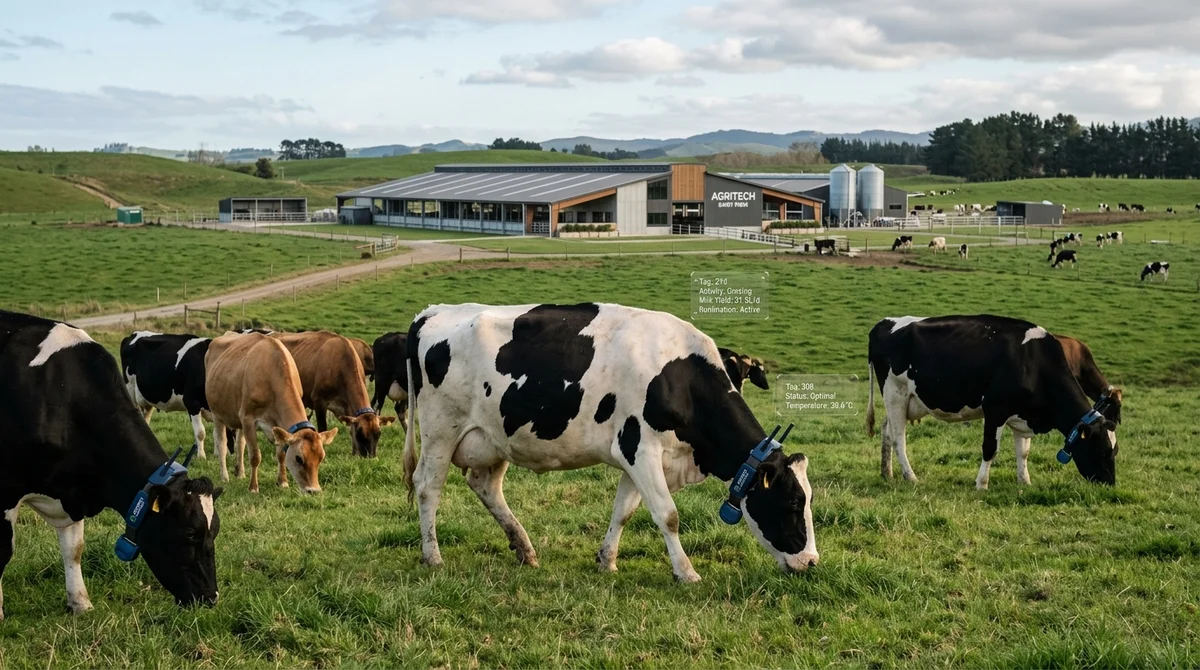
New Zealand startup Halter, which develops AI collars for cows, has raised $220M. The company plans to use the money to expand on farms and ranches worldwide and move its agtech product out of a niche segment and into a broader market.
A round built for export
For Halter, this is not just a top-up of the balance sheet. It signals that investors see a large market beyond New Zealand's domestic agriculture. The published description makes the main point clear: the company wants to scale its technology internationally and sell it to more farms. Details such as the company's valuation, the investors involved and the deal structure are not disclosed in the brief announcement, but the sum itself, $220M, points to a level of ambition rare in agtech. This is no longer about pilots but about preparing for wider deployment.
It also matters that Halter works at the intersection of hardware and software. Scaling such companies is usually harder than scaling purely cloud services: you have to manufacture a device, maintain connectivity in the field, train customers and prove payback on a real farm. A large round in this segment therefore reads as a bet on a long game. If the product genuinely helps manage a herd more efficiently, it has a chance of becoming part of daily operating infrastructure rather than another experiment with a fashionable AI label.
In practice on the farm
For farmers, the value of such solutions usually lies not in the fact that artificial intelligence is used, but in the wearable device turning a herd into a more observable and manageable system. When animals have a constant digital loop around them, a farm has fewer blind spots and more grounds for quick decisions. This is exactly what drives interest in smart collars as a category. For large farms it is especially noticeable, because the cost of delay and error is higher.
- More precise control over animal movement
- Faster detection of unusual activity or behavior
- Fewer manual rounds and less routine monitoring
- Better planning of staff work across large areas
- Data collection that can be used for long-term decisions
Even if agribusiness already knows some of these scenarios from trackers and sensors, the bet on AI changes how the product is pitched. The system promises not just to show a signal, but to interpret it and point out where there is a deviation, a risk or an opportunity for optimization. For a ranch with a large herd and a small team this matters most: any technology that saves hours of manual work and speeds up reaction quickly moves from the "interesting" category to the "we need to calculate the deployment economics" category.
Why the market is watching
Halter's story matters beyond a single company. In recent years, most AI talk has revolved around chatbots, content generation and office digital assistants. The new round is a reminder that the next wave of growth may come from industries where the effect is measured not in words generated, but in time saved, lower operating costs and more predictable management. Agriculture has long been seen as a conservative market, but it is precisely where technologies with clear economics often take lasting root.
Global expansion in agriculture almost always means complex operational work. The company has to account for differences in farm size, connectivity infrastructure, climate, service support and the local habits of the farmers themselves. So the $220M is not only a sales budget but also a resource for adapting the product to new markets, building out servicing and lowering barriers to entry for customers. If Halter handles this stage, it could establish itself not as a niche device maker but as a notable player in livestock technology.
What this means
Halter's large round shows that AI is increasingly moving out of office scenarios and into the physical world. If the company can prove its economics across different markets, investors will be even more willing to fund applied solutions where algorithms work not on a screen but right in the field.
Key Questions Answered
What are the key details on A round built for export?
For Halter, this is not just a top-up of the balance sheet. It signals that investors see a large market beyond New Zealand's domestic agriculture. The published description makes the main point clear: the company wants to scale its technology internationally and sell it to more farms. Details such as the company's valuation, the investors involved and the deal structure are not disclosed in the brief announcement, but the sum itself, $220M, points to a level of ambition rare in agtech. This is no longer about pilots but about preparing for wider deployment. It also matters
What are the key details on In practice on the farm?
For farmers, the value of such solutions usually lies not in the fact that artificial intelligence is used, but in the wearable device turning a herd into a more observable and manageable system. When animals have a constant digital loop around them, a farm has fewer blind spots and more grounds for quick decisions. This is exactly what drives interest in smart collars as a category. For large farms it is especially noticeable, because the cost of delay and error is higher. More precise control over animal movement Faster detection of unusual activity or behavior Fewer manu
Why the market is watching?
Halter's story matters beyond a single company. In recent years, most AI talk has revolved around chatbots, content generation and office digital assistants. The new round is a reminder that the next wave of growth may come from industries where the effect is measured not in words generated, but in time saved, lower operating costs and more predictable management. Agriculture has long been seen as a conservative market, but it is precisely where technologies with clear economics often take lasting root. Global expansion in agriculture almost always means complex operational
Test Frontier LLMs & Autonomous Agents in One Workspace
Run Claude Opus 5.5, GPT-6, Gemini 3.1, and DeepSeek side-by-side in Nomad AI (nomadnet.ai) — unified model routing, deep research, and multimodal workflows under one subscription.
The AI world, distilled — once a week
Seven stories that actually mattered, hand-picked. No noise, no reposts, no press releases.
Done! Check your inbox for a confirmation.