California pays farmers for 'green' gas from manure, but the math doesn't add up
For years, California has subsidized the conversion of methane from dairy manure into "renewable natural gas." The program has become hugely popular because it actually pays farmers. But climate researchers are sounding the alarm: the scheme indirectly encourages farmers to grow their herds, which means total greenhouse gas emissions may rise instead of fall.
AI-processed from MIT Technology Review; edited by Hamidun News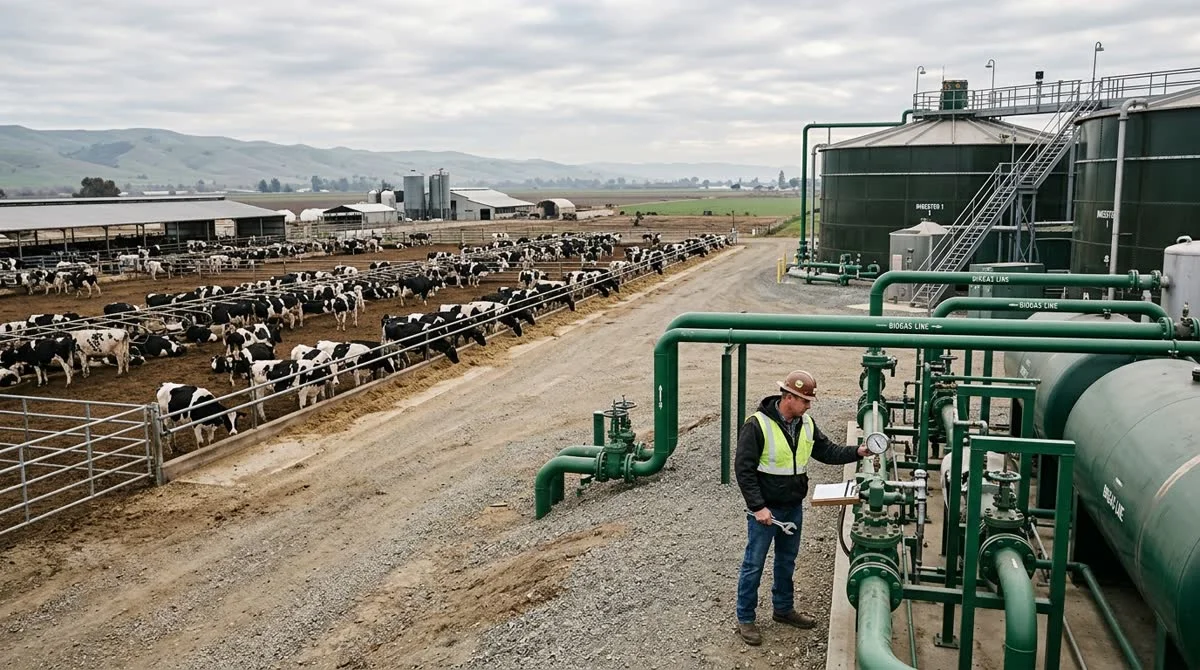
For several years, California has subsidized the conversion of methane from dairy manure into "renewable natural gas" (RNG). An investigation by MIT Technology Review, published on July 2, 2026, shows that the program's climate math doesn't add up: instead of cutting emissions, the scheme may encourage them.
How the LCFS program works
The mechanism runs through California's low-carbon fuel credit system, the Low Carbon Fuel Standard (LCFS). Farmers install anaerobic digesters over manure lagoons, which capture methane and turn it into natural gas for burning. Oil and gas companies buy the resulting credits and count them toward their own carbon obligations to the regulator.
A key detail: the program covers dairy farmers across the entire United States, not only in California. The state is effectively exporting its climate scheme nationwide.
On paper, the logic is flawless: over a 20-year horizon, methane is roughly 80 times more potent than CO₂ as a greenhouse gas, and capturing it from manure lagoons rather than releasing it directly into the atmosphere does look like a climate win.
- Oil companies buy LCFS credits to offset their carbon obligations
- The program covers dairy farms across the entire United States, not only California
- Methane from manure is officially classified as "renewable natural gas"
- The scheme became hugely popular precisely because it actually pays farmers
Why doesn't the math add up?
The investigation's authors identified at least three fundamental contradictions.
An incentive to grow the herd. The program indirectly pays for the number of cows: more animals mean more manure and higher subsidies. But every additional cow also produces enteric methane (from digestion), a gas the digesters do not capture at all. As a result, the financial incentive to expand the herd can completely wipe out the climate gain from processing manure.
Environmental side effects. Manure lagoons accumulate nitrogen and phosphorus, polluting groundwater in surrounding areas. A digester solves one environmental problem without touching the others, and as farms scale up, these side effects only get worse.
Disputed accounting methodology. RNG's carbon footprint is calculated using the concept of "avoided emissions": it assumes that without the program, the methane would have gone straight into the atmosphere. But the gas is still burned in the end, and the CO₂ still ends up in the air, just later and somewhere else. A number of researchers believe the system issues climate credits where no real emissions reduction occurs.
"Something is wrong with
California's climate policy," say the journalists who examined the program's mechanics from the inside.
What's behind the popularity
The program has become, in the authors' words, "wildly popular," and the reason is obvious: it brings participants real money. The dairy sector has received a powerful financial incentive that ties it to producing "green" gas. Alternative climate solutions, such as directly reducing herd sizes, changing livestock diets, or switching to other farming practices, become less attractive as long as manure reliably earns subsidies. This, critics argue, is the scheme's main trap.
What this means
California positions itself as a global leader in climate policy, and its LCFS standards are becoming a model for other states and countries. If the math of one of its key programs doesn't add up, it calls into question not only specific subsidies but also the broader principles for accounting for "green" energy sources. The program's popularity and its real climate effectiveness turned out to be different things, and the longer this is ignored, the more expensive a course correction will be.
- Oct 31, 2026Author puts his script before an AI jury: the verdict cost 850 thousand tokens
- Oct 29, 2026OvisOCR3: an 0.8B-parameter model that reads documents better than specialized systems
- Oct 29, 2026Tencent releases Youtu-Parsing-Omni: one model parses documents, audio and video
- Oct 28, 2026Liquid AI releases LFM2.5-24B-A2B: an agent model with 2B active parameters
Key Questions Answered
Why doesn't the math add up?
The investigation's authors identified at least three fundamental contradictions. An incentive to grow the herd. The program indirectly pays for the number of cows: more animals mean more manure and higher subsidies. But every additional cow also produces enteric methane (from digestion), a gas the digesters do not capture at all. As a result, the financial incentive to expand the herd can completely wipe out the climate gain from processing manure. Environmental side effects. Manure lagoons accumulate nitrogen and phosphorus, polluting groundwater in surrounding areas. A d
How the LCFS program works?
The mechanism runs through California's low-carbon fuel credit system, the Low Carbon Fuel Standard (LCFS). Farmers install anaerobic digesters over manure lagoons, which capture methane and turn it into natural gas for burning. Oil and gas companies buy the resulting credits and count them toward their own carbon obligations to the regulator. A key detail: the program covers dairy farmers across the entire United States, not only in California. The state is effectively exporting its climate scheme nationwide. On paper, the logic is flawless: over a 20-year horizon, methane
What's behind the popularity?
The program has become, in the authors' words, "wildly popular," and the reason is obvious: it brings participants real money. The dairy sector has received a powerful financial incentive that ties it to producing "green" gas. Alternative climate solutions, such as directly reducing herd sizes, changing livestock diets, or switching to other farming practices, become less attractive as long as manure reliably earns subsidies. This, critics argue, is the scheme's main trap.
Ship AI Faster with Founders, Engineers & Weekly Architecture Reviews
Inside Vibe Club (hamidun.com/club) — weekly live masterminds with Zhemal Khamidun, Tech Radar, full LMS access, and 370+ production Claude Code skills.
The AI world, distilled — once a week
Seven stories that actually mattered, hand-picked. No noise, no reposts, no press releases.
Done! Check your inbox for a confirmation.