Microsoft adds AI Restyle to OneDrive for artistic photo makeovers without distortion
Microsoft has built a new tool, AI Restyle, into OneDrive. It restyles photos without noticeably distorting the original frame, and it can turn shots into images in the vein of anime, movie posters and other artistic formats. The key difference: this is not a Copilot chat. It is a feature built directly into the cloud storage, designed for a quick, mass-market consumer use case.
AI-processed from 3DNews AI; edited by Hamidun News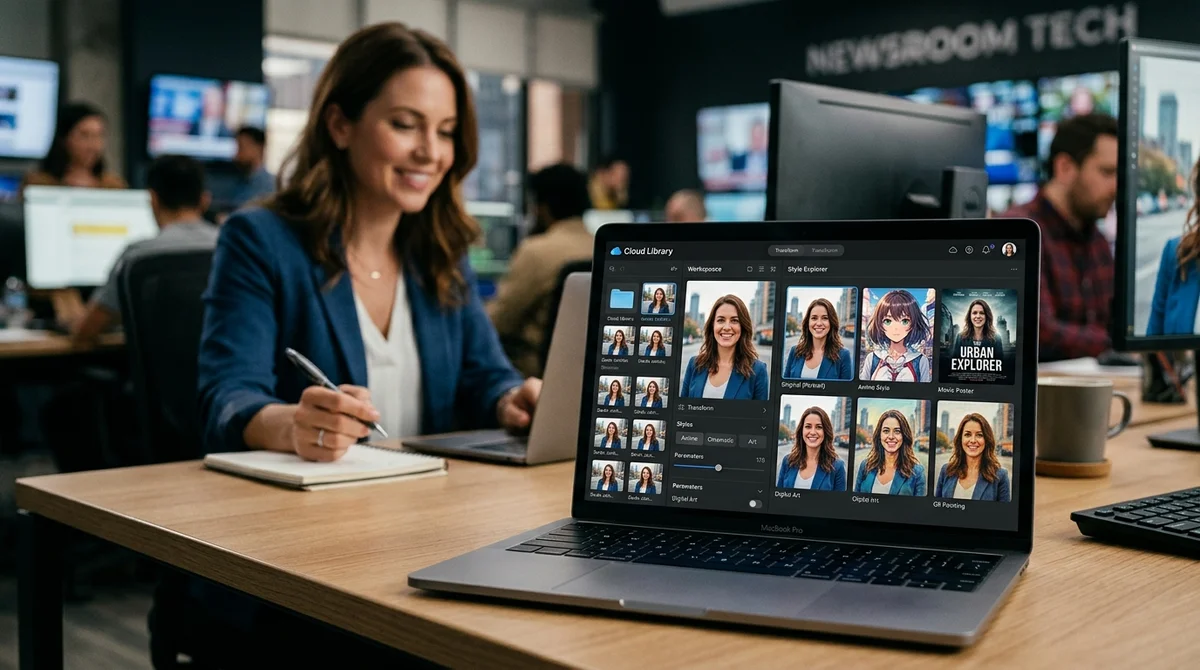
Microsoft has launched AI Restyle in OneDrive, a tool that uses AI to change the visual style of photos. Users can turn an ordinary shot into an anime-style image, a poster or another artistic treatment without noticeably breaking the original scene.
Why not Copilot
The news headline deliberately stresses the point: this is not about Copilot or a chat interface, but about a feature inside OneDrive itself. That is an important signal of how Microsoft packages generative capabilities: not only as a universal assistant, but also as a narrow tool for a specific scenario. Here the scenario is perfectly clear: take an existing photo and quickly give it a new artistic look, without lengthy manual retouching and without switching between several apps.
For OneDrive, this is a logical expansion of the cloud storage's role. The service stopped being just a folder for files a long time ago: users expect to be able not only to save and send a photo, but also to prepare it right away for publishing, a presentation or a personal archive. AI Restyle fills exactly that gap between storage and editing. If the feature works reliably, Microsoft gets one more argument for keeping photos in its ecosystem rather than exporting them to outside services.
How the photo changes
Judging by the description, AI Restyle does not bet on redrawing the frame entirely, but on carefully changing its visual presentation. That distinction matters: the user does not want a random new image, but the same photo in a different style. That is why Microsoft specifically emphasizes the absence of distortion. For a mass-market use case this is critical, because people react badly when AI mangles facial features, changes body proportions, ruins the background or swallows small details of clothing and objects.
The examples the company describes show an emphasis on familiar, easily recognizable styles: anime, movie posters and other expressive visual templates. It is a sensible choice for a consumer product. Users do not need to wade through complex settings or write long prompts to get a noticeable result. The faster someone sees a good-looking version of their photo, the more likely they are to keep experimenting, save variants and share them straight from OneDrive.
Where the tool is useful
Potentially, AI Restyle covers several everyday tasks where a regular photo editor seems too complicated and an image generator working from scratch seems too unpredictable. Here the user starts from a finished image, so the result is clearer and closer to expectations. It may especially appeal to people who regularly design social media posts, put together family albums, make covers for internal documents, or simply want to freshen up old photos quickly without heavy editing.
- Avatars and covers for social networks
- Posters for presentations and internal materials
- Styling personal photos as anime or movie posters
- Quick design variants without manual retouching
The main risk with such features is always the same: the promise of "no distortion" must be backed up by real quality across different types of photos. Nicely processing a studio portrait is much easier than handling a photo with poor lighting, a complex background, several people in the frame or small objects. So AI Restyle's success will depend not only on impressive demos, but on how predictably the tool behaves in an ordinary user library, where photos are far from ideal.
What this means
Microsoft continues to build AI not only into chat assistants but also into familiar consumer services, where time savings matter more than a wow effect. If AI Restyle can truly change a photo's style without noticeable distortion, OneDrive gets a clear feature with mass demand and one more way to keep users inside its ecosystem, instead of having them send photos to outside editors for manual processing or to hunt for new effects.
- Nov 2, 2026Microsoft releases 4B model Mage-VL-Cowork, which solves 66.0% of OSWorld-Verified tasks
- Nov 1, 2026Google's StreamVibe video agent beats other models by 10.7% on response timing and quality
- Oct 30, 2026Mistral opens Large 4 weights: strong at code, but Chinese models score 32 to its 26
- Oct 30, 2026128 AI Agents With No Boss Passed 49% More Tests Than One
Key Questions Answered
Why not Copilot?
The news headline deliberately stresses the point: this is not about Copilot or a chat interface, but about a feature inside OneDrive itself. That is an important signal of how Microsoft packages generative capabilities: not only as a universal assistant, but also as a narrow tool for a specific scenario. Here the scenario is perfectly clear: take an existing photo and quickly give it a new artistic look, without lengthy manual retouching and without switching between several apps. For OneDrive, this is a logical expansion of the cloud storage's role. The service stopped be
How the photo changes?
Judging by the description, AI Restyle does not bet on redrawing the frame entirely, but on carefully changing its visual presentation. That distinction matters: the user does not want a random new image, but the same photo in a different style. That is why Microsoft specifically emphasizes the absence of distortion. For a mass-market use case this is critical, because people react badly when AI mangles facial features, changes body proportions, ruins the background or swallows small details of clothing and objects. The examples the company describes show an emphasis on fam
Where the tool is useful?
Potentially, AI Restyle covers several everyday tasks where a regular photo editor seems too complicated and an image generator working from scratch seems too unpredictable. Here the user starts from a finished image, so the result is clearer and closer to expectations. It may especially appeal to people who regularly design social media posts, put together family albums, make covers for internal documents, or simply want to freshen up old photos quickly without heavy editing. Avatars and covers for social networks Posters for presentations and internal materials Styling pe
Build & Ship Production AI Agents Without Boilerplate Code
Start your free 72-hour trial at Hamidun Academy (academy.hamidun.com) — interactive lessons on Claude Code & Cursor, live Tech Radar, and production agent templates.
The AI world, distilled — once a week
Seven stories that actually mattered, hand-picked. No noise, no reposts, no press releases.
Done! Check your inbox for a confirmation.