ChatGPT helps design a controller for a 32-juice vending machine
A short but telling case has appeared on Habr: the author asked ChatGPT to help with a controller design for a juice vending machine. The model first gathered requirements, then proposed an architecture built around NFC, an Orange Pi, LTE and a separate power board. During the conversation, stepper motors were swapped for cheaper peristaltic pumps, with the caveat that they are less accurate.
AI-processed from Habr AI; edited by Hamidun News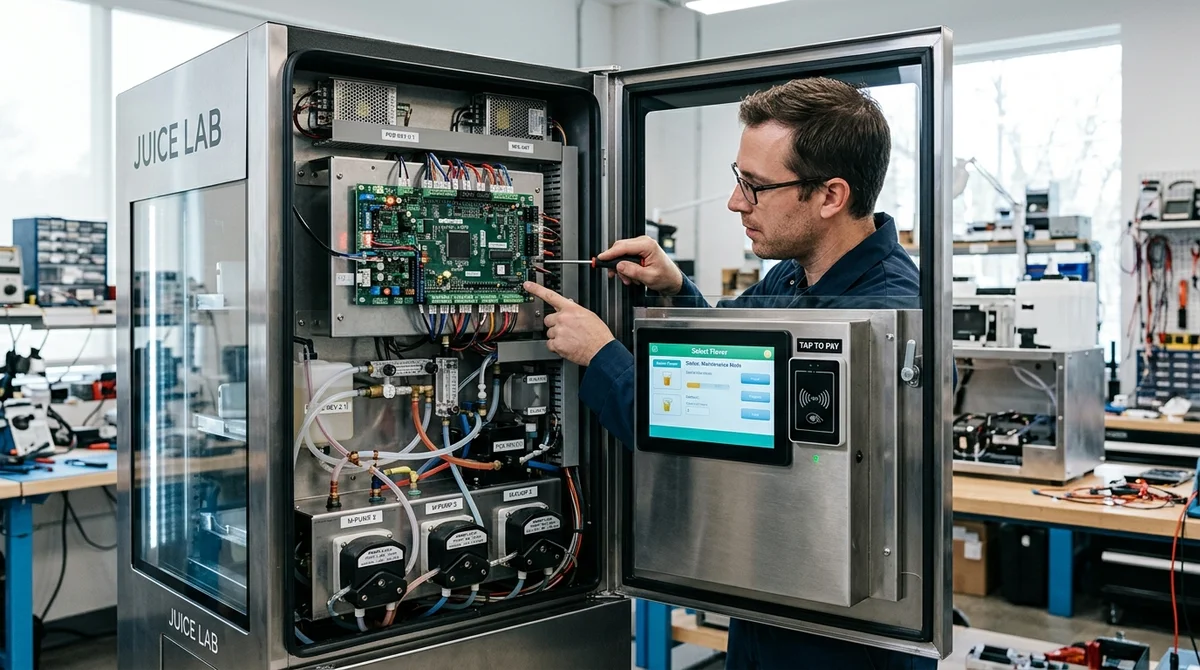
A telling post has appeared on Habr about using ChatGPT not for text or code, but for early hardware work: a controller for a juice vending machine. The author does not show a finished device, but the conversation itself demonstrates how an LLM can run an engineering interview and build a requirements spec step by step.
How the requirements were built
The author began with a direct question: could ChatGPT develop a schematic and Gerber files for a juice vending machine controller? Instead of immediately "drawing a board", ChatGPT first asked for the basics: payment methods, number of dosing channels, cooling requirements, type of user interface, how the machine talks to the server, and preferred computing platform. For a hardware task this matters: the model behaved not like a generator of random solutions, but like an engineer at the requirements-gathering stage.
After the clarifications, the picture became more concrete. The device must accept NFC cards, mix drinks from 32 juices, pour a standard cup, handle cooling, have a touchscreen and send telemetry to a cloud system over sockets. The user then gave a far more specific direction: separate the power board from the interface board, and use an Orange Pi, a 10-inch TFT, a PN532 and LTE to work with a Linux server.
What the model proposed
Based on these requirements, ChatGPT split the system into modules and proposed a preliminary architecture. The conversation contains not just general ideas but practical blocks that such a device really needs.
- a separate power board to control actuators and power
- a user interface board based on an Orange Pi
- a PN532 NFC module for accepting cards
- a 10-inch TFT display for drink selection
- an LTE modem and server communication over sockets
The model also offered options for liquid dispensing and cooling. At first it discussed stepper motors, solenoid valves and even options such as Raspberry Pi, STM32 and ESP32 in different roles. For cooling, ChatGPT mentioned either Peltier elements with fans or a compressor system, so it did not reduce everything to a single template solution.
It is also useful that the model kept asking questions instead of pretending all parameters were already known. It asked whether juice level monitoring was needed, which server communication stack was more convenient, whether there would be several cup types, and which drivers to choose. Details like these are often where overly optimistic AI demos break down.
How the design changed
During the dialogue the author revised one of the key parts: instead of stepper motors, he asked to use mini peristaltic pumps from AliExpress, because they are cheaper. ChatGPT accepted the trade-off and immediately noted the limitation: such pumps are simpler to control and cheaper, but usually less accurate in dosing.
"Peristaltic pumps are simpler to control and cheaper, although their
dosing accuracy is slightly lower."
The model then proposed a logical order of work: design the power board first, then move on to routing and Gerber files. The author confirmed this order.
The published excerpt contains no schematics, PCBs or manufacturing files. So this is not yet a fully finished controller, but an early stage of engineering work, where ChatGPT helps package an idea into a system structure and turn a vague request into a more formal spec.
That is why the post is interesting not as proof that LLMs already replace electronics developers, but as an example of a different scenario. The model acts as a conversation partner that helps avoid forgetting critical system blocks, structures component choices and quickly runs through architectural options before real design begins.
What this means
Such cases show that ChatGPT is already useful in hardware tasks as a tool for preliminary design and requirements gathering. But the value does not come from the model "doing everything itself"; it comes from a person using it to speed up the first engineering iterations and checking every decision before production.
- Nov 1, 2026Local models lose to Opus and Codex: 0.21 on a MacBook versus 1.00 for Codex
- Nov 1, 2026Kimi scores 96.2% on a 1C database analytics test and emerges as a fallback if Claude access is blocked
- Nov 1, 2026OpenAI Rewrites GPT Behavior Rules: Five Values and a Chain of Command
- Nov 1, 2026Google admits AI Mode cuts search revenue, shares fall 15%
Key Questions Answered
How the requirements were built?
The author began with a direct question: could ChatGPT develop a schematic and Gerber files for a juice vending machine controller? Instead of immediately "drawing a board", ChatGPT first asked for the basics: payment methods, number of dosing channels, cooling requirements, type of user interface, how the machine talks to the server, and preferred computing platform. For a hardware task this matters: the model behaved not like a generator of random solutions, but like an engineer at the requirements-gathering stage. After the clarifications, the picture became more concret
What the model proposed?
Based on these requirements, ChatGPT split the system into modules and proposed a preliminary architecture. The conversation contains not just general ideas but practical blocks that such a device really needs. a separate power board to control actuators and power a user interface board based on an Orange Pi a PN532 NFC module for accepting cards a 10-inch TFT display for drink selection an LTE modem and server communication over sockets The model also offered options for liquid dispensing and cooling. At first it discussed stepper motors, solenoid valves and even options s
How the design changed?
During the dialogue the author revised one of the key parts: instead of stepper motors, he asked to use mini peristaltic pumps from AliExpress, because they are cheaper. ChatGPT accepted the trade-off and immediately noted the limitation: such pumps are simpler to control and cheaper, but usually less accurate in dosing. "Peristaltic pumps are simpler to control and cheaper, although their dosing accuracy is slightly lower." The model then proposed a logical order of work: design the power board first, then move on to routing and Gerber files. The author confirmed this orde
Test Frontier LLMs & Autonomous Agents in One Workspace
Run Claude Opus 5.5, GPT-6, Gemini 3.1, and DeepSeek side-by-side in Nomad AI (nomadnet.ai) — unified model routing, deep research, and multimodal workflows under one subscription.
The AI world, distilled — once a week
Seven stories that actually mattered, hand-picked. No noise, no reposts, no press releases.
Done! Check your inbox for a confirmation.