AWS shows how to detect solar flares in SageMaker AI using data from ESA's STIX instrument
AWS has published a practical scenario for SageMaker AI, showing that the service can serve scientific work as well as business analytics. In the new material, the company explains how to build a solar flare detection system based on an LSTM and data from ESA's STIX instrument, then deploy the model for real-world use. The focus is on working with time series and on production deployment.
AI-processed from AWS Machine Learning Blog; edited by Hamidun News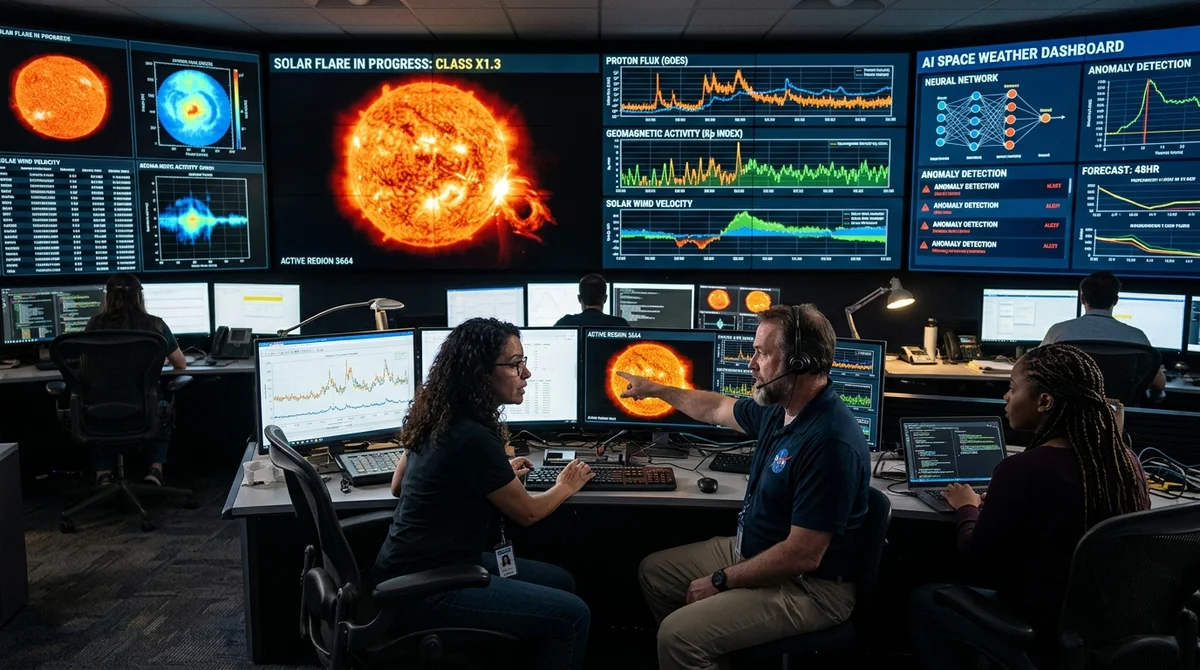
AWS has published a practical walkthrough of how to build a solar flare detection system in Amazon SageMaker AI. It is based on an LSTM network for time series and on data from STIX, a scientific instrument of the European Space Agency.
What AWS showed
Instead of an abstract demo task, AWS chose a scenario in which machine learning tackles a real scientific problem: spotting bursts of activity on the Sun in time, using the instrument's telemetry. Formally it is a learning project, but in practice the company demonstrates a full production loop: data preparation, model training, quality validation and deployment in the cloud.
For SageMaker AI itself this is a good case: the service is positioned not only as a platform for corporate analytics but also as a tool for research, where large volumes of signals and a reproducible ML pipeline matter.
Solar flares are not a niche topic only for astrophysicists. Such events affect space weather, which in turn can affect satellite communications, navigation and the stability of certain technical systems. So the task here is not a pretty data visualization but the early detection of characteristic patterns in a time series.
This is where an LSTM fits well: the architecture handles sequences and can capture dependencies between neighboring and more distant measurements, at the point where simple threshold analysis starts to lose the signal in the noise.
How the system works
The key data source in this example is STIX, a European Space Agency instrument that records the Sun's X-ray emission. Judging by the description in the material, AWS builds the pipeline around sequences of observations: the raw stream has to be cleaned, split into windows and converted to a convenient format, and only then fed to the model.
What matters here is not just the choice of LSTM but also the fact that SageMaker AI takes over the infrastructure side. The team does not need to spin up servers separately for experiments, manually link training and deployment, or build scaffolding around a prediction service.
- loading and preparing STIX data
- building time windows for training
- training the LSTM model in SageMaker AI
- deploying the model for predictions
- evaluating quality on new observations
The value of this scenario is that it shows ML not as a notebook with a nice chart but as a repeatable process. The same approach can be applied to other telemetry streams that have signal, noise and a need to respond quickly.
If the model is trained correctly on historical flares, it can then be used to flag anomalies automatically, to pre-sort events, or as a support layer for scientists who analyze observations by hand. For business this is a familiar pattern: time series, event classification and cloud deployment.
Why it matters
AWS has two goals here. The first is to show that SageMaker AI remains a platform not only for generative models but also for applied deep learning on classic data. The second is to give a clear example where a neural network solves a high-value problem without requiring an exotic architecture.
Amid the constant noise around LLMs, this material is useful because it returns the focus to practical engineering: there is a dataset, a sequence of signals and an event label, and from these you can assemble a working system without magic or manual heroics.
Another important point is that the bridge between science and cloud development is getting shorter. Previously, such projects often lived inside research teams and were hard to port: code ran locally, the environment was not reproducible, and the model existed separately from the service meant to use it. SageMaker AI lets you package this into a more standard process.
That is why the AWS article is interesting not only to those who follow space. It is a template for any task involving a stream of sensor data, from industrial monitoring and IoT to medicine and cybersecurity.
What it means
AWS reminded the market of a simple thing: the value of AI does not end with chatbots. Cloud platforms are increasingly turning scientific and industrial time-series tasks into ready, reproducible pipelines that can be taken quickly from experiment to working service.
- Oct 31, 2026Worldwide Express hands disputed invoices to AI agents and cuts unresolved disputes by 75%
- Oct 30, 2026AWS gives coding agents a live site preview straight from an isolated session
- Oct 30, 2026MoEngage Opens 400 Private APIs to AI Agents Through AgentCore Gateway, Without Building Its Own MCP Servers
- Oct 29, 2026NVIDIA Nemotron 3.5 Super VL: 120B Parameters, 12B Active, Running on AWS
Key Questions Answered
What AWS showed?
Instead of an abstract demo task, AWS chose a scenario in which machine learning tackles a real scientific problem: spotting bursts of activity on the Sun in time, using the instrument's telemetry. Formally it is a learning project, but in practice the company demonstrates a full production loop: data preparation, model training, quality validation and deployment in the cloud. For SageMaker AI itself this is a good case: the service is positioned not only as a platform for corporate analytics but also as a tool for research, where large volumes of signals and a reproducible
How the system works?
The key data source in this example is STIX, a European Space Agency instrument that records the Sun's X-ray emission. Judging by the description in the material, AWS builds the pipeline around sequences of observations: the raw stream has to be cleaned, split into windows and converted to a convenient format, and only then fed to the model. What matters here is not just the choice of LSTM but also the fact that SageMaker AI takes over the infrastructure side. The team does not need to spin up servers separately for experiments, manually link training and deployment, or bui
Why it matters?
AWS has two goals here. The first is to show that SageMaker AI remains a platform not only for generative models but also for applied deep learning on classic data. The second is to give a clear example where a neural network solves a high-value problem without requiring an exotic architecture. Amid the constant noise around LLMs, this material is useful because it returns the focus to practical engineering: there is a dataset, a sequence of signals and an event label, and from these you can assemble a working system without magic or manual heroics. Another important point
Ship AI Faster with Founders, Engineers & Weekly Architecture Reviews
Inside Vibe Club (hamidun.com/club) — weekly live masterminds with Zhemal Khamidun, Tech Radar, full LMS access, and 370+ production Claude Code skills.
The AI world, distilled — once a week
Seven stories that actually mattered, hand-picked. No noise, no reposts, no press releases.
Done! Check your inbox for a confirmation.