Equinix to invest 7.5 billion rand in new South African data centers as AI demand grows
Equinix plans to expand its data centers in South Africa, investing 7.5 billion rand, or about $438 million. The company wants to stake out a position as local demand for AI infrastructure grows quickly. For the region, it signals that the market is moving from pilots to real computing workloads and demand for local capacity. It is a bet on a market where AI already needs its own compute close to users.
AI-processed from Bloomberg Tech; edited by Hamidun News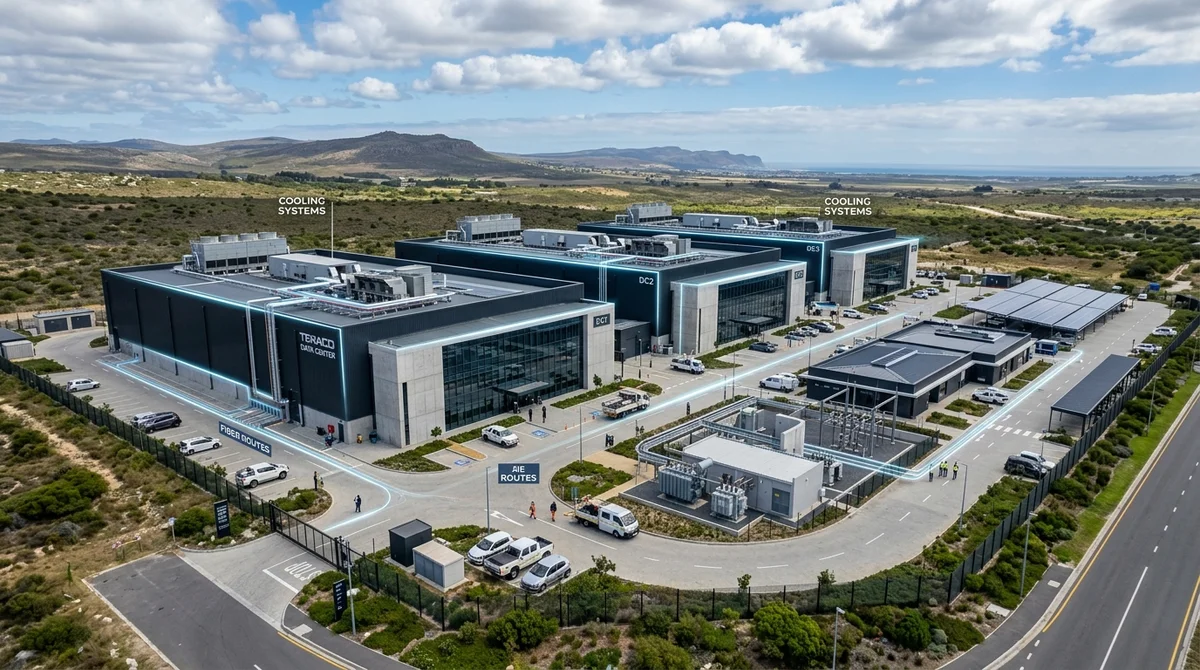
Equinix plans to expand its network of data centers in South Africa with a 7.5 billion rand investment, aiming to keep pace with growing local demand for AI infrastructure. The company is clearly betting that the market on the continent is moving from talking about AI to actually spending on compute, storage and service hosting.
A bet on South Africa
Equinix, a global data center operator, has announced plans to build new facilities in South Africa under a 7.5 billion rand program, or roughly $438 million. This is not a token expansion for the sake of a formal presence, but a sizable investment in a market the company considers promising precisely because of the AI boom. When a player of this scale commits to capital-intensive infrastructure, it usually means it sees not a short-lived burst of interest but lasting future demand from businesses, cloud services and digital platforms.
For Equinix, South Africa looks like the most obvious entry point into the wider African market. It is easier here to bring new capacity online, connect international customers and serve companies that need lower latency and want to keep data closer to their users. As interest in generative AI and enterprise automation grows, local data centers are turning from a "back office" into core infrastructure for new products. Without them, it is hard to scale models, deploy services and keep AI applications running reliably in the region.
Why demand is accelerating
The Equinix investment matters for more than its size. It shows that demand for computing capacity in Africa has become large enough to justify building new facilities, not just leasing existing capacity. For the local market this is a particularly sensitive point: AI services need more servers, networking, cooling and reliable power than classic enterprise applications. The more actively companies launch AI features in-house, the faster the load on physical infrastructure grows.
In practice, several factors usually feed this demand at once:
- the launch of local AI services and corporate pilots that need stable infrastructure
- the wish to cut application latency and keep data closer to customers
- growing requirements for sovereign data storage and regional hosting of compute
- the expansion of cloud and SaaS platforms, which move more and more workload into data centers
There is also a broader effect on the ecosystem. When new international-grade data centers appear on the market, startups and large companies get more options for where to run AI products, reserve capacity and build hybrid setups between local infrastructure and global clouds. This lowers the barrier to entry for those who previously depended on facilities outside the region. At the same time, telecom operators, energy suppliers and integrators grow in importance: the AI economy pulls along a whole chain of infrastructure contractors, not just the owner of the server halls.
For business, this means the market is gradually maturing. If many companies on the continent could previously test AI tools through external clouds without a local presence, it now makes economic sense to build capacity on site. This also changes competition: the winners will be not only model developers but also those who control the channels that deliver compute, from colocation and interconnection to cloud integration. Equinix is essentially betting on this layer of the market.
What this means
Equinix's expansion in South Africa is a sign that the AI boom is showing up not only in new models and applications but also in heavy infrastructure spending. If such projects continue, Africa will get more local AI capacity, and businesses will depend less on remote facilities and have better conditions for launching their own services.
Key Questions Answered
What are the key details on A bet on South Africa?
Equinix, a global data center operator, has announced plans to build new facilities in South Africa under a 7.5 billion rand program, or roughly $438 million. This is not a token expansion for the sake of a formal presence, but a sizable investment in a market the company considers promising precisely because of the AI boom. When a player of this scale commits to capital-intensive infrastructure, it usually means it sees not a short-lived burst of interest but lasting future demand from businesses, cloud services and digital platforms. For Equinix, South Africa looks like t
Why demand is accelerating?
The Equinix investment matters for more than its size. It shows that demand for computing capacity in Africa has become large enough to justify building new facilities, not just leasing existing capacity. For the local market this is a particularly sensitive point: AI services need more servers, networking, cooling and reliable power than classic enterprise applications. The more actively companies launch AI features in-house, the faster the load on physical infrastructure grows. In practice, several factors usually feed this demand at once: the launch of local AI services
What this means?
Equinix's expansion in South Africa is a sign that the AI boom is showing up not only in new models and applications but also in heavy infrastructure spending. If such projects continue, Africa will get more local AI capacity, and businesses will depend less on remote facilities and have better conditions for launching their own services.
Test Frontier LLMs & Autonomous Agents in One Workspace
Run Claude Opus 5.5, GPT-6, Gemini 3.1, and DeepSeek side-by-side in Nomad AI (nomadnet.ai) — unified model routing, deep research, and multimodal workflows under one subscription.
The AI world, distilled — once a week
Seven stories that actually mattered, hand-picked. No noise, no reposts, no press releases.
Done! Check your inbox for a confirmation.