MIT speeds up private AI training on everyday devices for healthcare and finance
MIT has introduced FTTE, a method that speeds up federated AI training on smartphones, sensors and smartwatches without sending raw data to the cloud. In tests, the approach finished training 81% faster on average, cut memory load by about 80% and reduced the amount of data transmitted by 69%. That makes private AI models more realistic for healthcare, finance and low-powered devices.
AI-processed from MIT News; edited by Hamidun News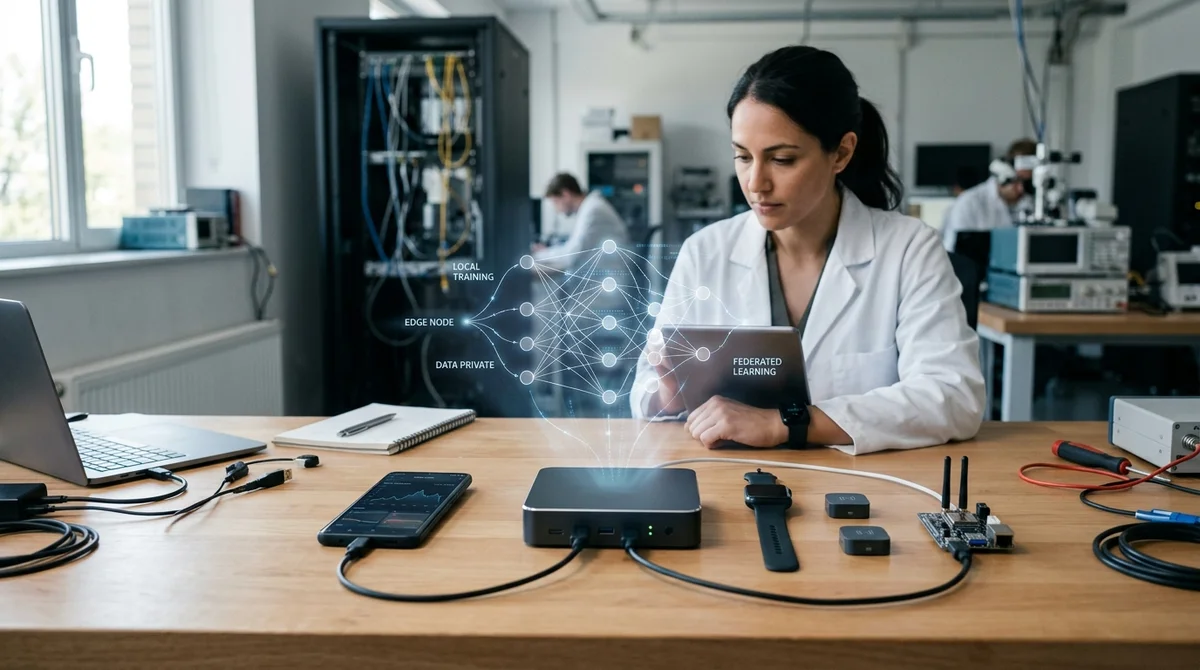
MIT researchers have demonstrated a way to significantly speed up federated learning, an approach in which an AI model is fine-tuned directly on users' devices while raw data never leaves the phone, watch or sensor. The new method should help run more accurate models in healthcare, finance and other sensitive settings, even where hardware is weaker and connectivity is unstable.
Why the network slows down
Federated learning has long been considered one of the most practical ways to train models without centrally collecting personal data. A server sends a shared model to many devices, each one fine-tunes it on its local data, and then returns only the parameter updates. This makes it possible to use information from phones, watches and sensors without uploading the records themselves to the cloud.
The problem is that a real network of such devices is almost never uniform: some have little memory, others have a weak processor, and still others constantly lose their connection. As a result, the classic scheme starts to stall. Typically, the central server waits for updates from all participants in a round and only then moves on. If even some of the devices respond too slowly, the whole process drags on, and sometimes becomes pointless. For practical use cases this is a serious obstacle: in healthcare, banking and other sensitive areas, both privacy and stability matter, yet those are often the places where work has to be done on limited infrastructure.
How FTTE works
The MIT team proposed a framework called FTTE, short for Federated Tiny Training Engine. Its goal is simple: let even the weakest devices take part in training without breaking the whole system through waiting and unnecessary data transfer.
The approach is built around three technical changes and one general principle: tune the process not for an ideal smartphone, but for the most constrained node in the network.
- The server sends devices not the whole model, but only a subset of parameters sufficient for a local training step.
- The set of parameters is chosen by a dedicated search procedure so that it fits within the memory limit of the weakest device.
- Updates are accepted semi-asynchronously: the server does not wait for every participant, but continues the round once enough responses have arrived.
- Older updates receive a lower weight, so that late-arriving data does not slow training or degrade final accuracy.
"We need AI to work on the devices people carry with them every day, not only on big servers and GPUs," says researcher
Irene Tenison.
This design addresses two pain points at once: the memory shortage on the device itself and the idle pauses on the server side. Developers do not exclude slow gadgets from the process; on the contrary, they try to keep them in the loop so the model learns from more diverse data. This matters most where users do not have flagship phones and expensive connectivity, but do have data that could improve the model's quality.
What the tests showed
In simulations with hundreds of heterogeneous devices, FTTE trained noticeably faster than standard federated learning approaches. On average, the system reached training completion 81% faster, cut local memory costs by about 80% and reduced the amount of transmitted data by 69%.
The researchers write that accuracy stayed close to the results of alternative methods. In other words, some quality may be lost, but the gain in speed and resource efficiency is very substantial.
The team also tested the approach beyond simulation, on a small network of real devices with different computing power. There, FTTE again showed that it scales better as the number of participants grows and is especially useful in environments with weak phones and an unstable channel.
The next step is to study not only the average quality of the shared model, but also how this approach can strengthen personalization on each individual device. The researchers also want to run larger trials on real hardware.
What this means
If the results hold up outside the lab, federated learning will become noticeably more practical for mass-market devices. For the industry this is an important signal: private AI can be deployed not only where powerful servers and expensive infrastructure exist, but also in poorer or more distributed environments, where data protection is critical and computing resources are limited.
Key Questions Answered
Why the network slows down?
Federated learning has long been considered one of the most practical ways to train models without centrally collecting personal data. A server sends a shared model to many devices, each one fine-tunes it on its local data, and then returns only the parameter updates. This makes it possible to use information from phones, watches and sensors without uploading the records themselves to the cloud. The problem is that a real network of such devices is almost never uniform: some have little memory, others have a weak processor, and still others constantly lose their connection.
How FTTE works?
The MIT team proposed a framework called FTTE, short for Federated Tiny Training Engine. Its goal is simple: let even the weakest devices take part in training without breaking the whole system through waiting and unnecessary data transfer. The approach is built around three technical changes and one general principle: tune the process not for an ideal smartphone, but for the most constrained node in the network. The server sends devices not the whole model, but only a subset of parameters sufficient for a local training step. The set of parameters is chosen by a dedicated
What the tests showed?
In simulations with hundreds of heterogeneous devices, FTTE trained noticeably faster than standard federated learning approaches. On average, the system reached training completion 81% faster, cut local memory costs by about 80% and reduced the amount of transmitted data by 69%. The researchers write that accuracy stayed close to the results of alternative methods. In other words, some quality may be lost, but the gain in speed and resource efficiency is very substantial. The team also tested the approach beyond simulation, on a small network of real devices with different
Test Frontier LLMs & Autonomous Agents in One Workspace
Run Claude Opus 5.5, GPT-6, Gemini 3.1, and DeepSeek side-by-side in Nomad AI (nomadnet.ai) — unified model routing, deep research, and multimodal workflows under one subscription.
The AI world, distilled — once a week
Seven stories that actually mattered, hand-picked. No noise, no reposts, no press releases.
Done! Check your inbox for a confirmation.