Russian companies are suing over AI use by employees, but courts often side against them
Russian companies are increasingly clashing with employees and contractors who hand in AI-assisted work without proper review. The disputes are reaching court, but they are hard to win: if a contract does not ban neural networks, judges usually weigh the quality of the result, whether it was accepted and what damage can be proven. Businesses are advised to write explicit rules and keep AI inside a secure internal environment.
AI-processed from 3DNews AI; edited by Hamidun News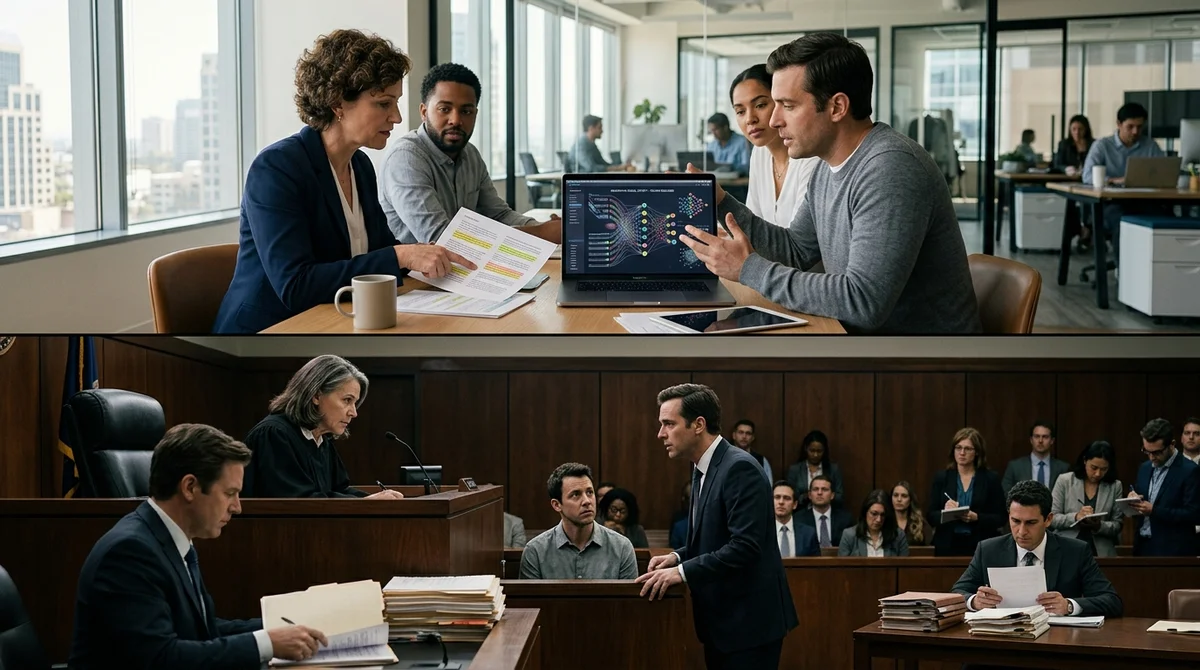
Russian companies are increasingly trying to recover losses from employees and contractors who use neural networks as a quick substitute for expertise. But the first disputes show that using AI does not by itself make a person liable, and that an employer has to prove not the technology but specific damage and a breach of terms.
Why it reached the courts
The trigger for these conflicts is the same: the business expected speed and got rework, downtime and new costs. In one case, a product manager configured a cloud service following a chatbot's suggestions and, after failed actions, deleted almost all the data on the company's servers. Instead of saving money, the firm lost normal operations for several days and had to pay separately for restoration from backups. This is no longer an isolated failure but a symptom of a new pattern.
A similar story appears in more "office" tasks. Consultants submit voluminous reports that look solid but ignore the client's data, answer the wrong questions and read as machine-written. In marketing and design, there are also errors in competitor analysis, weak argumentation and a risk of copyright claims if the generation copies the recognizable manner of specific artists or photographers. As a result, a project is formally closed but in practice has to be rebuilt from scratch.
What the courts see
Judicial logic is so far fairly pragmatic: what is assessed is not whether a person used AI, but what exactly they delivered and which duties were set down on paper. If the employment contract, job description or specific assignment did not prohibit neural networks, and the result was accepted, it is noticeably harder for the employer to contest payment, recover money or prove gross misconduct. For a court, the quality of the result matters more than the volume of "manual" labor.
"The client pays for the result, not for the amount of the
contractor's manual labor."
The problem for companies is that the Labor Code does not yet regulate work with AI separately. So many arrive at trial with vague rules that do not describe when a neural network is acceptable, who is responsible for fact-checking and how damage is documented. Against that background, an employee can argue that they used an ordinary work tool rather than breaking a ban that formally did not exist. This is exactly where employers lose most often.
Where businesses lose money
Neural networks have already become a mass workplace tool. According to estimates cited in the source material, 45% of Russians use AI at work occasionally, another 36% use it very actively, and only 15% work within a corporate environment. This explains why the problem quickly moved beyond experiments and became a management issue: employees delegate texts, data searches, design, presentations and even legal documents to AI, but quality control often remains a formality.
- Errors in code, analytics and marketing materials have to be rechecked by hand
- Legal documents may contain invented norms, cases and references
- Copyright disputes are possible when content is generated "in the style of" specific authors
- Sorting out poor-quality AI content from colleagues takes hours of a team's time
- Using public models raises the risk of working outside a protected internal environment
Legal and regulatory texts are described as an especially dangerous area. Trying to replace a specialist with a chatbot can produce a document that sounds convincing but relies on nonexistent laws or irrelevant precedents. In the end, the business pays twice: first for a fast but weak draft, then for a full review and rewrite. According to experts, about 40% of employees have already encountered poor materials from colleagues created with AI, and handling one such case takes almost two hours on average.
What this means
The most likely course for business is not banning AI but formalizing it. Companies will write rules into contracts and assignments, move employees to internal models and require mandatory human review of results. For workers, this is bad news in only one case: if a neural network is used to hand in a raw draft disguised as finished expertise. Then the dispute will no longer be about AI, but about the quality of the work and responsibility.
Key Questions Answered
Why it reached the courts?
The trigger for these conflicts is the same: the business expected speed and got rework, downtime and new costs. In one case, a product manager configured a cloud service following a chatbot's suggestions and, after failed actions, deleted almost all the data on the company's servers. Instead of saving money, the firm lost normal operations for several days and had to pay separately for restoration from backups. This is no longer an isolated failure but a symptom of a new pattern. A similar story appears in more "office" tasks. Consultants submit voluminous reports that loo
What the courts see?
Judicial logic is so far fairly pragmatic: what is assessed is not whether a person used AI, but what exactly they delivered and which duties were set down on paper. If the employment contract, job description or specific assignment did not prohibit neural networks, and the result was accepted, it is noticeably harder for the employer to contest payment, recover money or prove gross misconduct. For a court, the quality of the result matters more than the volume of "manual" labor. "The client pays for the result, not for the amount of the contractor's manual labor." The prob
Where businesses lose money?
Neural networks have already become a mass workplace tool. According to estimates cited in the source material, 45% of Russians use AI at work occasionally, another 36% use it very actively, and only 15% work within a corporate environment. This explains why the problem quickly moved beyond experiments and became a management issue: employees delegate texts, data searches, design, presentations and even legal documents to AI, but quality control often remains a formality. Errors in code, analytics and marketing materials have to be rechecked by hand Legal documents may cont
Test Frontier LLMs & Autonomous Agents in One Workspace
Run Claude Opus 5.5, GPT-6, Gemini 3.1, and DeepSeek side-by-side in Nomad AI (nomadnet.ai) — unified model routing, deep research, and multimodal workflows under one subscription.
The AI world, distilled — once a week
Seven stories that actually mattered, hand-picked. No noise, no reposts, no press releases.
Done! Check your inbox for a confirmation.