Taylor Swift Protects Her Image and Voice Against Wave of TikTok Deepfakes in Scam Ads
Taylor Swift's efforts to protect her image and voice are well-founded: researchers discovered sponsored deepfake ads on TikTok featuring her, Rihanna, and other celebrities. The videos promise easy earnings for watching content, but clicking leads to external pages with personal data collection forms. The case demonstrates how quickly deepfakes have become a tool for everyday online fraud.
AI-processed from Wired; edited by Hamidun News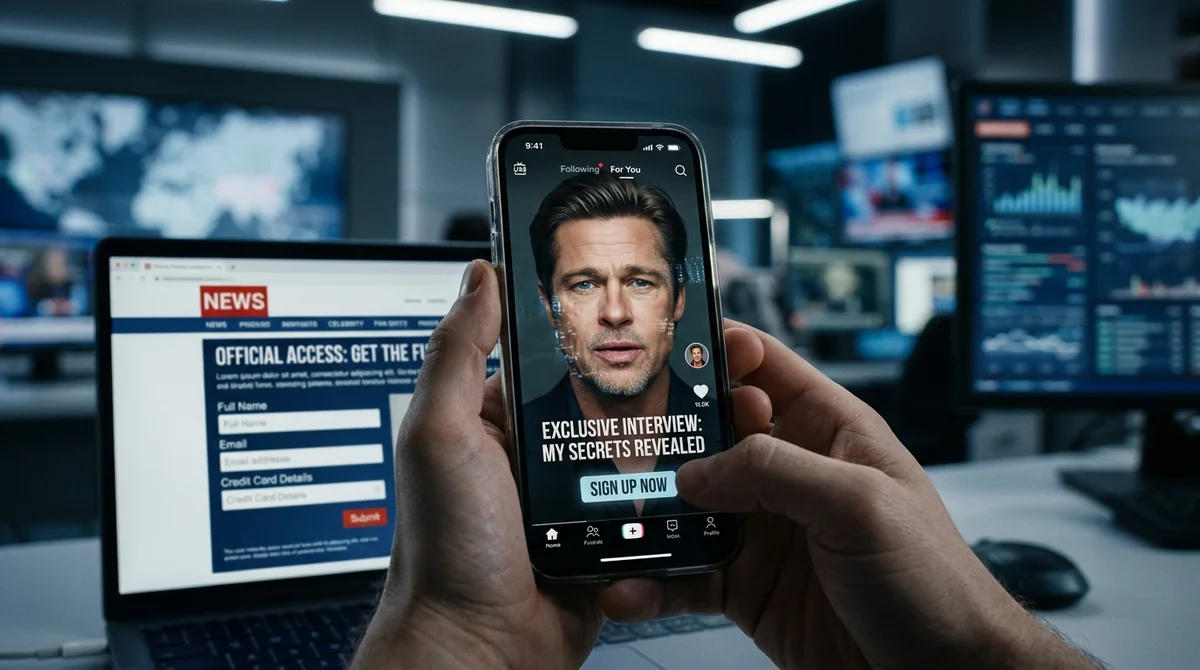
On April 24, Taylor Swift filed three trademark applications to protect her image and voice from AI deepfakes. The context seems quite practical: researchers discovered a wave of fraudulent advertising deepfakes on TikTok featuring celebrities that convince users to disclose personal data.
How the Scheme Works
According to Copyleaks, scammers take real interview fragments, red carpet appearances and TV show segments, then alter the video and audio as if Taylor Swift, Rihanna or Kim Kardashian were personally promoting a new earning opportunity within TikTok. The videos use synthetic voices and visual filters that smooth out generation artifacts. Because of the familiar context — studio, microphone, host, recognizable angle — the fake looks not like rough editing, but like an ordinary media interview fragment.
"If the page opened for you, don't think long."
One example — a fake Swift talking about the TikTok Pay feature and encouraging viewers to check if the program is available to them. After clicking, the user ends up not on TikTok, but on a third-party page with platform logos and a form to enter name and other personal information. Researchers separately note that such landing pages looked hastily assembled, and in some URLs and interface elements there was a visible connection to Lovable — a service for quickly building web pages.
Why They Target Stars
Celebrity faces here are needed not for reach, but for trust. The user sees a familiar person in a familiar setting and intuitively lowers their skepticism threshold. In the Copyleaks case, not only Swift but also Rihanna, Kim Kardashian and other celebrities are featured. Moreover, this is not about a fan meme, but about sponsored advertising — the videos were promoted by the platform's own algorithms and could reach a wide audience as regular promos.
- real original interview instead of a fully generated scene
- AI voice clone with familiar intonation
- filters and compression hiding video artifacts
- branded TikTok elements on the landing page
- promise of easy reward for simple action
Against this backdrop, Swift's move looks not symbolic but defensive. The singer filed three applications: one for an image from her Eras Tour concert and two for short voice identifiers — "Hey, it's Taylor Swift" and "Hey, it's Taylor". Formally this is a story about brand protection, but essentially — an attempt to obtain additional legal tools against fake promotional videos with her face and AI copies, which are now created faster, cheaper and in bulk.
The Problem Is Broader Than TikTok
The story doesn't come down to one singer or one platform. This scheme fits into a wider market of fraudulent advertising on social networks. This week the FTC reported that losses from fraud that began on social networks reached **$2.
1 billion** in 2025. Most often people encountered fake stores and investment schemes, and social networks became a convenient entry point for deception: familiar interface, targeting and the feeling that you're just looking at another regular promotional post. Meanwhile, in the US, first legal consequences around AI deepfakes are already emerging: in April, the first conviction under a new federal law against "intimate" visual deepfakes was recorded.
But the Swift case shows another side of the problem — not sexualized content, but commercial fraud and data collection under the guise of recommendations from celebrities. For platforms, this is an unpleasant signal: even if moderation knows how to find obvious misinformation, videos with fake endorsement at the intersection of advertising, phishing and generative video pass much better.
What This Means
Deepfakes have definitively moved out of the category of viral memes and become a working tool of social engineering. If previously the risk for stars was measured by reputation, now it's directly related to phishing, data theft and legal protection of digital identity.
Need AI working inside your business — not just in your newsfeed?
I build production AI for companies — custom CRM, internal tools, autonomous agents, workflow automation. Owned by you, shaped to your process, no per-seat tax. Built by Zhemal Khamidun, CPO of AlpinaGPT (AI platform, 6,000+ users).
The AI world, distilled — once a week
Seven stories that actually mattered, hand-picked. No noise, no reposts, no press releases.
Done! Check your inbox for a confirmation.