US emergency services say Waymo robotaxis are increasingly getting in the way on calls
US emergency services are sharpening their criticism of Waymo. They say the robotaxis freeze in place more often, obstruct traffic and don't always understand signals from officers directing traffic. In San Francisco, the cars block fire station exits, and in Austin one of them delayed an ambulance on its way to a shooting. As the service expands, regulators are already tightening the rules.
AI-processed from Wired; edited by Hamidun News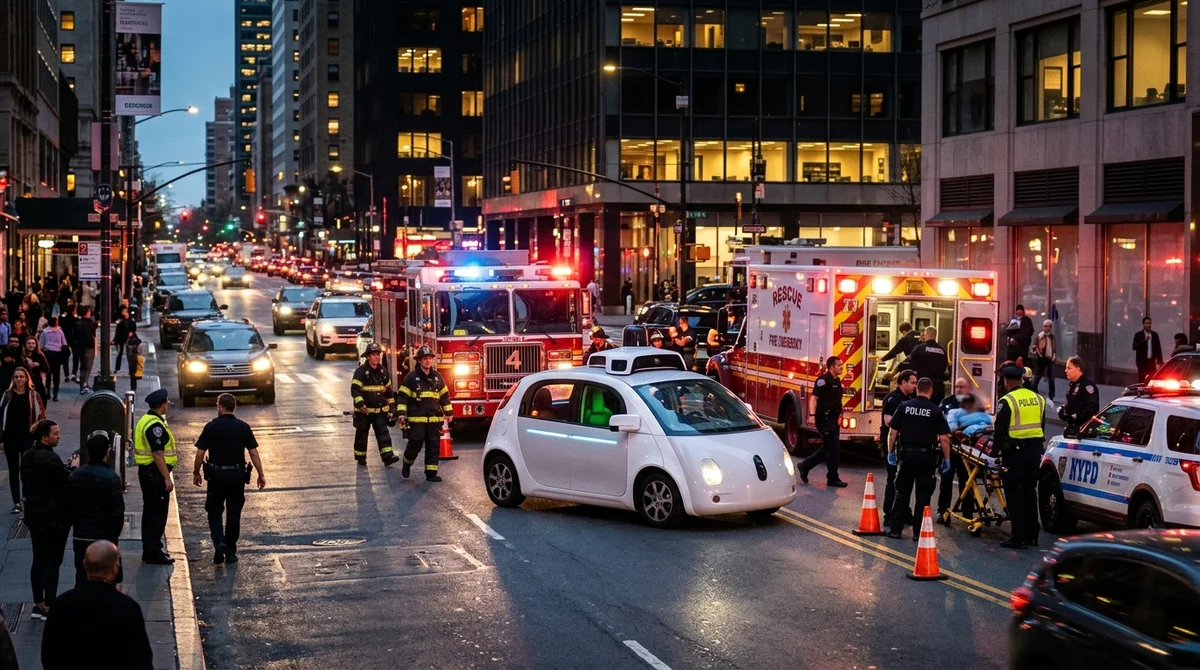
Emergency services in the US say Waymo's driverless taxis are causing problems more often during real emergency calls. Firefighters, police and paramedics aren't complaining about isolated glitches but about a recurring pattern: the cars freeze, fail to understand signals from people and eat up time in situations where every minute counts.
Complaints are mounting
At a closed-door meeting with the federal regulator NHTSA in March 2026, officials from San Francisco and Austin no longer talked about the technology's growing pains. They talked about backsliding. Mary Ellen Carroll, head of San Francisco's Department of Emergency Management, said the city is seeing "regression" in areas that had seemed to be improving. According to local agencies, Waymo vehicles are again breaking traffic rules more often, and in some scenarios they behave worse than they did a few years ago.
For firefighters, this isn't an abstract debate about the future of transportation. San Francisco Fire Chief Patrick Rabbitt said Waymo cars increasingly block fire station exits and keep crews from rolling out quickly on calls. In Austin, William White, who heads the police traffic unit, added that the service was deployed too fast and too widely — hundreds of vehicles at a time when the technology wasn't yet ready for chaotic street conditions.
What happens on the street
The main complaint from emergency services is how the cars behave in unusual situations that have no predefined script. Austin police said the robotaxis often "hang" when officers on motorcycles show up nearby, when traffic is directed manually or when roads are closed after incidents. According to them, the cars don't always recognize hand signals from officers directing traffic, even though Waymo had previously assured agencies that its system understands those signals. As a result, even a brief hesitation can set off a chain of delays around an incident scene.
"Their default reaction is to freeze," is how
San Francisco's fire chief described Waymo's behavior.
In April 2026, Austin officials discussed an incident in which a driverless car blocked an ambulance for two minutes on its way to a downtown shooting where three people died and at least 14 were injured. In San Francisco, similar questions came up after a massive power outage in December 2025: more than 60 Waymo cars had to be moved manually because they couldn't properly get through intersections without working traffic lights. In one case, a 911 operator waited 53 minutes for an answer on Waymo's hotline.
New rules
The problem is getting worse as the service grows quickly. As of April 2026, Waymo carries passengers without a driver in parts of ten US cities and plans to open ten more markets by the end of the year, including London. The company says it completes about 500 thousand paid rides per week and cites its own safety data: by its numbers, Waymo has noticeably fewer serious injury crashes than human drivers over comparable mileage.
Against this backdrop, authorities are starting to turn accumulated complaints into formal requirements. California's DMV approved new rules for driverless vehicles on April 28, 2026, and some requirements of AB 1777 take effect on July 1, 2026. The focus is no longer just on crash rates but also on how vehicles and remote operators must behave during fires, road closures and police operations. It's a direct response to cities' complaints that at critical moments emergency services take too long to reach a human who is actually in control of the situation.
- remote operators must respond to emergency services within 30 seconds
- the right to temporarily close zones to driverless vehicles during emergencies
- a requirement to move vehicles out of such a zone within two minutes
- clearer communication procedures between emergency services and driverless service operators
Waymo says in response that it values feedback from emergency services and has already trained more than 35 thousand first responders in person across the country. The company also says that after the December blackout in San Francisco it changed some internal procedures and stepped up coordination with city agencies. But the core criticism from police and firefighters hasn't changed: when a car gets stuck, it's too often the people on the scene, not the system itself, who have to sort things out.
What it means
The Waymo story exposes robotaxis' weak spot — not in ordinary map-guided rides, but in rare, high-stress scenarios where a car has to read context quickly, understand gestures and yield to humans. For the market, it's a signal that driverless scaling will now be judged not only on crash statistics but also on how the cars handle real-world urban chaos.
Key Questions Answered
What are the key details on Complaints are mounting?
At a closed-door meeting with the federal regulator NHTSA in March 2026, officials from San Francisco and Austin no longer talked about the technology's growing pains. They talked about backsliding. Mary Ellen Carroll, head of San Francisco's Department of Emergency Management, said the city is seeing "regression" in areas that had seemed to be improving. According to local agencies, Waymo vehicles are again breaking traffic rules more often, and in some scenarios they behave worse than they did a few years ago. For firefighters, this isn't an abstract debate about the futu
What happens on the street?
The main complaint from emergency services is how the cars behave in unusual situations that have no predefined script. Austin police said the robotaxis often "hang" when officers on motorcycles show up nearby, when traffic is directed manually or when roads are closed after incidents. According to them, the cars don't always recognize hand signals from officers directing traffic, even though Waymo had previously assured agencies that its system understands those signals. As a result, even a brief hesitation can set off a chain of delays around an incident scene. "Their def
What are the key details on New rules?
The problem is getting worse as the service grows quickly. As of April 2026, Waymo carries passengers without a driver in parts of ten US cities and plans to open ten more markets by the end of the year, including London. The company says it completes about 500 thousand paid rides per week and cites its own safety data: by its numbers, Waymo has noticeably fewer serious injury crashes than human drivers over comparable mileage. Against this backdrop, authorities are starting to turn accumulated complaints into formal requirements. California's DMV approved new rules for dri
Test Frontier LLMs & Autonomous Agents in One Workspace
Run Claude Opus 5.5, GPT-6, Gemini 3.1, and DeepSeek side-by-side in Nomad AI (nomadnet.ai) — unified model routing, deep research, and multimodal workflows under one subscription.
The AI world, distilled — once a week
Seven stories that actually mattered, hand-picked. No noise, no reposts, no press releases.
Done! Check your inbox for a confirmation.