SoftBank Launches Roze AI: Robots to Build Data Centers, Targeting a $100 Billion Valuation
SoftBank is putting together a new US company, Roze AI. Its job is to speed up data center construction with autonomous robots so infrastructure can be deployed faster for the AI boom. Inside the group, executives are also discussing a stock market listing in the second half of 2026 at a valuation of around $100 billion, although some managers think that pace is too aggressive.
AI-processed from TechCrunch; edited by Hamidun News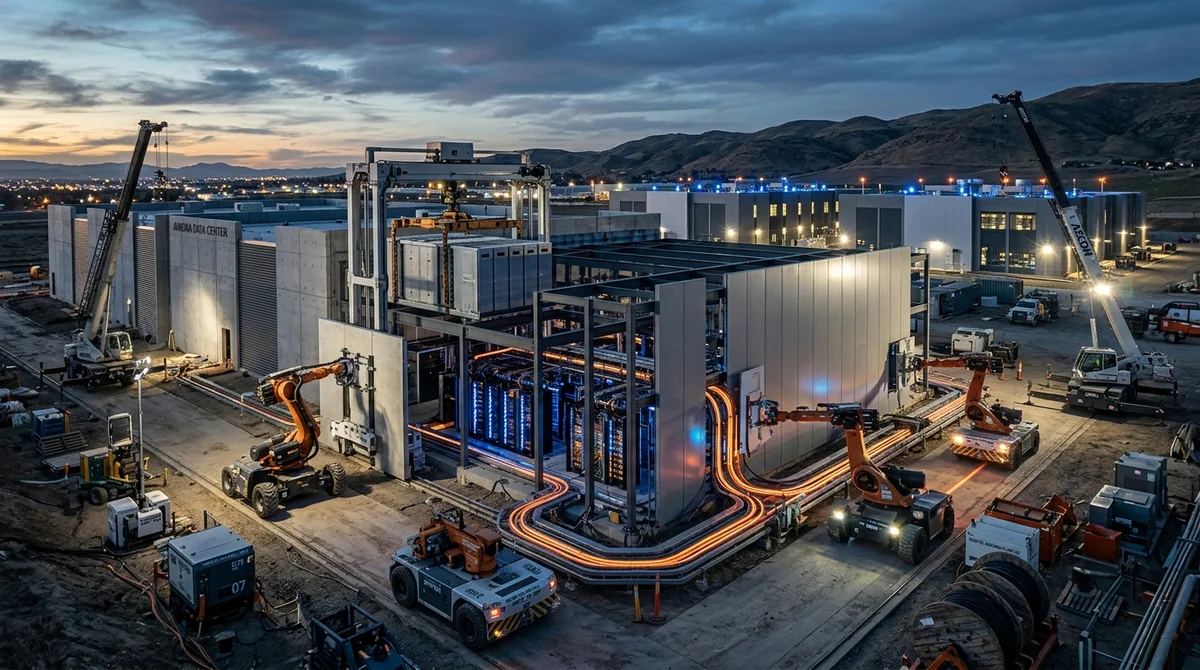
SoftBank plans to create a new US company, Roze AI, that will automate data center construction using autonomous robots. According to the Financial Times and The Wall Street Journal, the group is discussing not only launching the project but also a possible stock market listing in the second half of 2026, with a target valuation of around $100 billion.
Why SoftBank needs Roze AI
The idea looks like a near-closed loop of the AI boom: building artificial intelligence systems requires data centers, and to build data centers faster, SoftBank wants to use artificial intelligence and robots. The task is practical: speed up the rollout of server infrastructure in the US, where demand for computing capacity is growing faster than new sites appear.
For SoftBank, this is a logical extension of a strategy in which AI is not just models and chips but the entire physical base around them. Whoever controls the speed of building, connecting and commissioning data centers gains an advantage across the whole chain. In this market, the winner is not only the one with the best algorithm but the one that can bring a new facility online faster than anyone else.
What is known about the project
According to the Financial Times, the new entity will be called Roze AI. The Wall Street Journal writes that its goal is to make US data center construction more efficient, including through autonomous robots that will help build server campuses. So far, this is one of the few cases where a major technology group is trying to turn the process of building AI infrastructure into a standalone product and an independent public company.
Here is what is currently known about the project:
- the company is being created for the US market
- the focus is construction and deployment of data centers
- one of the key tools is autonomous robots
- some executives want to take the business public as early as the second half of 2026
- the desired valuation may reach around $100 billion
Key details are still missing, though. It is unclear which robotic systems will be used, whether Roze AI will build its own automation stack or integrate contractors' solutions, and how much work can realistically be removed from the manual process. But the framing itself is telling: SoftBank wants to earn money not only from AI services or chips, but from a machine that helps physically bring up the infrastructure for them.
Where the weak spots are
The project's ambition is huge, and the questions around it are just as numerous. The Financial Times notes that inside SoftBank there is skepticism about both the valuation and the timing of the listing. The company is only just taking shape, yet the talk is already of a market capitalization on par with the largest public players in the infrastructure market. For such a valuation, investors usually expect not a concept but clear revenue, proven demand and a sustainable operating model.
"Some inside
SoftBank are skeptical of the valuation and the proposed IPO timing."
SoftBank's own history adds to the doubts, since it has made very bold bets more than once. The company has had big successes but also expensive misses: the publication recalls that the group once invested hundreds of millions of dollars in Zume, an AI pizza-delivery startup that shut down in 2023. That does not mean Roze AI will repeat the same fate, but it shows the gap between a big visionary idea and real execution.
There is also a purely industry risk: data centers are not built with concrete and robots alone. They need land, permits, power supply, network connections, transformers, server hardware and long coordination with contractors. Even very strong automation will not remove every bottleneck. But if SoftBank's new business can cut launch times by even a few months, demand from large cloud operators and AI labs could be very high.
What this means
The AI market is moving ever deeper into hardware and physical infrastructure. After the race for models and chips, a race for the speed of building capacity begins. If SoftBank manages to package this process into a separate business, one of the most valuable AI assets may turn out to be not another chatbot but a company that builds the buildings for everyone else.
- Nov 1, 2026Local models lose to Opus and Codex: 0.21 on a MacBook versus 1.00 for Codex
- Nov 1, 2026Adobe's EditAgent judge picks a usable edit 81.3% of the time, versus 74.8% for EditScore
- Nov 1, 202616 models tested on 7 search tools: Exa averaged 10.5 out of 14, SearXNG about 3
- Nov 1, 2026Google's StreamVibe video agent beats other models by 10.7% on response timing and quality
Key Questions Answered
Why SoftBank needs Roze AI?
The idea looks like a near-closed loop of the AI boom: building artificial intelligence systems requires data centers, and to build data centers faster, SoftBank wants to use artificial intelligence and robots. The task is practical: speed up the rollout of server infrastructure in the US, where demand for computing capacity is growing faster than new sites appear. For SoftBank, this is a logical extension of a strategy in which AI is not just models and chips but the entire physical base around them. Whoever controls the speed of building, connecting and commissioning data
What is known about the project?
According to the Financial Times, the new entity will be called Roze AI. The Wall Street Journal writes that its goal is to make US data center construction more efficient, including through autonomous robots that will help build server campuses. So far, this is one of the few cases where a major technology group is trying to turn the process of building AI infrastructure into a standalone product and an independent public company. Here is what is currently known about the project: the company is being created for the US market the focus is construction and deployment of da
Where the weak spots are?
The project's ambition is huge, and the questions around it are just as numerous. The Financial Times notes that inside SoftBank there is skepticism about both the valuation and the timing of the listing. The company is only just taking shape, yet the talk is already of a market capitalization on par with the largest public players in the infrastructure market. For such a valuation, investors usually expect not a concept but clear revenue, proven demand and a sustainable operating model. "Some inside SoftBank are skeptical of the valuation and the proposed IPO timing." Soft
Test Frontier LLMs & Autonomous Agents in One Workspace
Run Claude Opus 5.5, GPT-6, Gemini 3.1, and DeepSeek side-by-side in Nomad AI (nomadnet.ai) — unified model routing, deep research, and multimodal workflows under one subscription.
The AI world, distilled — once a week
Seven stories that actually mattered, hand-picked. No noise, no reposts, no press releases.
Done! Check your inbox for a confirmation.