Micro1 Hires People Worldwide to Train Humanoids as the AI Market Demands New Benchmarks
As the humanoid robot market heats up, Micro1, Scale AI and DoorDash are already paying people to film ordinary household chores, from ironing to washing dishes. Robots need this footage to learn how to operate in the real world. The new data market also brings growing concerns about privacy, consent and the quality of AI testing itself: high benchmark scores increasingly fail to match real-world value in actual workflows.
AI-processed from MIT Technology Review; edited by Hamidun News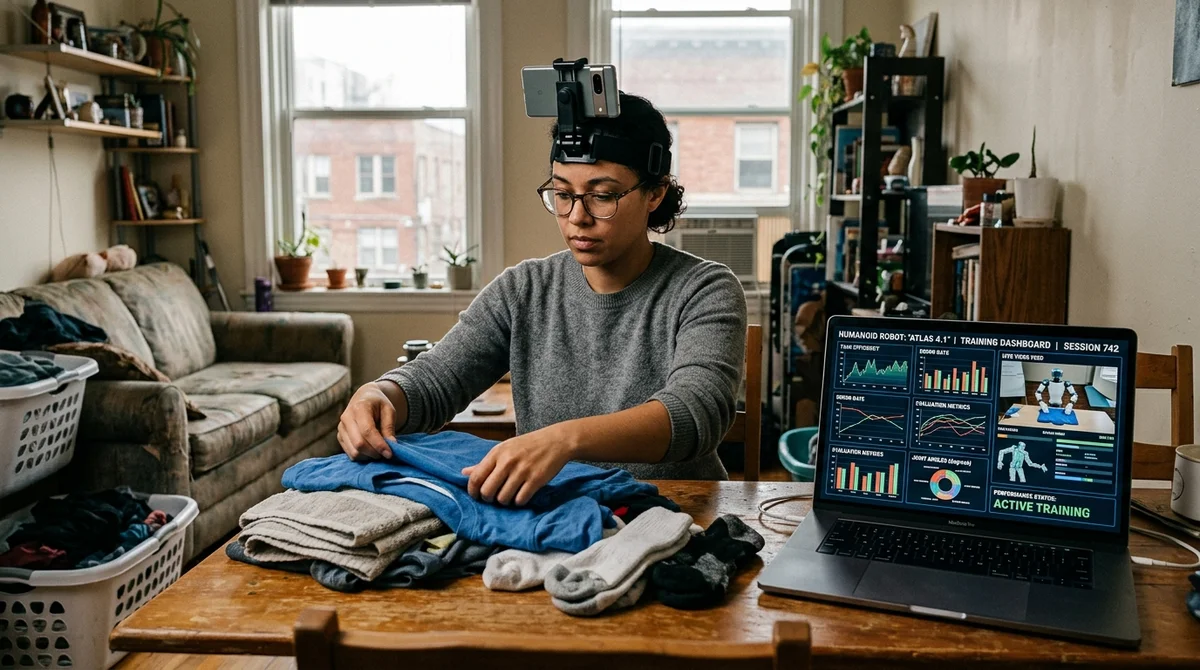
Embodied AI is no longer constrained only by hardware. It now also depends on human data: thousands of people around the world are filming themselves doing laundry, ironing and cleaning at home to train humanoid robots. At the same time, researchers are increasingly vocal that standard AI tests reveal almost nothing about how these systems will behave in real work.
How humanoids are trained
One of the most visible companies in this new layer of the market is Micro1. It hires contractors in more than 50 countries, including Nigeria, India and Argentina, to record everyday tasks from a first-person perspective: folding clothes, washing dishes, wiping tables, pouring water, opening the fridge. Workers strap an iPhone to their head and shoot short clips with their hands in frame. The videos are then reviewed, annotated and packaged into datasets that robotics companies buy.
The reasoning is simple: the internet was enough for large language models, but humanoid robots need the real physical world. Simulations help robots practice movements, but they poorly capture the chaos of an ordinary apartment: varied lighting, cramped kitchens, slippery surfaces, dozens of object types and countless ways to interact with them. That's why the market now includes not only Micro1 and Scale AI, which has collected more than 100 thousand hours of such footage, but also new channels like DoorDash Tasks.
On March 19, 2026, DoorDash officially launched a pilot that pays workers to film household tasks and record speech for AI and robotics. Even hundreds of thousands of hours of video don't yet look like the ceiling of market demand.
"This will take longer than many people think," — roboticist
Ken Goldberg.
The cost of this data
For many workers, it's decent side income: a rate of about $15 an hour is competitive in a number of countries. But the work quickly becomes monotonous. Participants have to film similar actions over and over, invent new scenarios within a small apartment and make sure each recording follows the guidelines. One worker in Delhi said it could take him almost an hour to produce fifteen minutes of usable video, simply because there aren't many different tasks at home to put in front of the camera.
- An iPhone or another compatible smartphone is mounted at head level
- Clips are recorded in first person, usually 1–2 minutes long
- Hands and the object must stay in frame almost the entire time
- Variation in lighting, rooms, surfaces and objects is required
- Workers try to keep faces, names and other personal data out of the shot
The bigger issue isn't the tedium but privacy. Even when no face appears on camera, the videos still capture home interiors, medications in the kitchen, children's belongings, daily routines and neighbors who wander into the background. Meanwhile, workers often don't know who their recordings will eventually be sold to, how long they'll be stored, or whether they can get them deleted. Researcher Yasmine Kotturi says plainly that companies should explain upfront where this technology could ultimately lead and how it may affect the people involved in the future.
Why the tests break down
Alongside the race for data, another debate is heating up: how to measure AI quality in the first place. Researcher Angela Aristidou argues that the industry has spent too long thinking in terms of a school exam, where a model is compared with a human on an isolated task with a right or wrong answer. Real life rarely works that way. AI gets embedded in teams, protocols and long processes, where what matters is not just accuracy and speed but how the system affects human coordination, workload, trust and the number of errors in downstream steps.
Instead, Aristidou proposes an approach called HAIC — Human–AI, Context-Specific Evaluation. The idea is to test not the model in a vacuum but how the system performs inside an organization over a long horizon. In her examples, medical AI tools could look good on tests yet slow down work in hospitals, because doctors had to adapt their outputs to local reporting standards and regulatory requirements.
This approach shifts the focus along several lines at once:
- from individual tasks to teamwork and workflows
- from one-off tests to long-term effects
- from raw accuracy to coordination quality and error detection
- from a single answer to the consequences before and after it is used
For businesses, this is an inconvenient but useful idea. A high benchmark score doesn't yet mean a tool will speed up a hospital, a warehouse, a customer support team or a humanitarian organization. In one case Aristidou cites, a system was evaluated for 18 months inside real workflows, with separate tracking of how easily people spotted and corrected its errors. Only that kind of evaluation revealed which safeguards were actually needed before large-scale deployment.
What it means
The story of home trainers for robots and the debate over new benchmarks share one conclusion: the AI industry depends less and less on slick demos and more and more on the quality of its hidden infrastructure. The winners won't just be the companies with the flashiest robot or the highest test score, but those that can collect real-world data ethically, clearly explain the rules for handling it, and prove their systems' value inside real processes, not just on stage.
- Nov 2, 20268 Skills for video in Claude Code: from 244 pixel effects to rough-cut editing
- Nov 1, 2026Pika Labs releases open video model H3 Flex: 6 steps instead of 50
- Nov 1, 2026Google's StreamVibe video agent beats other models by 10.7% on response timing and quality
- Oct 31, 2026AI cartoon series: a 24-second episode built ten ways, the best cost 162 credits
Key Questions Answered
How humanoids are trained?
One of the most visible companies in this new layer of the market is Micro1. It hires contractors in more than 50 countries, including Nigeria, India and Argentina, to record everyday tasks from a first-person perspective: folding clothes, washing dishes, wiping tables, pouring water, opening the fridge. Workers strap an iPhone to their head and shoot short clips with their hands in frame. The videos are then reviewed, annotated and packaged into datasets that robotics companies buy. The reasoning is simple: the internet was enough for large language models, but humanoid ro
What are the key details on The cost of this data?
For many workers, it's decent side income: a rate of about $15 an hour is competitive in a number of countries. But the work quickly becomes monotonous. Participants have to film similar actions over and over, invent new scenarios within a small apartment and make sure each recording follows the guidelines. One worker in Delhi said it could take him almost an hour to produce fifteen minutes of usable video, simply because there aren't many different tasks at home to put in front of the camera. An iPhone or another compatible smartphone is mounted at head level Clips are rec
Why the tests break down?
Alongside the race for data, another debate is heating up: how to measure AI quality in the first place. Researcher Angela Aristidou argues that the industry has spent too long thinking in terms of a school exam, where a model is compared with a human on an isolated task with a right or wrong answer. Real life rarely works that way. AI gets embedded in teams, protocols and long processes, where what matters is not just accuracy and speed but how the system affects human coordination, workload, trust and the number of errors in downstream steps. Instead, Aristidou proposes a
Test Frontier LLMs & Autonomous Agents in One Workspace
Run Claude Opus 5.5, GPT-6, Gemini 3.1, and DeepSeek side-by-side in Nomad AI (nomadnet.ai) — unified model routing, deep research, and multimodal workflows under one subscription.
The AI world, distilled — once a week
Seven stories that actually mattered, hand-picked. No noise, no reposts, no press releases.
Done! Check your inbox for a confirmation.