Kakao Mobility unveils Level 4 roadmap for autonomous driving and physical AI
Kakao Mobility announced that it will develop Level 4 autonomous driving technology in-house as part of its physical AI strategy. The roadmap includes proprietary ML models, a fault-tolerant vehicle architecture, validation through simulations and real-world rides, and a 24/7 control center. The company already draws on data from its robotaxi service in Seoul's Gangnam district and is preparing an open ecosystem for partners.
AI-processed from AI News; edited by Hamidun News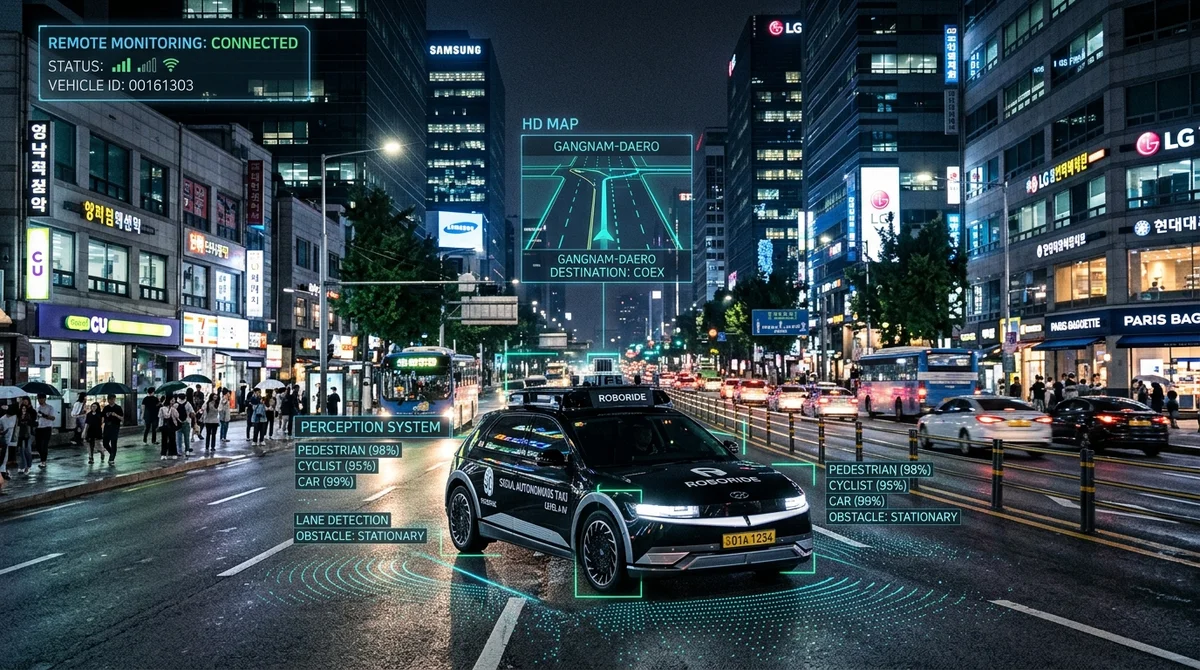
Kakao Mobility has explained how it intends to bring autonomous driving to Level 4 in-house and build it into its own mobility platform. This is not only about driverless cars as standalone vehicles, but about a full physical AI stack: from models and validation to dispatching, maps and remote oversight.
The Level 4 plan
The company presented its plans at World IT Show 2026 at COEX in Seoul. The presentation was given by Kim Jin-gyu, vice president and head of the Physical AI division. According to Yonhap, the show itself drew 460 companies and organizations from 17 countries.
The core idea is simple: Kakao Mobility wants to build autonomous services not as an isolated R&D project, but as part of its existing urban transport platform. Here, Level 4 means a mode in which the vehicle can drive without human involvement within a defined service area, and the passenger does not need to watch the road or be ready to take over immediately.
The roadmap rests on three technology blocks. The first is proprietary machine learning models for perceiving the surroundings, making decisions and controlling movement without a driver's help. The second is a vehicle architecture with redundancy for key systems, so critical functions keep working even if one component fails. The third is a validation platform that combines virtual simulations with data from real rides. This loop is needed not only for testing, but also for continuously improving service quality before scaling up.
"Beyond the idea, toward action: AI is moving reality."
Safety and oversight
A separate layer of the strategy is tooling for monitoring and safety during the ride itself. Kakao Mobility is building an integrated safety management platform for autonomous vehicles. One of its elements is the Autonomous Vehicle Visualizer, a 3D interface that shows in real time the vehicle's field of view and what it recognizes around it. For passengers, it is a way to understand the context in which the driverless car operates: which objects it sees, how it interprets the road situation and why it chooses a particular maneuver.
The next step is a 24/7 control center and an anomaly detection system based on vision-language models. These components are meant to analyze the situation in real time, support remote intervention and speed up response in abnormal scenarios. The company has not yet disclosed details about the specific model architecture or quality metrics, but the choice of a VLM approach itself suggests that Kakao wants to link visual perception of the road with more flexible contextual analysis, rather than limiting itself to a set of rigid rules and sensor triggers.
An open ecosystem
Kakao Mobility stresses separately that it does not intend to lock all its work inside the company. It wants to share part of its technology assets with other market players, from startups to automakers. The logic is clear: if every player builds the entire autonomous transport stack from scratch, the market will grow too slowly. So Kakao is betting on an open internal ecosystem that could strengthen the competitiveness of the South Korean market as a whole.
- large datasets for autonomous driving
- HD maps with detailed road geometry
- platform APIs for ride hailing and dispatching
- fleet management systems
- tools and resources for on-site response
As a working example, the company cites its night-time autonomous taxi service in Seoul's Gangnam district, available through the Kakao T app. According to the Seoul city government, from 26 September 2024 to 28 February 2026 the service completed 7,754 rides, and no accidents directly linked to autonomous driving technology were recorded in that period. The average load was about 24 rides per operating day. In April 2026 the service moved from a free pilot to a paid model, and the fleet grew from three to seven vehicles, not counting two backup cars.
What this means
Kakao Mobility is moving not toward a one-off robotaxi demo, but toward a platform model in which driverless operation is tied to data, maps, APIs and operational control. If the plan works, the company could aim to be not just a ride-hailing service, but a core infrastructure player for the Korean physical AI market.
- Nov 2, 2026Karpathy builds a YouTube clone with 6454 videos from Hacker News recommendations in two hours
- Nov 2, 2026Karpathy used Claude to build HackerTube from 6,454 videos recommended on Hacker News
- Nov 2, 2026Arca gives AI agents finance tasks lasting up to 10 days, but leaves the trades to humans
- Nov 2, 2026DeepSeek open-sources Super-agent prototype: p95 task completion time of 15.7 minutes vs. 29.5
Key Questions Answered
What are the key details on The Level 4 plan?
The company presented its plans at World IT Show 2026 at COEX in Seoul. The presentation was given by Kim Jin-gyu, vice president and head of the Physical AI division. According to Yonhap, the show itself drew 460 companies and organizations from 17 countries. The core idea is simple: Kakao Mobility wants to build autonomous services not as an isolated R&D project, but as part of its existing urban transport platform. Here, Level 4 means a mode in which the vehicle can drive without human involvement within a defined service area, and the passenger does not need to watch th
What are the key details on Safety and oversight?
A separate layer of the strategy is tooling for monitoring and safety during the ride itself. Kakao Mobility is building an integrated safety management platform for autonomous vehicles. One of its elements is the Autonomous Vehicle Visualizer, a 3D interface that shows in real time the vehicle's field of view and what it recognizes around it. For passengers, it is a way to understand the context in which the driverless car operates: which objects it sees, how it interprets the road situation and why it chooses a particular maneuver. The next step is a 24/7 control center a
What are the key details on An open ecosystem?
Kakao Mobility stresses separately that it does not intend to lock all its work inside the company. It wants to share part of its technology assets with other market players, from startups to automakers. The logic is clear: if every player builds the entire autonomous transport stack from scratch, the market will grow too slowly. So Kakao is betting on an open internal ecosystem that could strengthen the competitiveness of the South Korean market as a whole. large datasets for autonomous driving HD maps with detailed road geometry platform APIs for ride hailing and dispatch
Test Frontier LLMs & Autonomous Agents in One Workspace
Run Claude Opus 5.5, GPT-6, Gemini 3.1, and DeepSeek side-by-side in Nomad AI (nomadnet.ai) — unified model routing, deep research, and multimodal workflows under one subscription.
The AI world, distilled — once a week
Seven stories that actually mattered, hand-picked. No noise, no reposts, no press releases.
Done! Check your inbox for a confirmation.