GolangConf 2026 and Ontico: Go Teams Need to Fix Architecture, Not Code Speed
AI has sped up development, but it has not removed the main pain of Go teams: architecture and operations cannot keep pace with the speed of development. Ontico is building the new focus of GolangConf 2026 on this gap. The conference will have fewer abstract talks and more analysis of real problems: scaling, service coupling, technical debt, and the decisions that directly affect product resilience and business speed.
AI-processed from Habr AI; edited by Hamidun News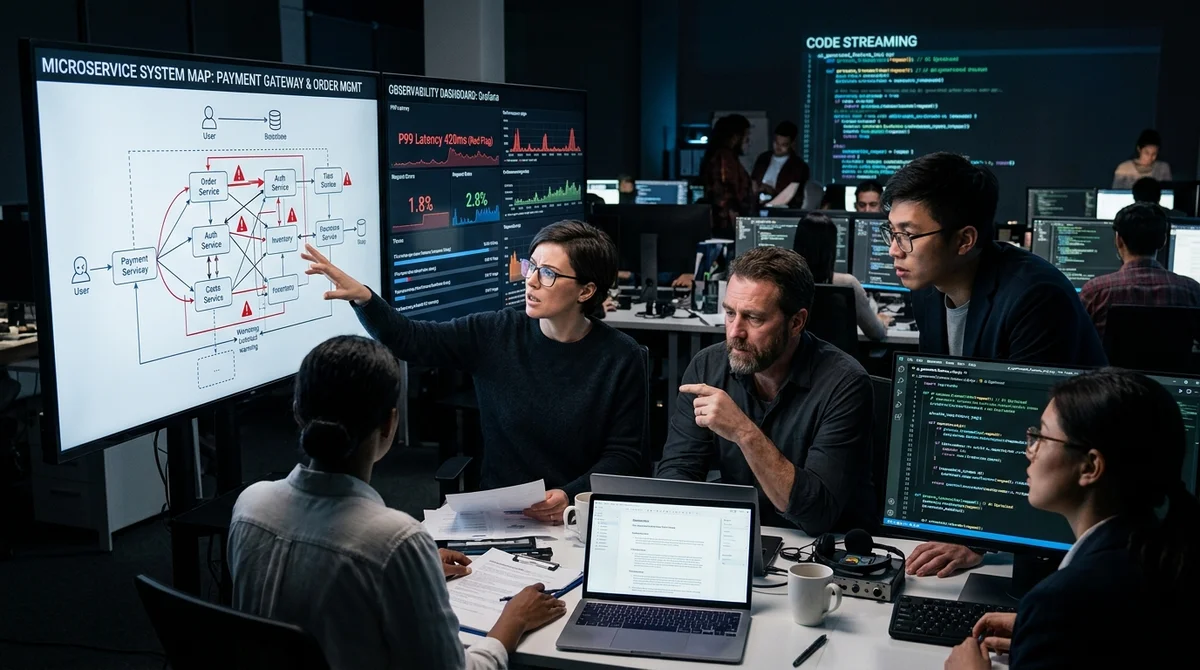
AI has sharply accelerated code production, but that has not made life easier for Go teams. The faster new services and features appear, the further architectural decisions, agreements and system boundaries fall behind. This gap between development speed and the ability to keep a platform coherent is becoming one of the main engineering problems of 2026.
A New Focus for GolangConf 2026
Against this backdrop, the Ontico team is shifting the focus of GolangConf 2026. The conference is no longer presented as a set of scattered talks about technology in general. The organizers propose to discuss what teams face every day: how to design services under constant growth, how not to drown in complexity after the next wave of automation, and how to rework engineering practice so that fast code does not turn into a slow business.
In recent years the industry has indeed learned to assemble microservices quickly, move load around and try new tools with relatively little pain. But along with that, the illusion that growth automatically makes a team mature has disappeared. The cheaper and faster implementation becomes, the more expensive platform-level mistakes get.
First Track: Architecture
The first track for Go teams is architecture. Generative tools help write handlers, integrations and internal utilities faster, but they do not make the key decisions for a team: domain boundaries, contracts between services, migration rules and acceptable coupling between components. As a result, code can appear faster than interaction schemas and technical principles can be updated.
For teams this means more hidden dependencies, more complicated releases and costlier mistakes at late stages. Where a single service once took weeks of discussion, the same days can now produce a ready skeleton, an API and the surrounding plumbing. But if these pieces are built without a single data model and clear boundaries of responsibility, the team gets not acceleration but accumulating debt.
That debt comes back as painful refactoring, conflicts between services and complex incidents where nobody can quickly pinpoint the source of the problem.
Second Track: Scaling and Resilience
The second track is scaling and operational resilience. Go has long been established as a language for high-load systems, infrastructure services and internal platforms, but today it is not only traffic that has to scale. Requirements are growing for observability, predictable service behavior and the cost of support. As products multiply and changes ship more often, weak spots show up sooner: non-obvious concurrency issues, fragile queues, badly configured retries, sprawling configs, and complex dependency chains between teams. This is especially visible in distributed systems, where even a small change in one place can unexpectedly hit latency, queues or infrastructure cost elsewhere. At this stage, the simple answer "let's just write faster" is no longer enough.
Third Track: How Work Is Organized
The third track is the organization of engineering work itself. If AI cuts the time spent on routine implementation, value shifts toward architecture review, sharing context, common standards and strong technical communication. Teams need not just to adopt new tools, but to learn to work in a mode where code is easy to generate while responsibility for the quality of decisions stays with people.
Hence the interest in a new format for professional meetups: instead of retelling slides, attendees jointly analyze real cases, trade-offs and failures that keep teams from moving forward. This also changes what is expected of developers: the valued person is not the one who simply writes new code fastest, but the one who sees the whole system best, knows how to set constraints and stops dangerous complexity in time. That is why professional communities are also forced to rethink how they communicate.
A Signal for the Go Ecosystem
For the Go ecosystem this is an important signal. The industry has entered a stage where competitive advantage comes not from raw coding speed alone, but from the ability to keep architecture in working order while development keeps accelerating. If GolangConf 2026 really focuses on these pain points, the conversation about Go will become noticeably more mature: less abstract talk about AI hype and more practice on how to build systems that survive growth, automation and rising complexity without losing manageability.
In short:
- AI sped up code production, but for Go teams it exposed the gap between development speed and the ability to keep architecture intact.
- Ontico's GolangConf 2026 shifts its focus to real pain points: architecture, scaling and the organization of engineering work.
- The advantage comes not from coding speed, but from the ability to keep architecture in working order as development accelerates.
Key Questions Answered
What are the key details on A New Focus for GolangConf 2026?
Against this backdrop, the Ontico team is shifting the focus of GolangConf 2026. The conference is no longer presented as a set of scattered talks about technology in general. The organizers propose to discuss what teams face every day: how to design services under constant growth, how not to drown in complexity after the next wave of automation, and how to rework engineering practice so that fast code does not turn into a slow business. In recent years the industry has indeed learned to assemble microservices quickly, move load around and try new tools with relatively litt
What are the key details on First Track: Architecture?
The first track for Go teams is architecture. Generative tools help write handlers, integrations and internal utilities faster, but they do not make the key decisions for a team: domain boundaries, contracts between services, migration rules and acceptable coupling between components. As a result, code can appear faster than interaction schemas and technical principles can be updated. For teams this means more hidden dependencies, more complicated releases and costlier mistakes at late stages. Where a single service once took weeks of discussion, the same days can now produ
What are the key details on Second Track: Scaling and Resilience?
The second track is scaling and operational resilience. Go has long been established as a language for high-load systems, infrastructure services and internal platforms, but today it is not only traffic that has to scale. Requirements are growing for observability, predictable service behavior and the cost of support. As products multiply and changes ship more often, weak spots show up sooner: non-obvious concurrency issues, fragile queues, badly configured retries, sprawling configs, and complex dependency chains between teams. This is especially visible in distributed sys
Ship AI Faster with Founders, Engineers & Weekly Architecture Reviews
Inside Vibe Club (hamidun.com/club) — weekly live masterminds with Zhemal Khamidun, Tech Radar, full LMS access, and 370+ production Claude Code skills.
The AI world, distilled — once a week
Seven stories that actually mattered, hand-picked. No noise, no reposts, no press releases.
Done! Check your inbox for a confirmation.