Saint HighLoad++ 2026: AI Gets Its Own Track and a New Term, Harness
At Saint HighLoad++ 2026, artificial intelligence got its own track for the first time. The buzzword of the season is harness: the infrastructure layer around AI agents (context, skills, rules of operation). Labels like ai-native and ai-first are also proliferating, much as Agile did ten years ago. The sharpest insight: speakers talked about fundamentally rebuilding processes while presenting models built on preserving them.
AI-processed from Habr AI; edited by Hamidun News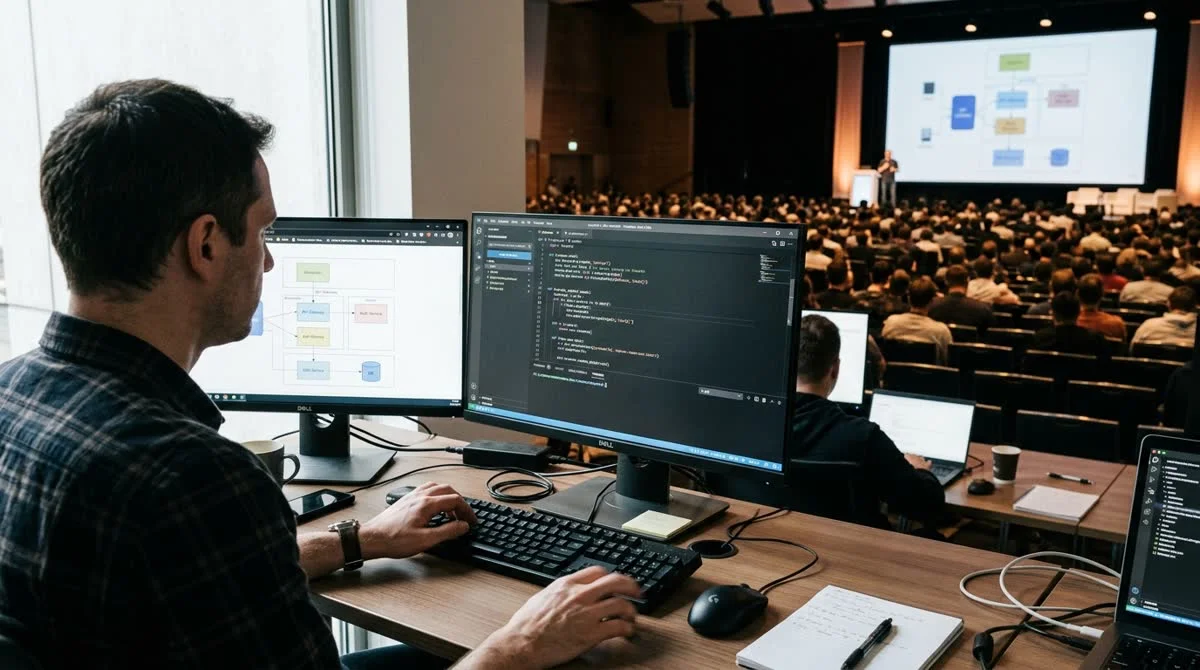
Saint HighLoad++ 2026 took place in Saint Petersburg in a revamped format: the organizers from Ontiko built the program around three conference tracks and two workshop tracks. Artificial intelligence got a dedicated thematic track for the first time, and also took up a significant share of the workshops on the other tracks.
The season's new vocabulary: what harness means
The conference's main terminological discovery was the word harness. It now refers to the whole infrastructure layer around an AI model: collecting and formatting context, configuring skills for agents, managing the rules they work by, and controlling output. Technically, people built all of this before, just without a common name. At Saint HighLoad++ 2026 the term came up often enough to settle in as professional jargon. Notably, the word is still almost absent at other technical conferences, which suggests the highload community is the one pushing it into wider professional use.
Key facts from the conference:
- Three conference tracks and two workshop tracks, the organizers' (Ontiko) revamped format
- One track is devoted entirely to AI; AI topics also run through the other tracks and workshops
- Harness is a new professional term for the infrastructure around AI agents
- Slides are published on the conference website; video recordings are available to attendees and for a fee
Alongside harness, the labels ai-native and ai-first came up often, adopted by companies and teams that want to look modern. The report's author draws a direct parallel with Agile a decade ago: the label was then attached for the image of a progressive organization, while the real substance behind it varied widely. The story is repeating: calling yourself an "AI-native" company has become a marker of being progressive, and behind that label may sit anything from deep, systemic adoption of agentic systems to minimal experiments with off-the-shelf APIs.
Why speakers don't notice the contradiction in their own claims
The most valuable insight of the conference came from the discussion of Spec Driven Development. Several speakers presented this approach as the ideal model: development runs through specifications, and AI agents replace humans step by step at every stage. The maturity models they showed are built precisely on preserving the current architecture of processes, only with humans swapped for agents.
Yet the same speakers, in the same talks, say that processes will be fundamentally rebuilt. The contradiction is direct and obvious: you announce a transformation while presenting a model based on preserving the existing order. Neither the speakers nor the audience, judging by the report, notice this gap.
This is a characteristic symptom of the industry's current moment. The rhetoric of transformation and the practice of "let's automate today's processes with AI" exist side by side without engaging in real dialogue. There is no consensus yet on exactly how agentic AI will change development over the next several years, and that is an honest outcome not just of one conference.
What this means
Saint HighLoad++ 2026 captured an important snapshot: big Russian IT is actively adopting AI rhetoric and launching its first practical experiments with agentic systems. Harness appears to be taking hold as a professional term, a useful standardization of language for discussing the infrastructure around AI agents. The gap between the declared transformation of processes and the proposed maturity models remains an open question and will evidently be a central theme of technical conferences in coming seasons.
- Nov 27, 2026Meta Launches Muse AI Shopper: A Third of Shoppers Expect to Use AI Help on Black Friday
- Nov 27, 2026In the UK, an AI Agent Bought Papa John's Pizza Without a Bank Card for the First Time
- Nov 27, 2026Claude Sonnet 5.5 Costs 32% to 304% of the Official Price at Russian Resellers
- Nov 27, 2026Agents Built a Hearthstone Bot in 20 Days and Raised Its Rating from 6,000 to 15,000
Key Questions Answered
What are the key details on The season's new vocabulary: what harness means?
The conference's main terminological discovery was the word harness. It now refers to the whole infrastructure layer around an AI model: collecting and formatting context, configuring skills for agents, managing the rules they work by, and controlling output. Technically, people built all of this before, just without a common name. At Saint HighLoad++ 2026 the term came up often enough to settle in as professional jargon.
Why speakers don't notice the contradiction in their own claims?
The most valuable insight of the conference came from the discussion of Spec Driven Development. Several speakers presented this approach as the ideal model: development runs through specifications, and AI agents replace humans step by step at every stage. The maturity models they showed are built precisely on preserving the current architecture of processes, only with humans swapped for agents. Yet the same speakers, in the same talks, say that processes will be fundamentally rebuilt.
What this means?
Saint HighLoad++ 2026 captured an important snapshot: big Russian IT is actively adopting AI rhetoric and launching its first practical experiments with agentic systems. Harness appears to be taking hold as a professional term, a useful standardization of language for discussing the infrastructure around AI agents. The gap between the declared transformation of processes and the proposed maturity models remains an open question and will evidently be a central theme of technical conferences in coming seasons.
Free 2-Day Vibecoding & AI Agents Intensive
Day 1: the autonomous Hermes + DeepSeek AI agent — vibecoding and development on par with Claude Code / Codex / Gemini. Led by Jemal Hamidun, Head of AI at Alpina Digital and academic supervisor at MIPT. Right after you register with our bot Nika: the recording + 11 materials from the previous intensive.
Daily 60-sec AI Voice Brief + Weekly Production AI Agent Playbook
Listen to a 60-second AI news brief every morning and get a weekly hands-on playbook for shipping AI agents to production — tools, MCP servers and patterns that work. Curated by Jemal Hamidun, Head of AI at Alpina Digital.
