Anthropic CEO Dario Amodei Promises 'Good AI', but Critics Call for Slowdown
In Australia, Anthropic CEO Dario Amodei's visit sparked a heated discussion about the price of 'good AI'. While authorities tout productivity gains and new data centers, critics point to risks: loss of entry-level office jobs, use of others' works for model training, and rising strain on energy infrastructure. The conclusion is straightforward: without strict rules, accelerating AI deployment is dangerous.
AI-processed from Guardian; edited by Hamidun News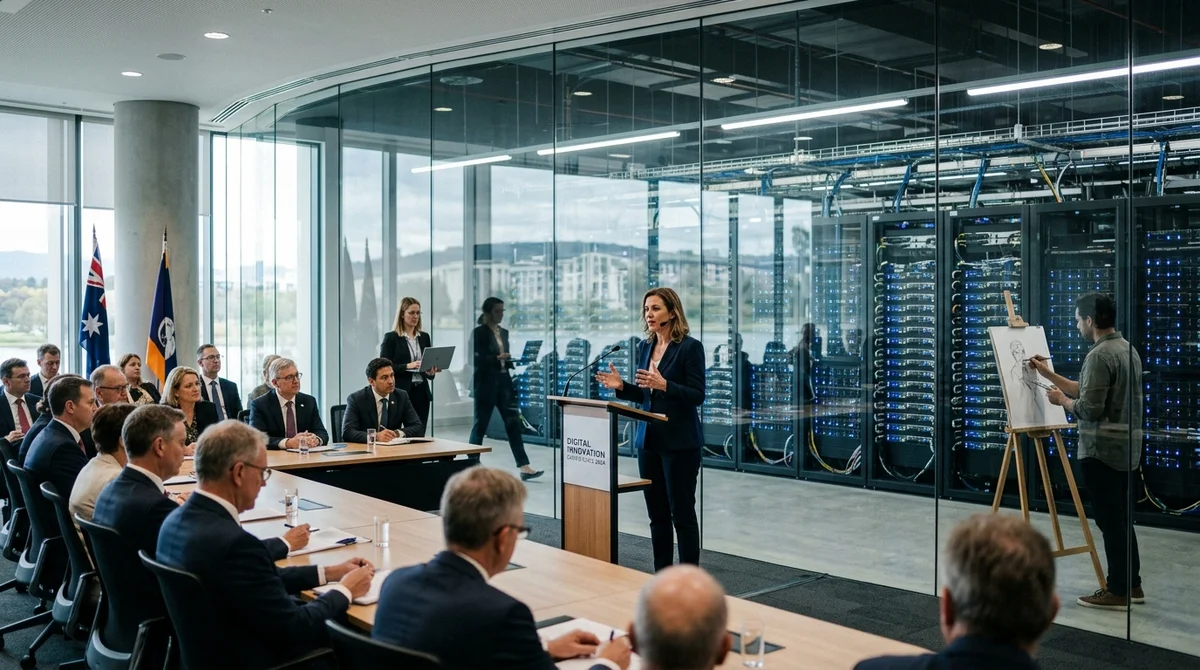
Anthropic CEO Dario Amodei's visit to Canberra became not just a presentation of "good AI," but a test of how far authorities are willing to go in alliance with big tech for the sake of promised productivity gains. Against a backdrop of political turbulence and fatigue from inequality, the question grows louder: can we call it progress if automation's price is jobs, energy, copyright, and even greater concentration of power? On April 2, 2026, the Australian government gave a warm reception to Anthropic CEO Dario Amodei.
He met with the prime minister, officials, and technology sector representatives, promoting the idea of "good AI" — a system that supposedly will accelerate the economy and help the country move faster through the next technological cycle. Almost simultaneously, authorities released new principles for data centers, and Anthropic was the first to join this framework. Formally, this was about security, tracking the development of advanced models, and supporting the local ecosystem, but the political signal looked even broader: Australia does not want to stand aside from the AI race.
At the same time, Amodei looks to many like not the most aggressive face in the industry. He left OpenAI and later launched Anthropic as a company with a stronger emphasis on safety. In public statements, he has repeatedly warned about the risks of his own technologies, and has also spoken out against extreme scenarios for their use — from mass surveillance to autonomous weapons.
This is why he is often perceived as a representative of the "responsible" camp within the industry. But even this reputation does not remove the main question: if one of the most cautious leaders on the market himself speaks of colossal consequences for the labor market, why are states rushing to implement faster than to establish rules? As UNSW professor Toby Walsh reminds us, universal "good AI" does not exist: the same technology can help doctors, teachers, and researchers, while simultaneously displacing office workers, cheapening creative labor, and increasing demand for energy-intensive infrastructure.
A separate front of disputes is connected to how models are trained. AI industry companies have long been accused of using works by authors, artists, and journalists without proper consent, and the developers themselves continue to sell this approach as an inevitable price of innovation. Against this background, promises of new productivity for the economy begin to sound less neutral: benefits are distributed at the top, while risk and losses go down.
This is especially noticeable in politics. The Australian government promotes AI as an accelerator of growth, largely relying on models and calculations prepared with the participation of the industry itself. But within its own coalition of support, cracks are already visible.
Unions worry about the fate of workers, artists speak of direct exploitation of their labor, parents worry about harm to children and adolescents who increasingly encounter synthetic content and digital conversationalists. For left-center politics, this is an uncomfortable conflict: on one hand, there is a desire to appear open to innovation, on the other — an obligation to protect those who usually pay first for the next technological leap. More broadly, this dispute boils down to an old problem, which the digital age has only intensified.
For a long time, technological change was sold as a natural path to a freer and fairer society. But the last decades have shown that the pace of change itself guarantees nothing. Globalization intensified the concentration of wealth, internet platforms built their business on extracting attention, and trust in institutions collapsed precisely when technological corporations became too big to simply regulate retroactively.
Therefore, the dispute around AI today is no longer about gadgets and chatbots, but about who determines the direction of progress and who has the right to impose its price on society. The main conclusion from this discussion is harsh: slowing down the AI race no longer looks like a reactionary gesture. On the contrary, for many it becomes the only way to make development manageable.
If models are really capable of destroying entry-level office positions, eroding copyright, increasing the strain on energy systems, and expanding surveillance tools, then first we need red lines, accountability, and verifiable rules, and only then memorandums, data centers, and another round of productivity promises. In this sense, the dispute around Anthropic in Australia is important far beyond one country: it shows that the question is no longer whether AI will come, but who will manage to set it boundaries.
Need AI working inside your business — not just in your newsfeed?
I build production AI for companies — custom CRM, internal tools, autonomous agents, workflow automation. Owned by you, shaped to your process, no per-seat tax. Built by Zhemal Khamidun, CPO of AlpinaGPT (AI platform, 6,000+ users).
The AI world, distilled — once a week
Seven stories that actually mattered, hand-picked. No noise, no reposts, no press releases.
Done! Check your inbox for a confirmation.