How AI is changing everyday work: professors and Amazon employees under pressure
AI is changing work routines faster than expected. Professors at U.S. universities complain that students are submitting essays generated by ChatGPT, detectors make mistakes, and the academic integrity system is under strain. In Amazon warehouses, algorithms track every step — and workers say challenging the system is impossible. White-collar workers are not safe either: tasks handled by lawyers and analysts are being automated faster than expected.
AI-processed from Guardian; edited by Hamidun News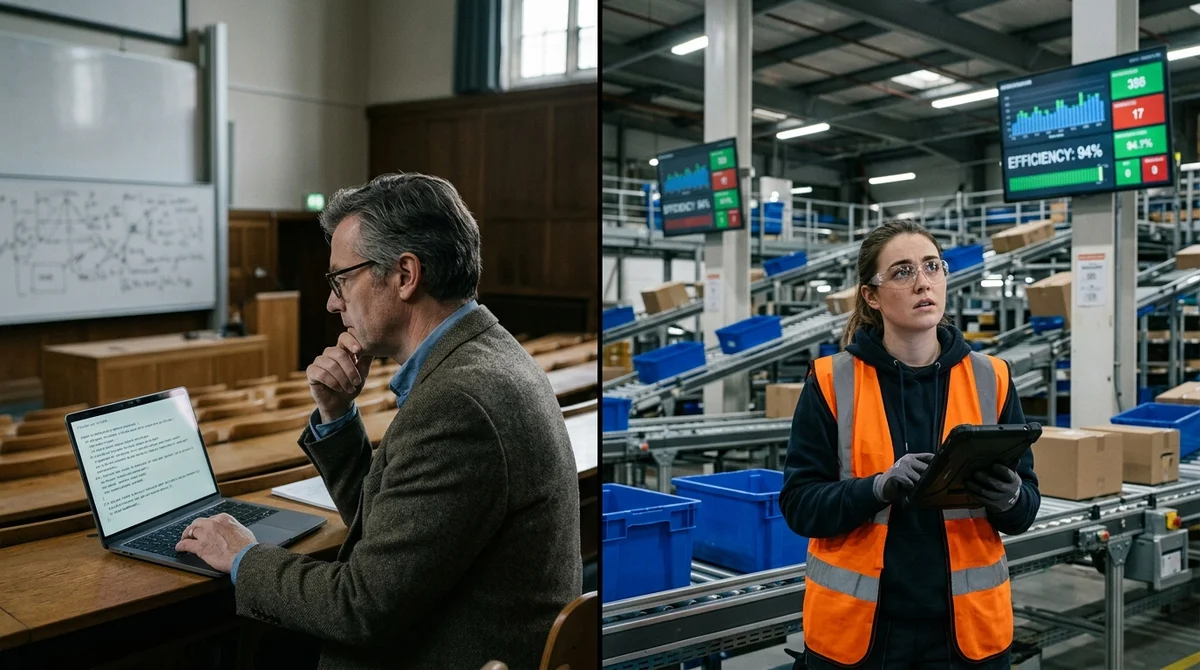
Artificial intelligence is changing familiar work processes faster than even the most optimistic forecasts predicted. Professors at American universities and Amazon warehouse operators are already living in a new reality — where an algorithm becomes a colleague, competitor, or supervisor.
Professors Against Neural Networks
The academic environment proved to be one of the first places where confrontation with AI became truly systemic. Teachers are recording en masse: students are submitting essays written by ChatGPT and its analogs, and distinguishing them from authentic texts is becoming increasingly difficult. AI-content detectors malfunction, false positives harm honest students — and the system of academic integrity finds itself in crisis. But the problem runs deeper than plagiarism. Some universities are already implementing AI tutors available 24/7 and adapting to each student's pace. For professors, this signals a need to rethink their role: lectures as knowledge transfer give way to mentorship, live dialogue, and critical examination of what AI tools do wrong.
- Half of American universities revised their academic integrity policies in 2025–2026
- The number of AI assistants in education increased by 340% over two years
- 30% of professors report reduced routine workload — but increased anxiety due to uncertainty
Some professors see this as an opportunity. Others speak of existential anxiety: when a student can get an explanation of any topic from a neural network in 30 seconds, it's unclear what exactly the professor is selling.
Amazon and Surveillance Algorithms
The situation at Amazon warehouses is fundamentally different. Here, AI long ago ceased to be an experiment — it became operational reality. Algorithms plan the routes of pickers, predict peak loads, track each employee's performance in real time, and automatically generate schedules. Workers describe what's happening ambivalently. On one hand — fewer meaningless tasks and clearer organization. On the other — a sense of constant, total surveillance. The standard that used to be set by a live manager is now dictated by the system, and it's psychologically difficult to challenge it, and formally almost impossible.
"The algorithm doesn't get tired, doesn't get angry, and doesn't understand that your back hurts," — from an interview with an
Amazon warehouse worker.
Labor unions are recording growing complaints specifically about algorithmic control, not working conditions. This is a new type of labor conflict — between a person and a system that has no face.
White-collar Workers at Risk
Traditionally, it was believed that AI threatens primarily physical, routine labor. Reality is more complex. Lawyers, analysts, copywriters, financial consultants — all face tools that accomplish in hours what used to take days. According to McKinsey estimates, by 2030, about 30% of tasks in office professions will be automated. An important nuance: not the professions themselves, but specific functions within them. This doesn't mean mass layoffs, but restructuring: some tasks disappear, new ones emerge — managing AI tools, verifying results, working with clients where algorithms fall short. Those who integrate AI into the process earlier than others gain an advantage.
What This Means
AI doesn't take away work entirely — it changes its composition, task hierarchy, and what people get paid for. For employers, this means reviewing hiring and retraining staff. For employees — the need to adapt now, not after changes become irreversible.
Want to stop reading about AI and start using it?
AI News is a curated feed of AI/tech news. Hamidun Academy teaches you to use AI systematically in your work.
The AI world, distilled — once a week
Seven stories that actually mattered, hand-picked. No noise, no reposts, no press releases.
Done! Check your inbox for a confirmation.