Podcast Index: nearly 40% of new podcasts are already being created by AI, and the audio market is concerned
Audio now has its own version of “AI slop”: according to Podcast Index, about 39% of new podcasts over nine days were likely created by AI. The problem is not just quality. Automated shows are clogging catalogs, making it harder to find normal episodes, and forcing platforms to spend resources on filtering and moderation. Content farms producing hundreds of shows a day are growing especially fast.
AI-processed from Bloomberg Tech; edited by Hamidun News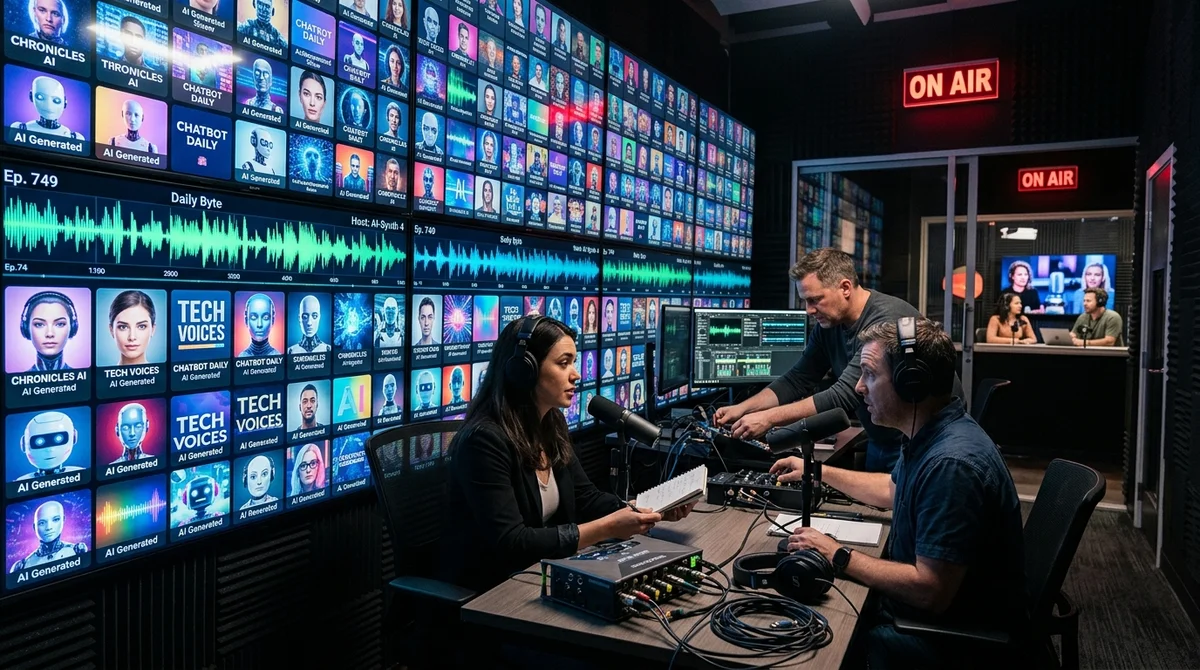
The audio industry faces a new problem: a stream of podcasts created entirely by neural networks and published with almost no human involvement. According to Podcast Index, over the past nine days, approximately 39% of new shows in the open catalog were likely created by AI.
Where the Numbers Come From
This is not about isolated experiments with synthetic voices, but a notable share of all new content. In one April snapshot from Podcast Index, over 24 hours, only 44.6% of new shows were marked as "likely legitimate," while 45.
7% were classified as potentially AI-generated. The index uses its own detection tools for classification—meaning the industry has reached a point where it must use AI to track AI. Against this backdrop, the catalog has begun deploying infrastructure measures.
Podcast Index launched a separate problematic API where new feeds marked as spam, phishing, or low-effort AI are registered. The idea is simple: hosting platforms, apps, and aggregators can more quickly filter out the garbage stream before it clogs search and recommendations. Importantly, this applies not to a single closed platform, but to the open part of the podcast ecosystem, where RSS feeds are picked up by various apps and catalogs.
If noise takes root here, it will spread further—into recommendations, charts of niche services, and advertising tools that rely on the mass appearance of new shows rather than their real value to listeners.
Who's Flooding the Market
One of the most prominent players is Inception Point AI. According to industry publications, the company managed to release 325 new shows in a single day—nearly one-fifth of all new podcasts that day. The catalog credits it with more than 8,000 active shows. Just the wellness podcast line alone added 20 programs in less than 75 minutes, covering topics like mental health, addiction, and vaccination.
"I'm an AI host, so I can talk about sensitive topics without judgment
and hidden agenda."
What's alarming is not just the volume, but the economics of the model. As recently as fall 2025, a co-founder of Inception Point AI told Bloomberg that the company publishes around 3,000 episodes per week and turns a profit if content gets just 20 listens. This changes the barrier to entry: to launch a "media network," you no longer need a studio, editorial staff, and permanent hosts—just a text generator, speech synthesis, and cheap distribution.
Why the Market Is Nervous
AI in audio production itself no longer shocks anyone: it's used for editing, dubbing, translation, and voice restoration. The problem emerges where the technology serves not to amplify the author, but to churn out endless copies without meaningful editorial oversight. The industry has begun calling this wave "podslop."
- It's harder to find live shows among thousands of identical feeds
- Recommendation algorithms get noise instead of signal
- Open catalogs incur additional costs for storage, parsing, and updating RSS feeds
- Topics like health, finance, and news become riskier due to factual errors and AI hallucinations
For independent creators, this is a double blow. On one hand, visibility of new launches drops: they're easier to drown in a stream of automatically generated titles and descriptions. On the other, it's harder for listeners to understand whether the voice belongs to a person with experience and accountability, or just a cheap content farm optimized for keywords.
There are already specific quality concerns. In Spanish-language biographical shows released by Inception Point AI, fragments in English were found that resembled internal prompts or error messages from AI tools. This is a good marker of the current market state: producing audio has become too easy, while controlling the final product lags for both creators and platforms.
What It Means
Podcasts are entering the same phase that search, SEO websites, and stock media went through earlier: the volume of synthetic content grows faster than mechanisms of trust and filtering. For platforms, this is a signal to strengthen labeling and moderation; for independent creators, it's a cue to bet on recognizable voice, expertise, and format that's hard to confuse with an automated feed.
Need AI working inside your business — not just in your newsfeed?
I build production AI for companies — custom CRM, internal tools, autonomous agents, workflow automation. Owned by you, shaped to your process, no per-seat tax. Built by Zhemal Khamidun, CPO of AlpinaGPT (AI platform, 6,000+ users).
The AI world, distilled — once a week
Seven stories that actually mattered, hand-picked. No noise, no reposts, no press releases.
Done! Check your inbox for a confirmation.