SpaceX and Blue Origin want to move AI data centers to orbit, but physics is against it
SpaceX wants to deploy up to a million satellites for AI computing to orbit, Blue Origin 51,600. The idea looks impressive against the backdrop of Earth's energy deficit, but faces serious constraints: cooling, radiation, communication delays, and launch costs. Even startups are already testing space hardware, but for now it looks more like a long engineering bet than a real replacement for ground data centers.
AI-processed from TNW; edited by Hamidun News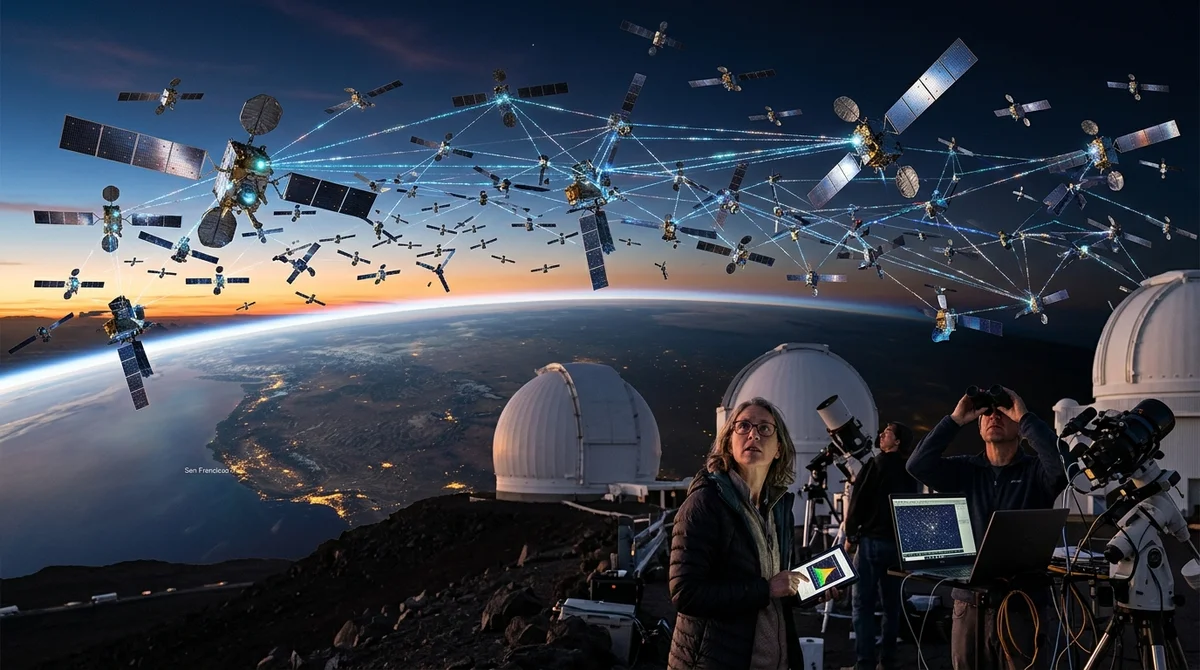
The idea looks almost flawless on paper: if AI is running into an energy deficit on Earth, computations can be lifted to orbit, where the sun shines almost constantly, and new data centers don't need to be coordinated with local networks and authorities. But the louder SpaceX and Blue Origin talk about space computing clusters, the harsher the response from scientists and engineers: the problem is being presented as a near-term solution, although it cannot yet be closed by physics, economics, or the architecture of orbital systems themselves. On January 30, SpaceX filed an application with the US Federal Communications Commission to launch up to 1 million satellites into low Earth orbit.
The company describes the network as orbital computing infrastructure for advanced AI models. The satellites are to be placed at altitudes of 500 to 2000 kilometers, keeping them as long as possible on the sunny side and routing traffic through Starlink. SpaceX also requested relief on deployment timelines, under which half of the constellation normally should become operational within six years.
Seven weeks later, Blue Origin filed a similar application. Its Sunrise project envisions 51,600 satellites in sun-synchronous orbits at altitudes of 500 to 1800 kilometers. Computations are to be performed in space, with the results sent to Earth via a separate optical network, TeraWave.
In parallel, startups are accelerating too. Starcloud attracted $170 million in March at a $1.1 billion valuation and has already deployed a satellite with Nvidia H100 GPUs.
Aethero is testing radiation-hardened onboard computers using Nvidia Orin NX chips this year. Interest in such projects is understandable. Global electricity consumption by data centers in 2024 reached approximately 415 TWh, and by 2026 it could exceed 1000 TWh.
AI servers are driving the fastest growth, with around 30% annual growth forecast. In Virginia, data centers already consume 26% of all electricity, and in Ireland their share could reach 32% by year-end. On Earth it's increasingly difficult to quickly connect new capacity, build networks, and obtain permits, so orbit looks like an enticing workaround.
But then engineering reality sets in. The main enemy of an orbital data center is heat. On Earth, servers are cooled by air and liquids, but in space, excess energy can only be dissipated by radiation.
To dissipate just 1 megawatt of heat and keep electronics around 20 degrees Celsius, radiators of approximately 1200 square meters are needed — that's about four tennis courts. For an installation with even several hundred megawatts, heat dissipation systems would need to be orders of magnitude larger than anything humanity has deployed in orbit. The second problem is radiation.
In low orbit, ordinary chips suffer failures and physical damage from cosmic rays and charged particles. Radiation protection increases hardware cost by 30–50% and simultaneously cuts performance by 20–30%. The alternative of triple redundancy means sending three copies of each chip to space, along with three times as much mass, cooling, and energy consumption.
The third constraint is latency. Training advanced models requires links between nodes at the microsecond level, but low orbit provides milliseconds between satellites and approximately 60–190 milliseconds for signal propagation between Earth and orbit. This makes such systems potentially more useful for inference than for training large models.
There's also the economics. An estimate for a 1 GW orbital data center exceeds $50 billion — roughly three times more expensive than a comparable ground-based facility even accounting for several years of operation. For space computing to begin looking reasonable, launch costs, by some estimates, would need to fall below $200 per kilogram, whereas the current economics of Starlink launches are approximately in the range of $1000–2000 per kilogram.
Some analysts believe that true competition would require a level of $20–30 per kilogram. Even within the AI industry, the idea is met with skepticism: the question isn't just cost, but mundane maintenance — how to replace a failed GPU in orbit. A separate front of criticism comes from astronomers.
SpaceX's application received around a thousand public comments, and the majority of them urge the regulator not to approve the project. If such a constellation appears, the night sky for a significant part of the year could contain more satellites than visible stars. This means more light and radio frequency pollution, as well as an even more congested orbital environment.
The main conclusion is this: orbital data centers don't look absurd as a long-term direction, especially if launch costs drop sharply and Earth's power grid continues to struggle with AI demand. But between the filing for tens of thousands or even a million satellites and a truly operational, economically sensible space computing network lie years of unresolved challenges. Therefore, right now this is more of a bet on the distant future and a way to stake a claim on orbit, rather than an answer to the computing power shortage that the market needs today.
Need AI working inside your business — not just in your newsfeed?
I build production AI for companies — custom CRM, internal tools, autonomous agents, workflow automation. Owned by you, shaped to your process, no per-seat tax. Built by Zhemal Khamidun, CPO of AlpinaGPT (AI platform, 6,000+ users).
The AI world, distilled — once a week
Seven stories that actually mattered, hand-picked. No noise, no reposts, no press releases.
Done! Check your inbox for a confirmation.