Google DeepMind lets an LLM rewrite game-theory algorithms and beat the experts
Google DeepMind applied AlphaEvolve to algorithms for imperfect-information games such as poker. The LLM-based system rewrote the code of two core approaches, CFR and PSRO, and produced new variants called VAD-CFR and SHOR-PSRO. The first matched or beat the best hand-designed solutions in 10 of 11 games, the second in 8 of 11. Testing was done on larger scenarios the algorithms had not seen before.
AI-processed from MarkTechPost; edited by Hamidun News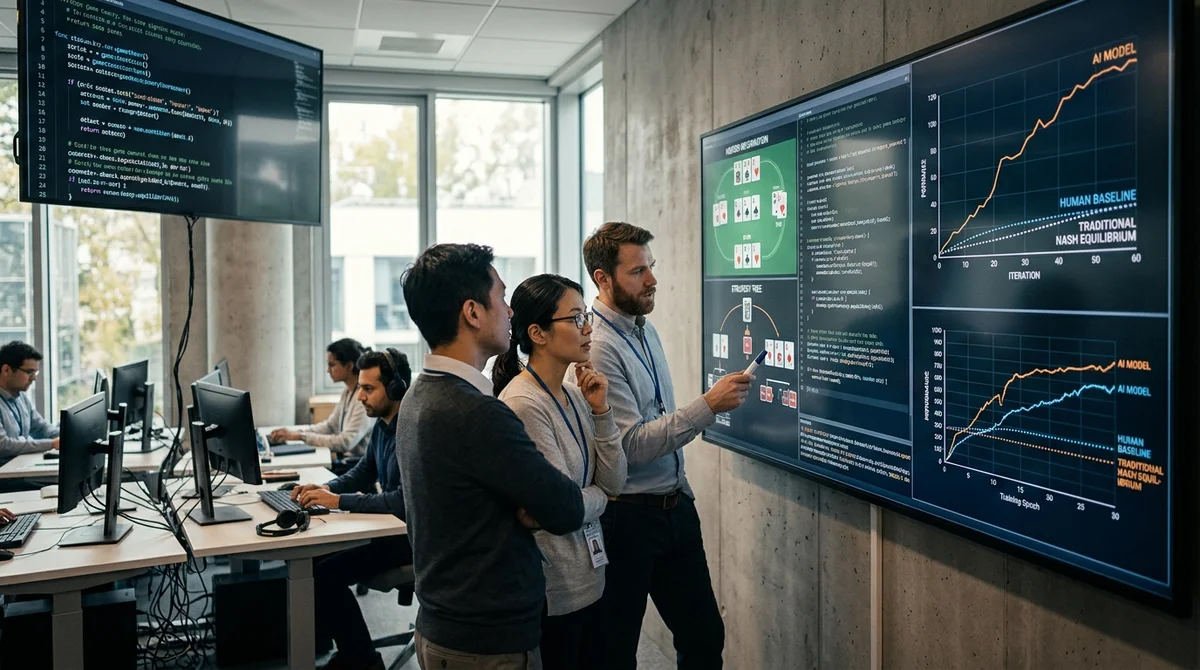
Google DeepMind has shown that a language model can do more than help researchers write code: it can search for new algorithmic ideas in game theory on its own and beat solutions that humans have refined for years. The work concerns Multi-Agent Reinforcement Learning for imperfect-information games, where players take turns and cannot see each other's hidden data, as in poker. In these tasks an algorithm's quality often depends not only on the underlying theory but on many engineering details: how to accumulate regret, how to discount old signals, when to start averaging the strategy, and how to search for equilibrium.
Usually all of this is tuned by hand, through intuition, a series of hypotheses and long experiments. In a preprint published on arXiv on 18 February 2026, the DeepMind team proposed handing this work to AlphaEvolve, an evolutionary code-rewriting agent that uses an LLM and automatically checks the quality of each new version. In this work, AlphaEvolve was applied to two classic families of algorithms: CFR (Counterfactual Regret Minimization) and PSRO (Policy Space Response Oracles).
The experiments used the OpenSpiel framework, and quality was measured by exploitability, a metric showing how much an opponent's best response can exploit the strategy that was found. One important point: the researchers did not stop at tuning hyperparameters. The system changed the logic of the Python code itself, which handles regret accumulation, construction of the current policy and strategy averaging.
The paper explicitly names Gemini 2.5 Pro as the model on which this search loop was built. For the CFR family, the system found a new variant called VAD-CFR, Volatility-Adaptive Discounted CFR.
Its idea is that the algorithm does not use fixed rules for forgetting old information; it watches the volatility of learning and discounts history more heavily in unstable moments. AlphaEvolve also added asymmetric boosting of positive instantaneous regret signals with a coefficient of 1.1, and an unexpected averaging rule: do not start accumulating the average policy at all until iteration 500.
This is particularly interesting because the evaluation horizon was 1000 iterations, and the system derived the 500 threshold itself, with no explicit hint in the prompt. On the full set of 11 games, VAD-CFR matched or exceeded the best known solutions in 10 of 11 cases; the only exception was the four-player version of Kuhn Poker. For PSRO, AlphaEvolve searched not for regret-update rules but for a meta-solver, which determines the probability distribution over the population of strategies.
This produced SHOR-PSRO, Smoothed Hybrid Optimistic Regret PSRO. This variant blends optimistic regret matching with a soft distribution over the best pure strategies and, as training proceeds, smoothly shifts the balance between exploration and convergence to equilibrium. In practice this removes some of the manual tuning that used to be mandatory: researchers no longer need to guess in advance when the system should encourage strategy diversity and when it should push harder toward equilibrium.
On the full slice of 11 games, SHOR-PSRO matched or exceeded the best hand-built baselines in 8 cases. It also matters that DeepMind tested for more than overfitting to training examples. Both discovered schemes were first evolved on four games, including 3-player Kuhn Poker, 2-player Leduc Poker, 4-card Goofspiel and 5-sided Liar's Dice, and were then tested, without further retuning, on larger variants of the same problem classes that they had not seen.
This is stronger than the usual demonstration on one or two toy environments: it shows at least a basic ability of the algorithms to generalize beyond the set on which the search was run. The main takeaway is simple: LLMs are starting to automate not only code writing but the design of algorithms themselves. For researchers this shifts the role: less manual trial and error with heuristics, more work defining the metric, the constraints and the verification system.
The work does not prove, however, that a model can invent anything and everything: the success here relies on a clear evaluation function and on domains where solution quality can be checked rigorously. Even with that caveat the result looks serious: DeepMind showed that in narrow, formalizable areas a machine can already find moves that experts did not reach by hand.
- Nov 2, 2026Karpathy builds a YouTube clone with 6454 videos from Hacker News recommendations in two hours
- Nov 2, 2026Karpathy used Claude to build HackerTube from 6,454 videos recommended on Hacker News
- Nov 2, 2026Anthropic needs to grow revenue 32% a year to cover $850 billion in contracts
- Nov 2, 2026Bun creator uses Claude Code to port 750K lines from Zig to Rust in 11 days
Test Frontier LLMs & Autonomous Agents in One Workspace
Run Claude Opus 5.5, GPT-6, Gemini 3.1, and DeepSeek side-by-side in Nomad AI (nomadnet.ai) — unified model routing, deep research, and multimodal workflows under one subscription.
The AI world, distilled — once a week
Seven stories that actually mattered, hand-picked. No noise, no reposts, no press releases.
Done! Check your inbox for a confirmation.