DeepMind Predicts AGI by 2030: Hassabis on the Coming AI Revolution
Speaking at Google I/O, Google DeepMind CEO Demis Hassabis predicted that artificial general intelligence (AGI) will arrive by 2030. He said the technology will revolutionize global computing systems. Hassabis is convinced that AGI will mark a turning point not only for the IT sector but for the entire economy, transforming how decisions get made.
AI-processed from 3DNews AI; edited by Hamidun News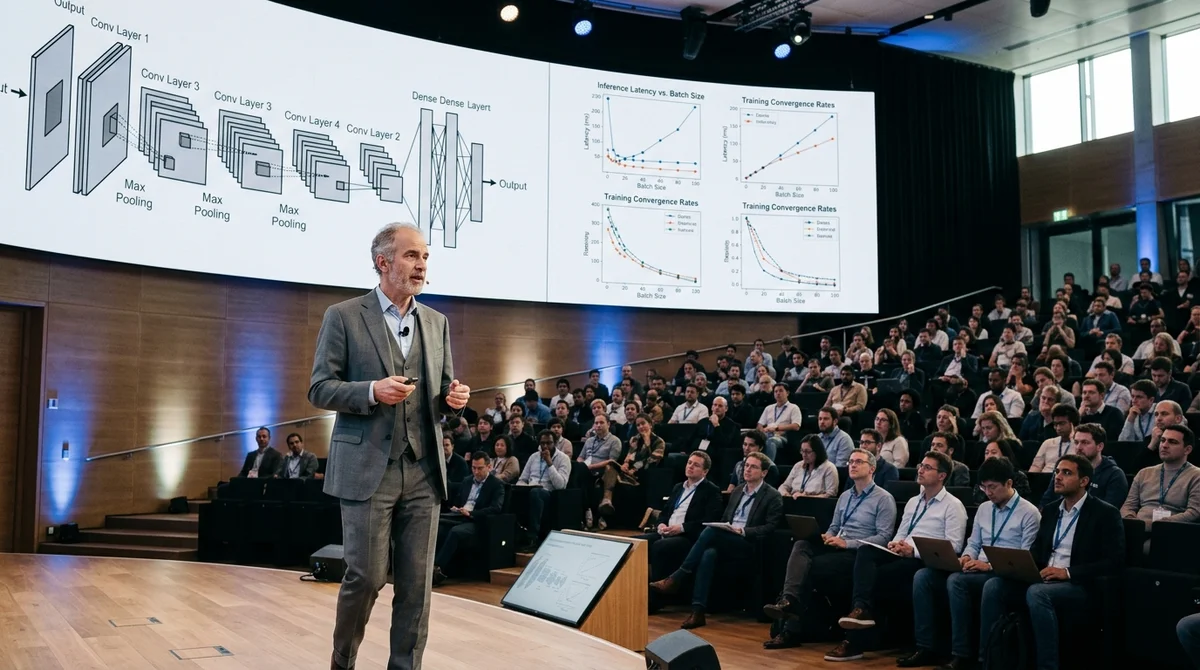
At Google I/O, Google DeepMind CEO Demis Hassabis made a sweeping prediction: artificial general intelligence (AGI) will arrive around 2030. He said the technology will radically change not only global computing systems but the economy as a whole, rewriting the rules for every industry.
Hassabis's Forecast: AGI Is Close
Hassabis didn't mince words at Google I/O. AGI, he said, is no longer a sci-fi horizon but a very real future, and it's approaching faster than many people think. He defined AGI as an AI system that can solve problems at the level of the human mind across a wide range of complex challenges, from scientific discovery to economic planning.
DeepMind is actively working toward that goal. Over the past three years, the team has made breakthroughs in neural network architectures, model generalization, and scaling efficiency. Recent progress in multimodal systems, which handle text, images, and video at the same time, shows that the core building blocks for AGI are already in place. According to Hassabis, what remains is optimization and clearing the last fundamental hurdles.
The Scale of Change: What Gets Upended
If DeepMind's forecast is right, the consequences will be revolutionary. Here's what the industry can expect:
- Automation without limits — systems solve complex tasks on their own, with no human in the loop
- An explosion in scientific discovery — research in biology, medicine, and physics accelerates tens of times over
- A rethink of IT infrastructure — moving to AGI-optimized architectures will require trillions of dollars
- Economic transformation — new models of production, services, and value distribution
- Urgent safety concerns — controlling AGI will become a critical task for governments and regulators
Hassabis stresses that the transition will be gradual rather than explosive, but irreversible. Organizations that prepare their systems for the AGI era now will gain a significant competitive edge.
Why 2030?
DeepMind isn't just pulling a number out of thin air. Trend analysis suggests the timeline is realistic.
First, compute is growing exponentially: data center capacity doubles every 1.5–2 years. Second, algorithms keep getting more efficient, needing less data and compute to reach the same result. Third, the shift to multimodal models has shown that systems generalize knowledge better when they learn from diverse data.
Still, Hassabis is candid about the uncertainty. A lot depends on unexpected discoveries in learning theory, on solving the energy consumption problem of large models, and on whether the industry can break through current plateaus in quality improvements. Serious obstacles requiring conceptual breakthroughs may still remain by 2030.
What This Means
Hassabis's forecast isn't fearmongering; it's a call to action. If AGI really is approaching by 2030, then the groundwork for developing the technology safely and effectively is being laid right now, in 2026–2029.
For investors, startups, and large corporations, the message is simple: betting on AGI-oriented solutions is no longer speculation but a strategic necessity. Companies that invest in R&D, train engineers, and migrate their systems to AGI-compatible architectures today will be ahead of the competition tomorrow.
For regulators and policymakers, the challenge is even sharper: they urgently need to set the rules of the game while AGI is still in development. Without international safety norms, the result could be chaos. That's why Hassabis pairs his optimism with a call for responsibility: AGI is not just an opportunity but a serious challenge for humanity.
- Nov 1, 202616 models tested on 7 search tools: Exa averaged 10.5 out of 14, SearXNG about 3
- Nov 1, 2026Google's StreamVibe video agent beats other models by 10.7% on response timing and quality
- Nov 1, 2026OpenAI Rewrites GPT Behavior Rules: Five Values and a Chain of Command
- Nov 1, 2026Voice bots built on LLMs turn to Jev, a fast classifier, for decisions in 200–500 ms
Key Questions Answered
Why 2030?
DeepMind isn't just pulling a number out of thin air. Trend analysis suggests the timeline is realistic. First, compute is growing exponentially: data center capacity doubles every 1.5–2 years. Second, algorithms keep getting more efficient, needing less data and compute to reach the same result. Third, the shift to multimodal models has shown that systems generalize knowledge better when they learn from diverse data. Still, Hassabis is candid about the uncertainty. A lot depends on unexpected discoveries in learning theory, on solving the energy consumption problem of larg
What are the key details on Hassabis's Forecast: AGI Is Close?
Hassabis didn't mince words at Google I/O. AGI, he said, is no longer a sci-fi horizon but a very real future, and it's approaching faster than many people think. He defined AGI as an AI system that can solve problems at the level of the human mind across a wide range of complex challenges, from scientific discovery to economic planning. DeepMind is actively working toward that goal. Over the past three years, the team has made breakthroughs in neural network architectures, model generalization, and scaling efficiency. Recent progress in multimodal systems, which handle tex
What are the key details on The Scale of Change: What Gets Upended?
If DeepMind's forecast is right, the consequences will be revolutionary. Here's what the industry can expect: Automation without limits — systems solve complex tasks on their own, with no human in the loop An explosion in scientific discovery — research in biology, medicine, and physics accelerates tens of times over A rethink of IT infrastructure — moving to AGI-optimized architectures will require trillions of dollars Economic transformation — new models of production, services, and value distribution Urgent safety concerns — controlling AGI will become a critical task fo
Test Frontier LLMs & Autonomous Agents in One Workspace
Run Claude Opus 5.5, GPT-6, Gemini 3.1, and DeepSeek side-by-side in Nomad AI (nomadnet.ai) — unified model routing, deep research, and multimodal workflows under one subscription.
The AI world, distilled — once a week
Seven stories that actually mattered, hand-picked. No noise, no reposts, no press releases.
Done! Check your inbox for a confirmation.