Nvidia partner Hon Hai grows quarterly revenue 29.7% on AI server demand
Hon Hai, better known as Foxconn and one of Nvidia's key partners, reported quarterly revenue growth of 29.7%, to NT$2.13 trillion. March was a record month, with revenue of NT$803.7 billion, and the report showed that even amid tension in the Middle East, demand for AI servers and infrastructure is not sagging. The Taiwanese manufacturer published the unaudited figures on April 5, 2026. They roughly matched analyst expectations, but the larger point is that demand held up despite market jitters.
AI-processed from Bloomberg Tech; edited by Hamidun News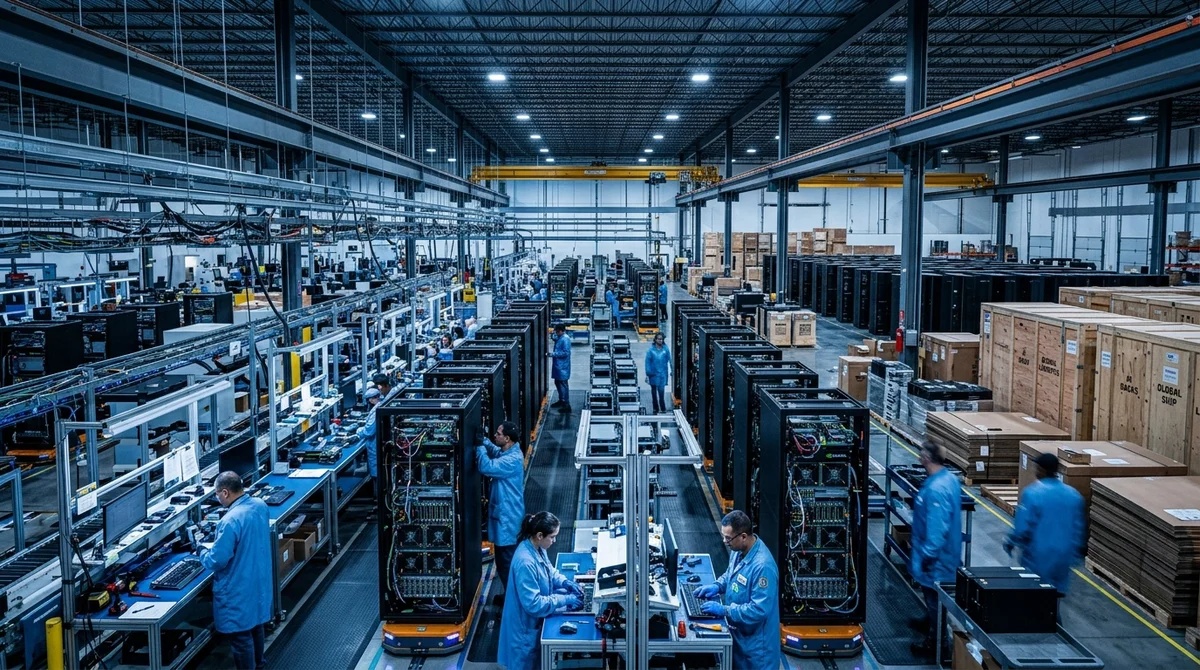
Hon Hai's first-quarter revenue growth shows that the AI investment cycle is, for now, stronger than geopolitical noise. The Taiwanese manufacturer, better known under the Foxconn brand and a supplier to Nvidia, reported quarterly revenue of NT$2.13 trillion, up 29.7% from a year earlier. For the market this is an important signal: the largest buyers of AI infrastructure keep purchasing servers and racks even as a new wave of instability hits the Middle East.
The company published the operating update on April 5, 2026, as unaudited revenue. By month, the quarter looked like this: January brought in NT$730.0 billion, February NT$595.8 billion, and March NT$803.7 billion. March was the record month, up 45.6% year over year. Total revenue for January–March came to NT$2.1296 trillion, or about US$66.5 billion. That nearly matched analyst expectations; according to Bloomberg, they had expected an average of NT$2.14 trillion. Formally there was no upside surprise, but the more important fact is that demand did not slump despite jittery markets and worries over logistics.
Why are these numbers watched so closely?
Hon Hai has long been more than an assembler of consumer electronics. The company remains the world's largest contract electronics manufacturer, and in the AI supply chain it acts as an industrial hub: from components and modules to assembling servers and racks for data centers. That is why its quarterly revenue is not an abstract sentiment gauge but a fairly direct reflection of how quickly customers are actually deploying computing infrastructure. If companies like this keep growing by almost 30%, AI budgets have stopped being experiments and are increasingly becoming baseline capital expenditure for large cloud players.
The context supports this reading. On March 16, when publishing its full-year 2025 results, Foxconn reported revenue of NT$8.1 trillion, up 18% year over year, and net profit of NT$189.4 billion. The most telling part was the shift in the business mix. The cloud and networking segment, which includes AI servers, became the largest category for the first time, accounting for 40% of revenue and overtaking smart consumer electronics at 38%. Chairman Young Liu said then, in plain terms, that the AI server sector should show strong growth in 2026 and that AI rack shipments should accelerate. The January–March sales look like confirmation of that shift rather than a one-off spike.
Management is not pretending there are no external risks. In the quarterly revenue report, the company separately warned of a "volatile" global political situation. Earlier in March, Young Liu named the overall political and economic situation, especially the war in the Middle East, as the main external challenge of 2026, though he noted that the direct impact on the business remained limited for now. The caveat matters: Foxconn has a huge manufacturing and transport network, and any new disruption to routes, insurance or component supply quickly becomes a question of timing and margins.
But the first-quarter figures show that, at this stage, customers are not putting AI projects on pause. On the contrary, demand for infrastructure sustained the growth pace and pushed March to an all-time high.
What does this mean?
For the AI market as a whole, Hon Hai's report is one of the clearest hardware signals that the boom does not rest only on model launches and loud big-tech statements. When a manufacturer at the center of the server supply chain for Nvidia and large cloud customers grows quarterly revenue by almost a third and sets a monthly record, it means money keeps turning into hardware. The main question is no longer whether companies are ready to spend on AI, but how quickly the global supply chain can absorb that demand without serious geopolitical disruptions.
- Nov 1, 2026Local models lose to Opus and Codex: 0.21 on a MacBook versus 1.00 for Codex
- Nov 1, 2026Habr author fine-tunes YOLOv8l on dental X-rays and pushes mAP50 to 0.642
- Nov 1, 2026Voice bots built on LLMs turn to Jev, a fast classifier, for decisions in 200–500 ms
- Nov 1, 2026MoneyGate safety layer blocked all 42 fraudulent requests to local AI models
Key Questions Answered
Why are these numbers watched so closely?
Hon Hai has long been more than an assembler of consumer electronics. The company remains the world's largest contract electronics manufacturer, and in the AI supply chain it acts as an industrial hub: from components and modules to assembling servers and racks for data centers. That is why its quarterly revenue is not an abstract sentiment gauge but a fairly direct reflection of how quickly customers are actually deploying computing infrastructure. If companies like this keep growing by almost 30%, AI budgets have stopped being experiments and are increasingly becoming bas
What does this mean?
For the AI market as a whole, Hon Hai's report is one of the clearest hardware signals that the boom does not rest only on model launches and loud big-tech statements. When a manufacturer at the center of the server supply chain for Nvidia and large cloud customers grows quarterly revenue by almost a third and sets a monthly record, it means money keeps turning into hardware. The main question is no longer whether companies are ready to spend on AI, but how quickly the global supply chain can absorb that demand without serious geopolitical disruptions.
Test Frontier LLMs & Autonomous Agents in One Workspace
Run Claude Opus 5.5, GPT-6, Gemini 3.1, and DeepSeek side-by-side in Nomad AI (nomadnet.ai) — unified model routing, deep research, and multimodal workflows under one subscription.
The AI world, distilled — once a week
Seven stories that actually mattered, hand-picked. No noise, no reposts, no press releases.
Done! Check your inbox for a confirmation.