Foxconn Industrial Internet Doubles Profit But Misses Expectations Amid China's AI Boom
Foxconn Industrial Internet delivered a strong quarter: revenue grew 57% and net profit more than doubled. However, the market anticipated an even greater lift from China's AI boom. While AI server and data center equipment sales surged, the company missed consensus forecasts on both revenue and profit. Additional pressure came as some clients shifted to a new procurement model for high-cost components.
AI-processed from Bloomberg Tech; edited by Hamidun News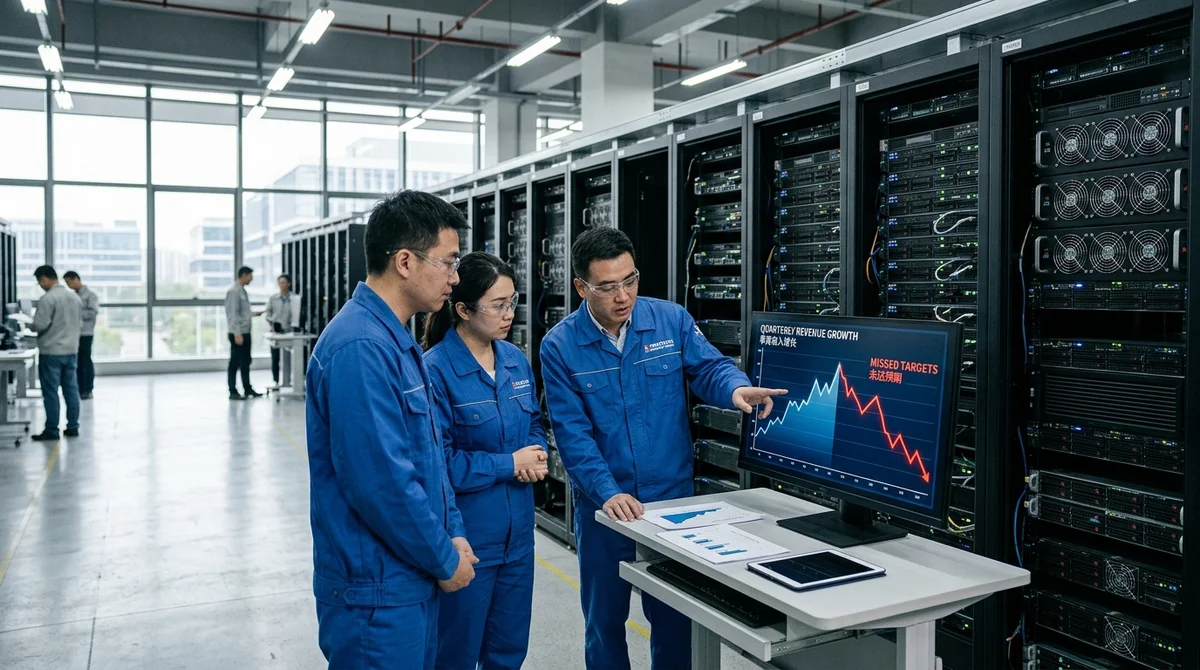
On April 28, 2026, Foxconn Industrial Internet reported strong growth amid artificial intelligence boom, but this proved insufficient to justify inflated market expectations. The company sharply increased sales and more than doubled profits, however both figures came in below analyst consensus.
Why the Market is Unhappy
For the first three months of 2026, Foxconn Industrial Internet received 251.1 billion yuan in revenue — this is 57% more than a year earlier. Net profit reached a record 10.
6 billion yuan, meaning it more than doubled. On a normal market, such figures would look like an outright victory. But on AI themes, the bar is now much higher: analysts expected around 303.
5 billion yuan in revenue and 12.4 billion yuan in net profit. Against this backdrop, even a very strong quarter turned into a story about underperformance.
The problem is not only the gap with the forecast, but also the dynamics. Before this, the market was banking on an even sharper acceleration, because Foxconn Industrial Internet is considered one of the key manufacturers of AI-servers and hardware for data centers. Investors expected the first quarter to be a new record growth rate, but in fact the revenue growth turned out to be weaker than the 73% in the previous quarter.
In other words, the business continues to grow very quickly, but not as fast as the market wanted after several quarters of AI-hype.
What Grew Inside
If you look not just at the bottom-line figures, but at the operational picture of the quarter, everything looks significantly better. The company directly links the result to continued explosive demand for AI-compute. The cloud direction in the first quarter doubled revenue year-over-year, the company expanded its customer base, and manufacturing automation helped accelerate deliveries. This means that demand for assembling complex systems for model training and inference has not gone anywhere and is only strengthening.
- Revenue in the first quarter grew 56.52% year-over-year
- Net profit increased 102.55%
- Shipments of AI GPU-racks grew 3.8x
- Shipments of AI ASIC-servers grew 3.2x
- Shipments of 800G and above switches grew 1.6x year-over-year and 46% quarter-over-quarter
Separately important is the technological signal: the company announced the beginning of shipments of samples of fully optical CPO-switches. For the market, this is an indicator that Foxconn Industrial Internet is trying to establish itself not only as a large contract manufacturer, but also as a supplier of more complex infrastructure for the next stage of AI growth. In other words, the story is no longer just about assembling server racks: the company is trying to secure a place in more expensive and strategic elements of the supply chain.
The Revenue Nuance
Part of the disappointment is explained not by a weakening of demand, but by a change in purchasing model. On new orders, some cloud customers began purchasing expensive components themselves, such as GPUs and memory, and Foxconn Industrial Internet in such cases is primarily responsible for integration and assembly. For business, this is not necessarily bad: the added value of assembly remains, and gross margin can even look better. But recognized revenue in reports becomes lower than under the old buy-and-sell scheme, when the company passed through the entire cost of hardware itself.
When a customer brings expensive components themselves, the company's revenue is lower, although the value of assembly does not go away.
This is exactly why the physical volume of shipments can grow faster than accounting revenue. For operational business, this is an important caveat, but the stock market is rarely patient with such nuances, especially when the stock already trades as one of the main beneficiaries of the AI boom in China. Right now investors want to see not just growth, but almost perfect alignment with the boldest expectations. Foxconn Industrial Internet showed that demand exists, but also reminded: monetization of AI infrastructure does not always linearly reflect in quarterly revenue.
What This Means
Foxconn Industrial Internet's report shows a new standard for AI infrastructure companies: it's not enough to grow fast, you also need to outperform extremely aggressive forecasts. For the company itself, the story remains positive — demand for AI-servers, racks and networking equipment remains strong. But after this quarter, the market will watch the second quarter of 2026 especially carefully: will the company be able to offset revenue pressure through margin improvement and confirm that the AI boom brings not only volume growth, but also results above consensus.
Need AI working inside your business — not just in your newsfeed?
I build production AI for companies — custom CRM, internal tools, autonomous agents, workflow automation. Owned by you, shaped to your process, no per-seat tax. Built by Zhemal Khamidun, CPO of AlpinaGPT (AI platform, 6,000+ users).
The AI world, distilled — once a week
Seven stories that actually mattered, hand-picked. No noise, no reposts, no press releases.
Done! Check your inbox for a confirmation.