Why AI Agents Fail in Production: What a Mature Enterprise LLM System Is Made Of
AI agents look convincing in demos but regularly fail in production. The model is not the cause: a bare LLM delivers almost no business value on its own. Real value appears only when the system has the right context, quality metrics, constraints, secure integrations, and a clearly defined role for the human in the loop. The author breaks down what a mature LLM system consists of, and why the future belongs not to the "smartest model" but to the most controllable one.
AI-processed from Habr AI; edited by Hamidun News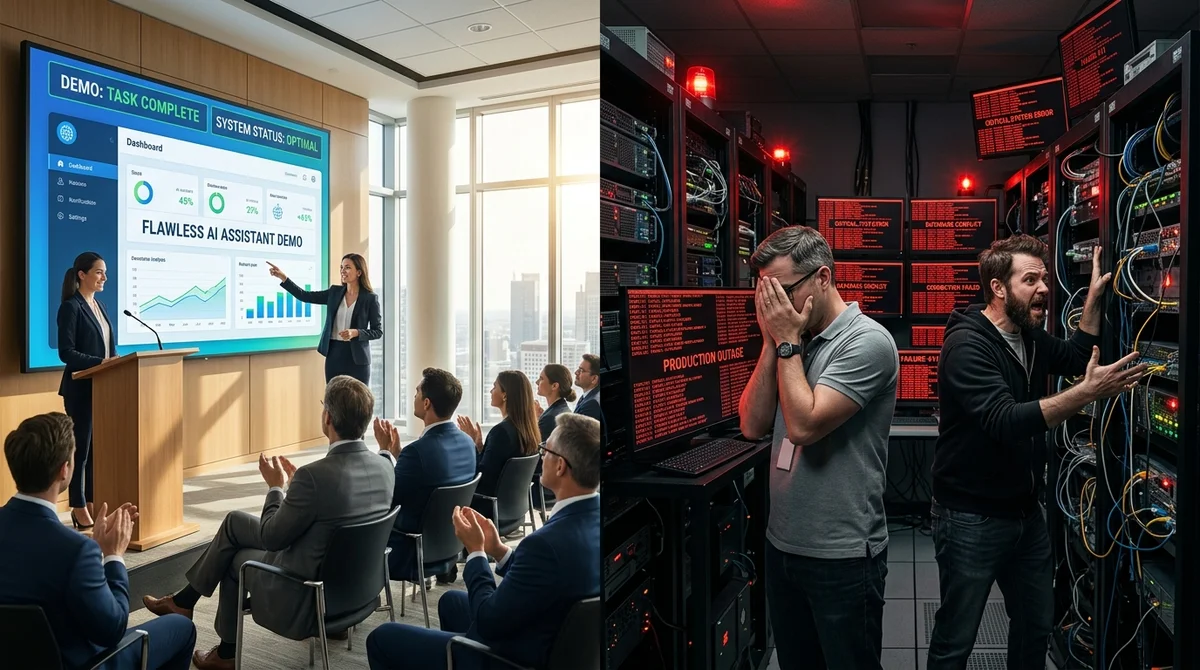
An AI agent can look impressive in a demo: confident answers, instructions carried out, no glaring mistakes in sight. Put it into a real business process, though, and the picture changes. The agent gets lost in context, gives irrelevant answers, "hallucinates" facts, and fails on edge cases. The gap between demo and production is one of the most painful problems for teams trying to bring AI into their companies.
The model is almost never the cause of that gap. An LLM on its own is a powerful but blind tool. It knows nothing about the business context, the company's constraints, or what happened an hour ago in connected systems. A demo works because someone picked the right context and the necessary data in advance and phrased the request carefully. In real life there is no such manual setup, so the model works blind.
A mature LLM system in a company is an assembly of several mandatory components, and each one is critical.
First is context: relevant data, documents, interaction history, and company policies that the model receives at request time through RAG or direct injection. Without it, even the most advanced model will miss the mark.
Second is quality metrics. Without measurement, you cannot tell whether things improved after the latest prompt change or model update. Teams that do not measure are simply working blind.
Third is constraints and guardrails. The model must know what it must not do, which tone is acceptable, and which data must not leave the company.
Fourth is secure integrations: connections to internal APIs and databases with proper access levels and logging of every call.
Fifth, and the most underrated, is a clearly defined role for the human in the process. That means knowing where the agent acts autonomously and where manual review or confirmation is required.
Many teams skip one or more of these components, and the omission almost always shows up in production, because a demo simply doesn't need them. A demo is an optimistic scenario with hand-picked data and clear requests. Production means chaotic users, messy unstructured data, unexpected combinations of requests, and situations that developers never put into their test cases. This is where systems with no internal structure or protective mechanisms break.
Monitoring and controllability are a separate issue, and one that is often ignored. Most engineering teams know how to monitor ordinary code: metrics, logs, threshold alerts. With LLM systems it is fundamentally harder, because the "correctness" of an answer is subjective and context-dependent. Evals help here: specially selected examples with a known expected output, automatic comparison against reference answers, and separate LLM judges that rate the main system's answers against set criteria. All of this is infrastructure that must be built deliberately. Hoping the model will "figure it out on its own" is not a strategy.
Versioning and change management are another underrated aspect. Conventional development has git, CI/CD, and tests before deployment. LLM systems need versioning for prompts, context templates, RAG configurations, and vector indexes. Changing a prompt is effectively a release and should be treated as one: tested on real data, audited for its impact on system behavior, and rollback-ready. Without this, every "improvement" can become a source of unpredictable regressions.
The future of enterprise AI does not belong to the company that is first to deploy the most powerful model. It belongs to the company that builds the most controllable, measurable, and secure AI system. Models get cheaper every quarter, and they are already a commodity. The competitive advantage lies in how well a company can embed them into its processes, control quality, and scale without losing reliability.
- Nov 2, 2026DeepSeek open-sources Super-agent prototype: p95 task completion time of 15.7 minutes vs. 29.5
- Nov 2, 2026Bun creator uses Claude Code to port 750K lines from Zig to Rust in 11 days
- Nov 2, 2026Microsoft releases 4B model Mage-VL-Cowork, which solves 66.0% of OSWorld-Verified tasks
- Nov 2, 2026Meta's Muse assistant keeps dossiers on loved ones and gets root on Ubuntu by default
Test Frontier LLMs & Autonomous Agents in One Workspace
Run Claude Opus 5.5, GPT-6, Gemini 3.1, and DeepSeek side-by-side in Nomad AI (nomadnet.ai) — unified model routing, deep research, and multimodal workflows under one subscription.
The AI world, distilled — once a week
Seven stories that actually mattered, hand-picked. No noise, no reposts, no press releases.
Done! Check your inbox for a confirmation.